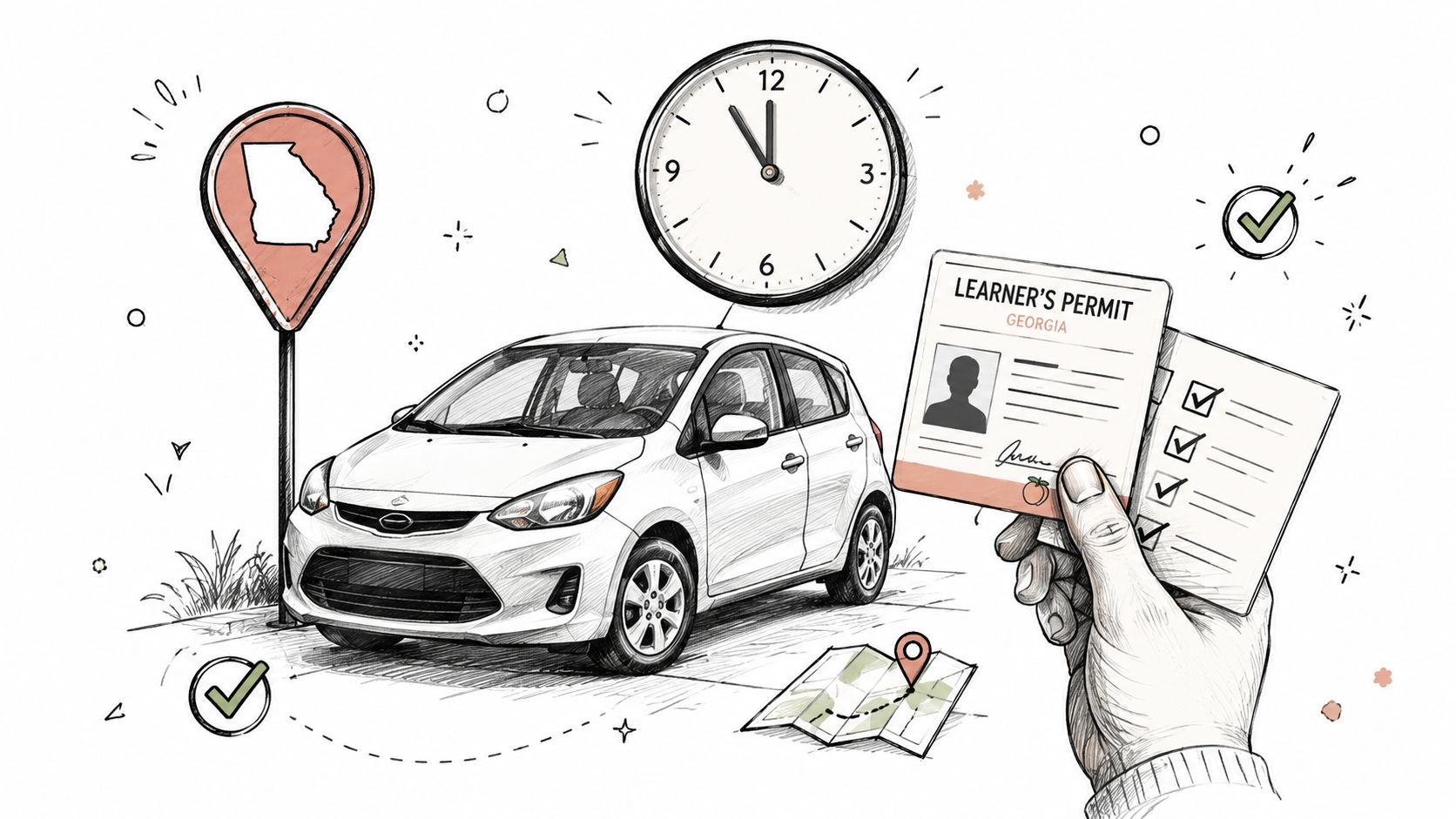
You need a road test today. Maybe you're in the Atlanta area, your permit is ready to convert, and a new job starts soon. You search “same day road testing near me”, expecting a nearby Georgia Department of Driver Services office to produce an opening.
That expectation causes most of the wasted time. Georgia drivers shouldn't treat a same-day result through DDS as the normal path. The practical question is whether you can find a cancellation, use an authorized third-party tester, or work with a driving school that offers testing support. Before you spend the morning driving from office to office, understand how the system works.
Why Same Day Road Testing in Georgia Is Harder Than It Sounds
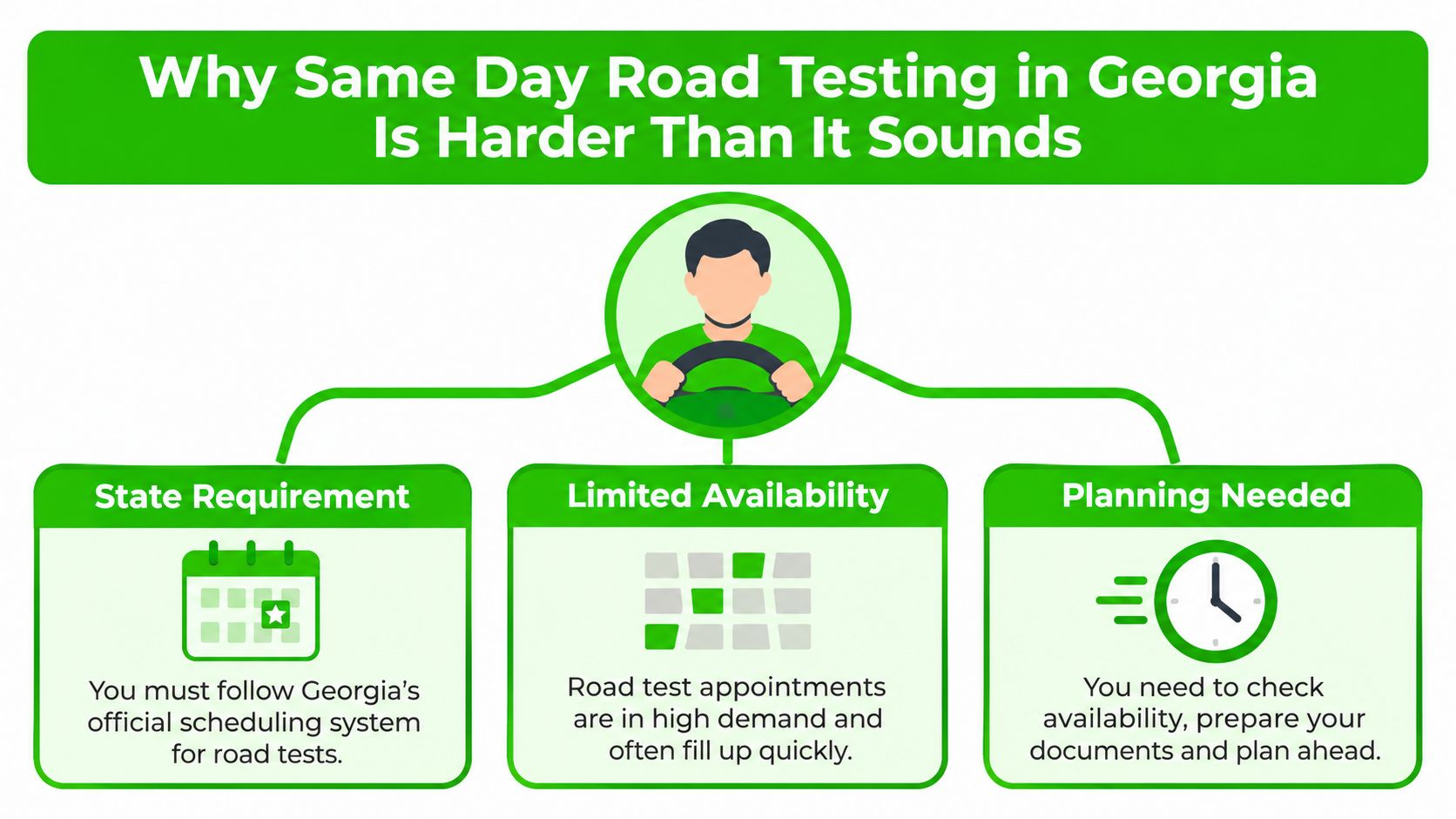
Georgia DDS requires appointments for behind-the-wheel automobile, CDL, and motorcycle road tests. DDS also states that same-day appointments aren't available because of resource management. That makes a walk-in road test at a state customer service center an unrealistic plan, even when your need is immediate. The New York DMV road-test scheduling guidance describes the same basic model, with available dates shown by ZIP code and normal waits of three to five weeks, sometimes reaching ten weeks during peak summer and school-break periods.
For an Atlanta driver, the problem usually starts with a simple assumption. You check the closest DDS office, see no opening, and conclude that another office must have a hidden same-day slot. It might have an earlier appointment, but staff, test routes, examiner schedules, and local appointment capacity determine what the scheduler can offer. A customer service representative can't create a safe test route or add an examiner because a driver arrived early.
The three channels worth checking
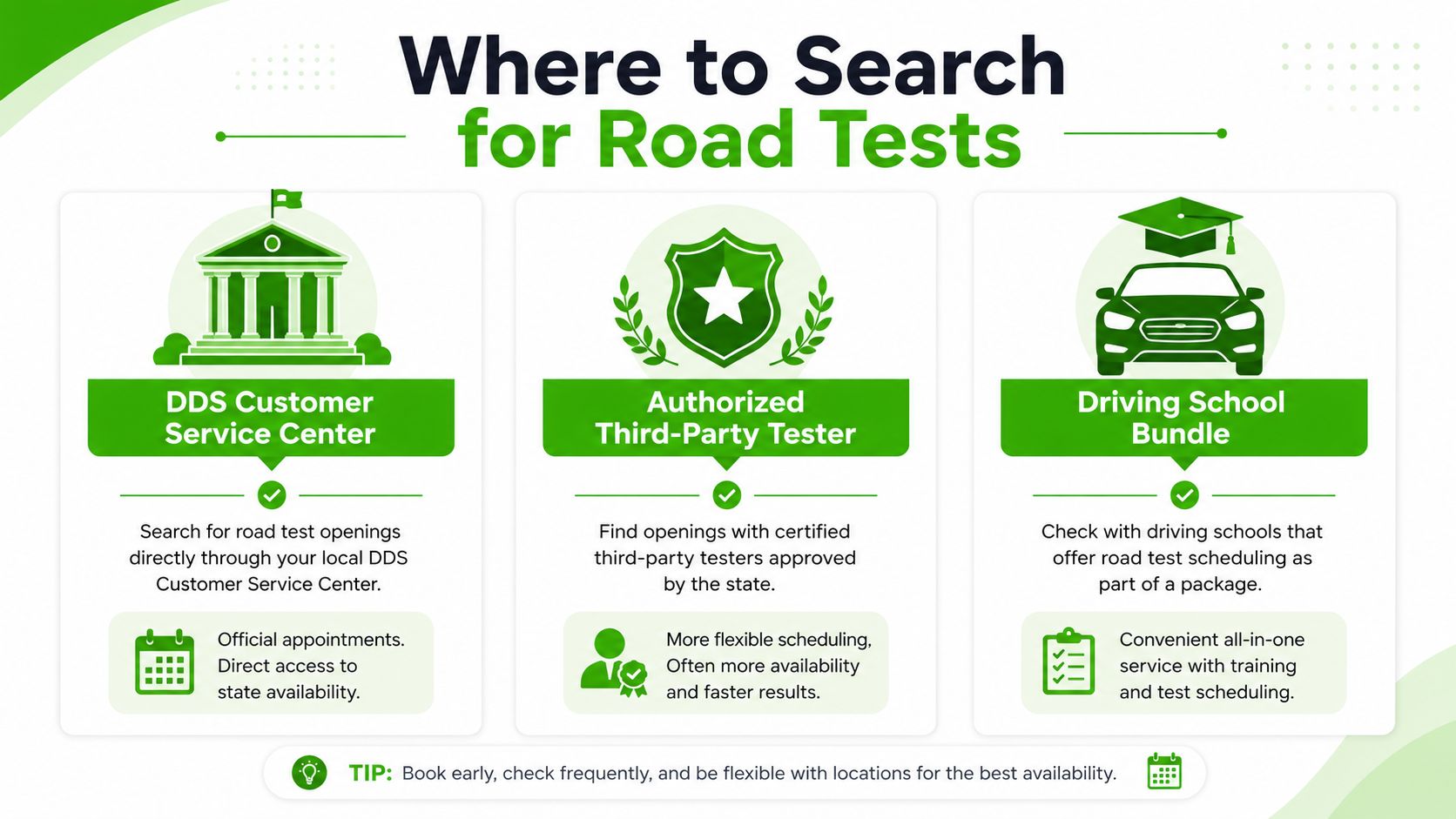
Georgia drivers have three practical channels:
- A DDS customer service center, which follows the state's appointment system and is generally the most controlled option.
- A DDS-authorized third-party tester, which may have more flexible scheduling and may offer cancellation openings.
- A private driving school, which can sometimes combine preparation, vehicle access, and testing support.
Those options aren't interchangeable. A private listing that says “same-day testing” might mean a same-day inquiry, an office visit, a cancellation search, or an actual completed road test. Ask exactly what the provider means before paying.
Practical rule: Treat “same day” as an appointment-status question, not a promise.
If you're also dealing with an impaired-driving charge, don't confuse a road-test search with an arrest or court process. A separate resource on Minnesota roadside sobriety test rights from Gerald Miller P.A. explains why roadside testing and post-licensing requirements are different legal issues. For Georgia drivers, the immediate road-test decision still starts with eligibility, documentation, and a legitimate testing channel.
Eligibility and Documents You Need Before You Book
A fast appointment doesn't help if DDS or the tester turns you away at check-in. Audit your eligibility before you search. The usual trouble spots are incomplete supervised-driving records, an unsigned parent affidavit, unresolved DDS issues, and a test vehicle that can't pass inspection.
Separate booking blockers from test-day blockers
Booking blockers concern whether you're allowed to schedule or take the exam. Confirm that your learner's permit is valid, that you've met the applicable waiting and practice requirements, and that any suspension, hold, or other DDS issue has been cleared. If your record includes a prior reinstatement problem, resolve that before chasing an appointment.
For younger drivers, Georgia's pathway commonly involves Joshua's Law classroom and behind-the-wheel requirements, while adult applicants may use supervised driving practice instead. Don't rely on memory. Verify the requirements that apply to your age and license category directly with DDS before you book.
Test-day documents are a separate issue. Put these in one folder:
- Permit card: Bring the valid learner's permit.
- Identity documents: Carry any secondary identification the provider requests.
- Parent affidavit: An under-18 applicant should have the required affidavit completed and signed before arrival.
- Insurance and registration: Bring current vehicle documents, not photographs that leave important details unclear.
- Practice records: Keep any required driving log or completion paperwork available.
- Vehicle access: Confirm that the car is approved for the test and can be driven legally to the location.
A vision screening may also need to be on file. If DDS has an unresolved hold, a clean vehicle won't fix the problem. Check the record first.
Georgia road-test eligibility by age
| Age Group | Minimum Supervised Hours | Required Documents |
|---|---|---|
| Under 18 | Use the applicable Georgia supervised-driving and Joshua's Law requirements | Learner's permit, parent affidavit, required completion records, insurance, registration, and approved vehicle |
| Adult applicant | Confirm the applicable DDS supervised-driving requirement before booking | Learner's permit, identification, insurance, registration, and approved vehicle |
The table is a self-audit, not a substitute for current DDS confirmation. Requirements can depend on the applicant's license type and history. If a provider gives you a different checklist, ask which rule supports it and whether DDS will accept the documentation.
Where to Search for Road Tests Around Atlanta and Beyond
Don't choose a testing channel by distance alone. Choose it by speed, legitimacy, and what you need included.
A DDS customer service center is the most straightforward route, but it isn't a same-day walk-in solution in Georgia. It suits drivers who can wait for an appointment and want the state channel. A third-party tester can be faster when cancellations or local openings exist, but you must confirm that the tester is authorized and that the appointment results in a recognized road-test completion.
Driving schools sit between testing and instruction. Some bundle a test with vehicle use or behind-the-wheel preparation, which helps if you don't have a suitable car or need a quick skills check. That convenience usually comes at a higher price than using DDS alone.
A practical channel comparison
| Channel | Speed | Cost position | Best fit | Main risk |
|---|---|---|---|---|
| DDS customer service center | Usually the least flexible | Generally the lowest-cost route | Drivers who can wait | No same-day appointment path |
| DDS-authorized third-party tester | Often more flexible | May charge a separate testing fee, commonly advertised around $50 to $100 | Drivers prioritizing speed | Unclear authorization or vague “same-day” claims |
| Private driving school | Flexible when bundled with lessons | Usually the most expensive option | Drivers needing a car, coaching, or scheduling help | Paying for services you don't need |
The third-party fee range above is a market description from the supplied planning information, not a guaranteed Georgia price. Get the complete price in writing, including vehicle use, rescheduling, paperwork, and any lesson requirement.
For Atlanta, search beyond the closest office. Compare locations in the metro area, then check Athens and surrounding communities if travel is practical. The Georgia road-test location guide can help you identify locations to investigate, but you still need to verify availability and authorization directly.
Pros and cons at a glance
- DDS: Lower cost and official process, but little flexibility for urgent testing.
- Third-party testing: Potentially quicker, but authorization and terms require careful verification.
- Driving-school bundle: Convenient and useful for nervous or underprepared drivers, but don't buy a full lesson package when you only need a test.
Booking Tactics That Actually Move the Needle
The best booking strategy is aggressive but organized. Don't refresh one DDS location for hours and call that research. Build a short list of offices, authorized testers, and schools, then contact each one with the same questions.
Start with the state scheduler
Check the DDS scheduler early in the week, including Monday morning, and continue checking for cancellations rather than assuming the first result is final. The suggestion to check around 8 a.m. on Mondays is a practical tactic, not an official DDS guarantee. Cancellations can appear unpredictably, so the useful habit is repeated checking across more than one location.
Ask whether the scheduler permits you to compare offices rather than locking you into the closest site. A farther location may have a more suitable appointment. Don't book an earlier slot unless you can reach it with the correct documents and a compliant vehicle.
Call third-party testers with a precise script
Use direct questions:
- “Are you authorized to conduct Georgia road tests?”
- “Do you have a completed test appointment available, or only a cancellation waitlist?”
- “What is the full price, and does it include vehicle use?”
- “What documents must I bring?”
- “If the appointment disappears, what happens to my payment?”
- “Will you report the result through the required state process?”
Ask about waitlist priority and cancellation calls. A legitimate provider should explain its process clearly. Be suspicious of ads that promise a guaranteed same-day test but won't identify the tester, location, authorization, or total cost.
Use a school when you need more than a slot
A driving school may be the right choice if you need a test vehicle, a short preparation lesson, or help coordinating the appointment. Ask whether the school can schedule testing as part of a behind-the-wheel package, and whether the package is required or optional. The Georgia road-test booking service is one option to compare with other local providers.
Your morning checklist is simple:
- Check the DDS scheduler at multiple locations.
- Call authorized third-party testers about cancellations.
- Ask driving schools about test-only and bundled options.
- Confirm documents and vehicle requirements before paying.
- Get the appointment time, location, price, and cancellation terms in writing.
Vehicle and Day-Of Requirements That Cause Surprise Cancellations
A hard-won appointment can disappear before you leave the parking lot if the vehicle fails inspection. Examiners need a car that's legal, insured, controllable, and safe for the test.
Check the car the night before
Test every turn signal, brake light, horn, and mirror. Inspect the windshield from the driver's position, confirm the registration is current, and verify that the insurance information matches the vehicle. Clean the interior enough that the examiner can enter, buckle in, and observe without obstruction.
The silent disqualifiers are predictable:
- Expired tag or registration: Renew it before test day.
- Inactive insurance: Bring current proof and confirm coverage applies to the test vehicle.
- Cracked windshield: Repair damage in the driver's line of sight.
- Warning lights: Have dashboard warnings diagnosed instead of hoping the examiner ignores them.
- Broken lights or horn: Replace bulbs and fix electrical problems.
- Missing mirror: Make sure required mirrors are present and usable.
- Unsigned affidavit: Under-18 drivers should confirm every required parent signature before leaving home.
The test-taker also needs the correct permit and identification. Until the examiner takes over, a licensed adult should be in the front seat as required for lawful supervised driving. Don't arrive alone and expect staff to solve that problem.
Mirror checklist
- Valid permit and secondary identification
- Current registration
- Current insurance
- Working signals and brake lights
- Working horn and mirrors
- Clean windshield and passenger area
- No unresolved warning lights
- Required licensed adult present
- Parent affidavit signed when applicable
The Georgia driver road-test preparation resource can help you review preparation and testing options, but it can't replace checking the specific provider's instructions. Call before you travel.
Closer Is Not Always Faster Choosing the Right Test Site
“Near me” is a search filter, not a decision rule. The closest DDS office may have no useful appointment while a location farther away has an earlier opening. If you're willing to drive about thirty minutes to a less busy site, that can be more practical than waiting weeks at the nearest office.
The same pattern appears in other jurisdictions. In Great Britain, the 2024/25 practical driving-test pass rate was 48.7% across 1,836,558 category B tests, with 893,609 passes and 942,949 fails, according to published centre-level pass-rate data. The most recently published 2025/26 figure was 50.0%, and centre rates varied from roughly 34% to 70% among locations conducting at least 1,000 annual tests. Those figures don't describe Georgia, but they show why location and local conditions deserve attention rather than being treated as irrelevant.
Use a wider search radius
Compare three things before you commit:
- Wait time: Ask for the earliest completed test, not merely the earliest consultation or office visit.
- Route conditions: Practice near the actual test site if possible. Familiarity with intersections, lanes, and traffic patterns reduces surprises.
- Provider credibility: Confirm authorization, vehicle rules, fees, and result reporting.
The UK DVSA publishes monthly data through the end of the previous month, including tests conducted, passes, pass rate, and forward bookings. Its pass-rate definition is tests passed divided by tests conducted with an outcome. The official DVSA data tables also warn, in practical terms, against treating small samples as strong comparisons.
Location rule: Compare the earliest credible appointment, the route you can handle, and the total travel burden. Miles alone don't tell you which test site is fastest.
Don't assume an early morning slot automatically means an easier exam or a lower failure rate. You can use time of day to manage traffic and stress, but no verified Georgia data here supports a claim that a particular hour improves pass odds. Choose a site you can reach reliably and a route you can practice.
After You Pass What Comes Next and Where DUI Schools Fit In
Passing the road test doesn't end every Georgia driving requirement. The examiner processes the result, and you need to follow DDS instructions about your license documentation and any temporary credential issued while the permanent license is completed. If your driving privileges involve a suspension, DUI case, court order, or reinstatement condition, passing the road test may be only one part of the process.
Georgia's DUI Risk Reduction program has an assessment component and a 20-hour intervention component. Georgia DDS says the classroom portion must be completed in person rather than online for license or driving-privilege purposes, as described in the Georgia DUI Risk Reduction program guidance. The statutorily set total cost is $360, consisting of $100 for the assessment, $235 for the intervention class, and $25 for the workbook, according to Georgia program cost information. The process also includes a mandatory 130-question NEEDS assessment before the intervention course.
Post-test requirements can follow a different track
A defensive driving or driver-improvement course is not the same as DUI Risk Reduction. Georgia's defensive driving program lasts 6 hours, can be used once every 5 years to remove up to 7 points, and may qualify a driver for at least a 10% insurance premium discount lasting 3 years, according to Georgia defensive-driving information.
DUI reinstatement can also require a clinical evaluation. Georgia law and DDS guidance require that evaluation as part of the reinstatement path, and the state regulates approved providers and instructor training under its risk-reduction rules. The Georgia DDS DUI program FAQs explain those program and provider requirements.
Victim Impact Panels, clinical evaluations, and ASAM Level 1 treatment may also matter, depending on the court order and reinstatement circumstances. If you're trying to understand the separate court process, this DUI bail process guide provides useful legal-process context, but it doesn't replace advice from your lawyer, probation officer, or DDS.
An Atlanta-area driver I'd advise would handle a six-week DDS wait by checking authorized third-party testers, confirming the total cost and documents, and choosing the earliest legitimate appointment within a manageable driving distance. If that driver later needs Risk Reduction, a clinical evaluation, a Victim Impact Panel, or defensive driving for points, those requirements should be scheduled separately rather than treated as part of the road test.
Georgia DUI Schools offers Georgia DDS-approved DUI/Risk Reduction and defensive driving education, along with clinical services and Victim Impact Panels for drivers handling reinstatement or court-related requirements. Visit the program page to choose the course or service that matches your specific DDS and court paperwork, then confirm the format and completion requirements before enrolling.