

You may be reading this because a judge, probation officer, or attorney told you to get a mental health evaluation for court, and now you're trying to figure out whether this is a routine step or a sign that your case has taken a bad turn. That reaction is normal. Individuals often hear the phrase and immediately worry that the court has already made assumptions about them.
In practice, a court-ordered evaluation is a tool. It gives the court structured information about mental health, decision-making, functioning, and, in many Georgia DUI cases, substance use concerns that may affect the case outcome, sentencing, treatment requirements, or license reinstatement. The process can feel personal, but its purpose is legal. That distinction matters.
If your case is in Georgia, especially a DUI or related matter, the details matter even more. The evaluator, the documents reviewed, the testing used, and the final recommendations can all shape what happens next. That means your job isn't to guess what the court wants to hear. Your job is to understand the process, prepare carefully, and show up in a way that's accurate, organized, and credible.
Navigating Your Court-Ordered Mental Health Evaluation
A mental health evaluation for court is different from regular counseling or a first therapy appointment. You're not walking into a confidential support session designed around your personal treatment goals. You're participating in a forensic process built to answer a legal question.
For criminal matters, these evaluations are conducted by forensic psychiatrists or psychologists who specialize in legal appraisals, and they focus on issues such as competency to stand trial and a defendant's mental state at the time of the alleged offense rather than general clinical intake, as outlined in this guide on forensic mental health evaluations in criminal proceedings.
What the court is actually asking
The court usually wants a professional opinion about one or more specific issues:
- Current functioning: Can you understand what's happening in court and work with your lawyer?
- Mental state tied to the case: Was a mental health condition affecting your judgment during the incident in question?
- Treatment needs: Would education, counseling, substance use treatment, or monitoring be more appropriate than a purely punitive response?
- Risk and compliance concerns: Are there signs that suggest the court should structure supervision more tightly?
That legal focus changes how you should think about the appointment. The evaluator is not there to cheer for you, but they also aren't there to punish you. They gather data, compare your statements to records, and write an opinion the court can use.
Practical rule: Treat the evaluation like a formal legal appointment with clinical components, not like casual therapy.
Why this feels stressful
People usually worry about three things right away. Who will see the report, whether one bad answer can hurt their case, and how much the process will cost. Those concerns are legitimate.
If your records include documents in another language, translation quality can also become part of the legal reliability problem. In those situations, certified translation may matter just as much as the evaluation itself for ensuring legal admissibility in 2026.
A calm approach helps. Read the order carefully. Confirm whether the court named a provider or specified an approved evaluator. Bring your paperwork. Ask what records the evaluator wants in advance. Most avoidable problems happen before the interview starts, not during it.
Understanding the Different Types of Evaluations
A defendant may walk into an appointment expecting to answer a few questions about stress or drinking, then learn the court wants an opinion about competency, future risk, or sentencing factors. That mismatch creates problems fast. The type of evaluation controls what the evaluator asks, what records matter, and how the final report may affect your case.
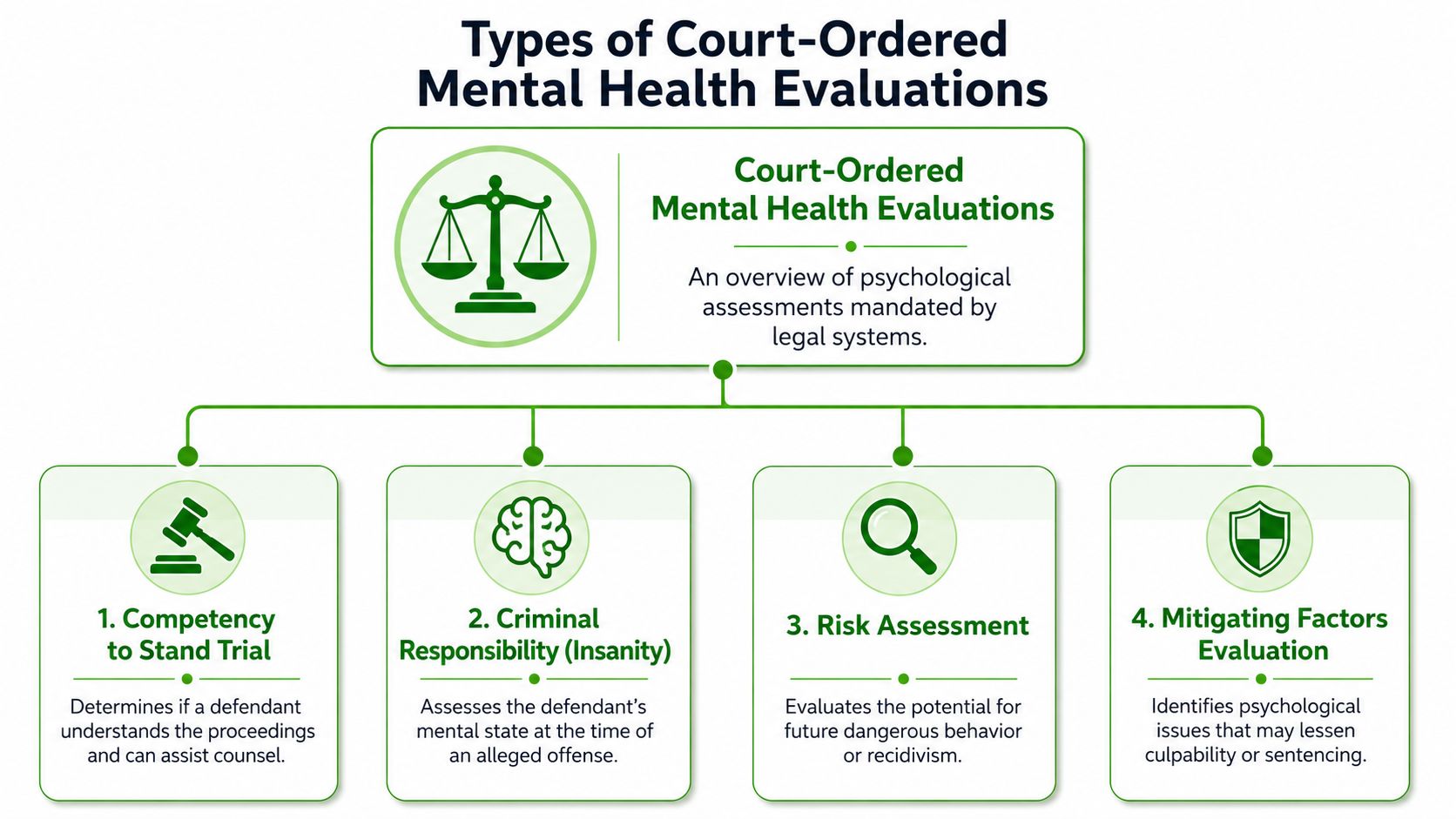
The court is not asking one general question. It is asking a specific legal question, and each evaluation is built around that question. If you prepare for the wrong one, you can waste time, money, and credibility.
Competency is about your present ability
A competency evaluation addresses whether you understand the court process now and whether you can work with your lawyer in a rational, usable way. In Georgia criminal cases, this issue comes up when there is concern that a mental illness, cognitive problem, or severe emotional instability is interfering with participation in the defense.
The evaluator is looking at present functioning. Can you follow the charges, recognize the roles of the judge and attorneys, and make decisions that show basic legal understanding? A competency opinion does not decide guilt or innocence.
Criminal responsibility examines your mental state at the time of the event
A criminal responsibility evaluation, sometimes tied to an insanity defense, looks backward. The focus is your mental condition during the alleged offense, not only how you present at the appointment weeks or months later.
This distinction matters. A person can be stable and organized during the interview but still raise a serious question about mental state during the incident. The reverse is also true. Courts separate those issues for a reason, and experienced evaluators do the same.
Risk assessments focus on future concerns
A risk assessment helps the court decide how much structure, monitoring, or treatment may be needed. This can affect bond conditions, probation terms, specialty court eligibility, sentencing recommendations, or supervision planning.
In practice, evaluators may examine prior compliance, substance use patterns, impulsive behavior, violence history, treatment follow-through, and other facts tied to future conduct. For a defendant, this is one of the more stressful categories because honesty matters, but so does context. A flat denial that conflicts with records can damage credibility. A clear explanation of what happened, what has changed, and what support is in place usually serves you better.
Mitigation evaluations can influence sentencing
A mitigating factors evaluation looks for conditions that may help explain behavior and support a more individualized court response. That can include trauma history, mood disorders, cognitive limitations, substance-related problems, or functional impairments that affect judgment.
This does not erase responsibility. It can, however, change the recommendations a judge sees. A well-supported report may help shift the discussion toward treatment, structure, and realistic compliance expectations instead of a purely punitive approach. From a defendant's perspective, that is often where the evaluation feels most personal, because the report may affect both the outcome and the cost of what comes next.
DUI-related referrals in Georgia usually have a narrower purpose
In Georgia, many DUI and related cases involve an evaluation centered on substance use, behavioral risk, treatment need, and decision-making rather than a full forensic exam on every mental health issue. That is why the referral language matters. A Georgia court psychological evaluation for DUI-related cases is often more focused than defendants expect.
Before you schedule, confirm what the judge ordered, who must receive the report, and whether you are responsible for payment. Many defendants worry that being fully candid will automatically make the outcome worse. In reality, the larger risk is inconsistency. Evaluators compare what you say with records, charges, prior treatment, and testing results. Honest answers with context are usually easier to defend than minimization that does not match the file.
Practical rule: Ask one question before the appointment is booked. “What legal issue is this evaluator being asked to answer?” That answer tells you what kind of evaluation you are actually facing.
The Evaluation Process From Start to Finish
Once the order is entered, the process usually becomes much less mysterious. It follows a sequence. When people get into trouble, it's often because they skip a step, miss a deadline, or show up without the records the evaluator needs.
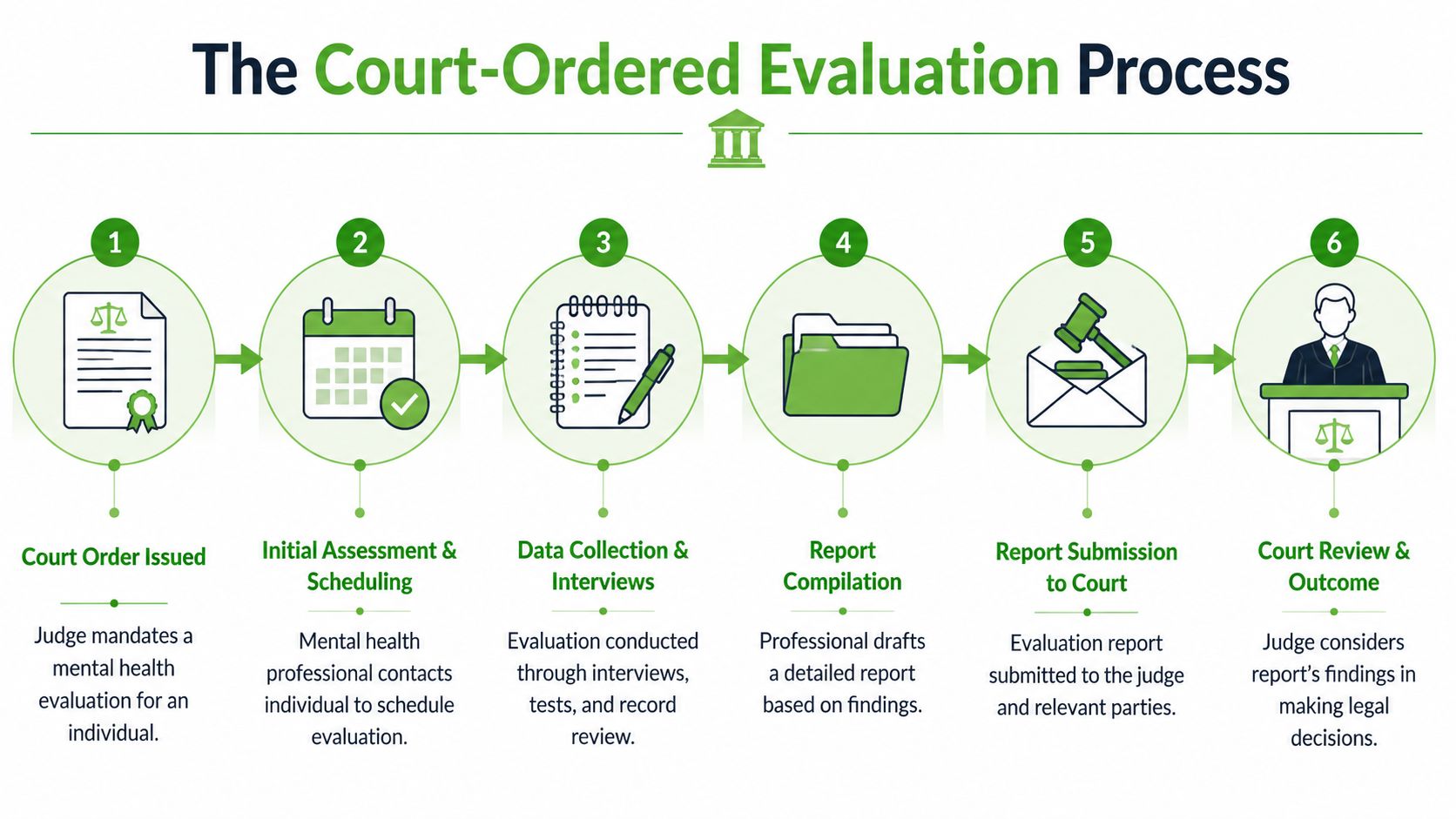
Step one through step three
Read the court order carefully
Check whether the judge named a specific evaluator, required a certified or approved provider, or set a filing deadline. Don't rely on memory after a hearing. Read the document itself.Schedule with the right provider
In Georgia DUI and related substance cases, that often means confirming the evaluator handles court-referred work and understands reporting requirements. If your order is substance-related, this overview of a court-ordered substance abuse evaluation in Georgia gives a useful picture of what the referral is usually designed to address.Gather records before the appointment
Bring the referral order, charging documents if available, medication lists, prior treatment records if relevant, and contact information for your lawyer. If the evaluator has to chase basic records after the appointment, the report may be delayed.
What happens during the appointment
The actual session may include several components rather than one conversation. In Georgia DUI cases, the process may involve a clinical interview, formal testing, and review of outside records. In other court matters, the structure changes depending on the referral issue.
Expect the evaluator to ask about:
- Case history: What happened, from your perspective
- Mental health background: Prior diagnoses, hospitalizations, counseling, medication
- Substance history: Alcohol, drugs, treatment, relapses, periods of sobriety
- Daily functioning: Work, family, sleep, concentration, stress tolerance
- Legal understanding: Particularly if competency is at issue
The evaluator may also compare your account to police reports, medical records, prior evaluations, or probation documents. That's normal. Consistency matters in forensic work.
How the report gets written
After the interview and testing, the evaluator organizes the information into a report for the court. In treatment court settings, assessment findings can be used to determine clinical eligibility, and examination findings may be admitted into evidence to help the court decide how a person's mental condition affects legal issues, as described in the BJA mental health court essential elements.
A useful report usually does three things well:
| Part of report | What it does | Why it matters |
|---|---|---|
| Referral question | Identifies what the court asked | Keeps the evaluation focused |
| Clinical findings | Summarizes interview, testing, observations, records | Shows the basis for the opinion |
| Professional opinion | States conclusions and recommendations | Gives the judge something actionable |
Bring documents in a folder, not loose in your car. The person who arrives organized usually presents as more reliable before a single question is asked.
How to Prepare and What to Expect During the Session
Preparation isn't about rehearsing a fake version of yourself. It's about reducing avoidable mistakes and presenting accurate information in a way the evaluator can use.
The biggest misunderstanding I see is this: people think they have only two choices. Tell every painful detail exactly as it comes to mind, or clamp up and say almost nothing. Neither approach works well. One can create a messy, inconsistent interview. The other can make you look evasive.
Start with logistics and records
Before the appointment, do the basic work:
- Confirm the purpose: Know whether the evaluation is for DUI, competency, sentencing, probation, or treatment planning.
- Bring your paperwork: Court order, photo ID, lawyer contact information, relevant medical or treatment records.
- List medications accurately: Include dose if you know it, and don't guess if you don't.
- Arrive steady: Don't show up impaired, hung over, or late unless an emergency prevented it.
Clothing doesn't need to be formal, but it should be clean and calm. Court-facing evaluations are not the place for "I didn't care how this looked."
Honesty matters, but framing matters too
This is the part people rarely get explained clearly. Emerging 2025 to 2026 forensic psychology data indicates that up to 40% of defendants who disclosed full histories of substance use received more restrictive custody or sentencing recommendations than those who provided minimally detailed but truthful accounts, according to this discussion of preparation for court-ordered psychological evaluations.
That doesn't mean you should lie. It means you should answer truthfully and with structure.
A better approach sounds like this:
- Past problem, current status: "I did have a period where alcohol was a problem. I've been addressing it, and I can now describe the changes I've made."
- Specific, not dramatic: "I used cocaine in the past" is better than rambling through every episode in disorganized detail.
- Recovery context: If you've completed counseling, stayed compliant, or built sober supports, say that clearly.
Don't hide facts. Put them in time, context, and treatment history so they read as information, not chaos.
Know who may read the report
This isn't private therapy. The final report may be reviewed by the judge, attorneys, probation, and others connected to the legal issue. Answer with that audience in mind.
If your hearing is in Cherokee County, practical courthouse preparation can reduce stress around the whole day, not just the evaluation itself. This guide on what to expect at Canton courthouse is helpful for getting your logistics right before you walk in.
What doesn't work
A few strategies almost always backfire:
- Minimizing obvious facts: If the records show repeated alcohol-related incidents, pretending there was never a pattern hurts credibility.
- Talking too much to fill silence: Nervous oversharing often creates contradictions.
- Trying to sound clinical: Evaluators can tell when someone is using therapy language they don't understand.
- Blaming everyone else: Even when the arrest feels unfair, complete externalization raises concerns about insight.
Georgia Laws for Court-Ordered Evaluations
You get a court order, read the words "mental health evaluation," and the first questions are usually practical ones. Who is allowed to do it. Will the court accept it. Who pays for it if money is already tight. In Georgia, those questions matter because the state does not treat this as informal counseling or a box to check.

For DUI-related matters, Georgia uses a regulated process that can affect both the court case and your driving privileges. The evaluation is used to determine whether further education, treatment, or supervision is recommended, and those recommendations can carry real consequences for probation terms, program requirements, and license reinstatement.
Georgia also separates ordinary anxiety from legal relevance. The evaluator is not deciding whether you are a good person or whether you feel sorry. The question is whether the facts, history, testing, and available records support a diagnosis, a risk concern, or a treatment need that the court or state agency must address. That is why honesty matters, but so does precision. A vague answer can create as many problems as a dishonest one.
In practice, Georgia agencies often expect a DUI clinical evaluation that follows state standards. If you need a provider that understands those requirements, review these Georgia DUI clinical evaluations before you schedule with just anyone. A report from the wrong type of provider can waste time and money if the court, probation office, or DDS will not accept it.
The evaluation can affect your license, not just your case
A common mistake is treating the criminal case and license reinstatement as separate tracks. In many Georgia DUI situations, they overlap. You may resolve one issue and still be blocked on the other because the required evaluation or recommended follow-up has not been completed.
That is where people get frustrated. They thought they were paying for one appointment. Instead, they learn the evaluation may lead to education classes, counseling, treatment, or monitoring recommendations that carry additional cost and time. It is better to know that early than to act surprised later.
Georgia uses evaluations to guide supervision decisions
Under Georgia accountability court standards, DUI and Drug Courts use structured screening and ongoing monitoring. The state standards for those courts include the DUI Risk and Needs Triage and regular drug testing for participants, as outlined in the Georgia Accountability Court Standards for DUI and Drug Courts.
That approach tells you how Georgia views these cases. The evaluation is part of a larger supervision system. If the report identifies substance use concerns, poor insight, relapse risk, or untreated mental health symptoms, those findings can shape what the court requires next.
Payment is often the part no one explains clearly
In many cases, the defendant pays for the evaluation. That is the practical reality, even though people are often told about the requirement without being told the full cost picture. The evaluation fee may be only the first expense if the final recommendation includes treatment, classes, or follow-up testing.
If cost is going to be a problem, say so early. Tell your lawyer, probation officer, or the court before the deadline becomes the bigger issue. Some courts or jurisdictions may have limited options for people with no financial resources, but those options are not automatic, and confusion about payment is one of the fastest ways people fall out of compliance.
Your Next Steps and How Georgia DUI Schools Can Help
You finish the evaluation, leave the office, and then the worry starts. What happens next. Who gets the report. What if the recommendation is tougher than you expected. Those questions matter because the evaluation is usually the start of the court's next decision, not the end of the case.

In Georgia DUI cases, the written recommendation can affect probation terms, treatment requirements, license-related steps, and how the court views your judgment. A report that says no further care is needed leads to one path. A report that recommends counseling, substance use treatment, relapse prevention, or a higher level of care leads to another. The practical question is whether the report is court-usable, clear, and completed in the format Georgia decision-makers expect.
What to do right after the order
Handle the next few steps in sequence.
Confirm the deadline in writing
Do not rely on memory, and do not assume the due date is flexible. Check the court order, probation paperwork, or instructions from your lawyer.Verify what kind of evaluation the court wants
Some defendants hear "evaluation" and assume any counselor can do it. That mistake causes delays. In DUI-related cases, ask whether the court expects a clinical evaluation tied to Georgia DUI requirements, a mental health evaluation, or both.Find out who must receive the report
Some providers send the report directly to probation or the court. Others release it to your lawyer or to you after you sign forms. Clear this up before the appointment so nothing sits in limbo after the evaluation is done.Ask about cost before you book
Defendants often focus on the appointment date and forget the financial side until it becomes a compliance problem. Ask for the fee, whether payment is due up front, and what happens if follow-up services are recommended.Prepare to act on the recommendation
If the report calls for counseling, treatment, classes, or monitoring, start quickly. Courts tend to respond better when they see prompt follow-through instead of excuses after the deadline has passed.
Picking a provider
Choose a provider who regularly handles court referrals in Georgia and knows how to write for a legal audience, not just a clinical one. The evaluation has to do two jobs at once. It must be clinically sound, and it must answer the question the court is asking.
Ask direct questions before you schedule. Does the provider complete DUI-related clinical evaluations under Georgia standards. Will the report include a clear recommendation and, when required, an ASAM level of care determination. How long does the written report take. Who receives it. If you need a starting point, review the Georgia DUI clinical evaluation service details and compare them against what your court order requires.
A weak report creates expensive problems. You may have to redo the evaluation, explain gaps to probation, or lose time waiting for corrected paperwork.
What a productive outcome looks like
A productive outcome is a credible report that matches the facts, addresses the legal referral question, and gives the court a workable next step. That does not mean the recommendation will always be light. Honest reporting sometimes leads to more treatment, more supervision, or a longer process. But a report that appears evasive or incomplete can create a worse result because it raises concerns about insight, reliability, and compliance.
From the defendant's side, the strategy is simple. Be accurate, be prepared, and take the recommendation seriously. Trying to sound better than the record usually fails. So does minimizing substance use when the arrest history, probation file, or prior treatment records point in another direction.
If Georgia DUI Schools is part of your next step, use it for what it is. A factual resource for completing a Georgia-related requirement correctly and on time.
If you need a Georgia-compliant next step for a DUI-related requirement, contact Georgia DUI Schools to schedule the service that fits your court, probation, or license reinstatement requirements.