
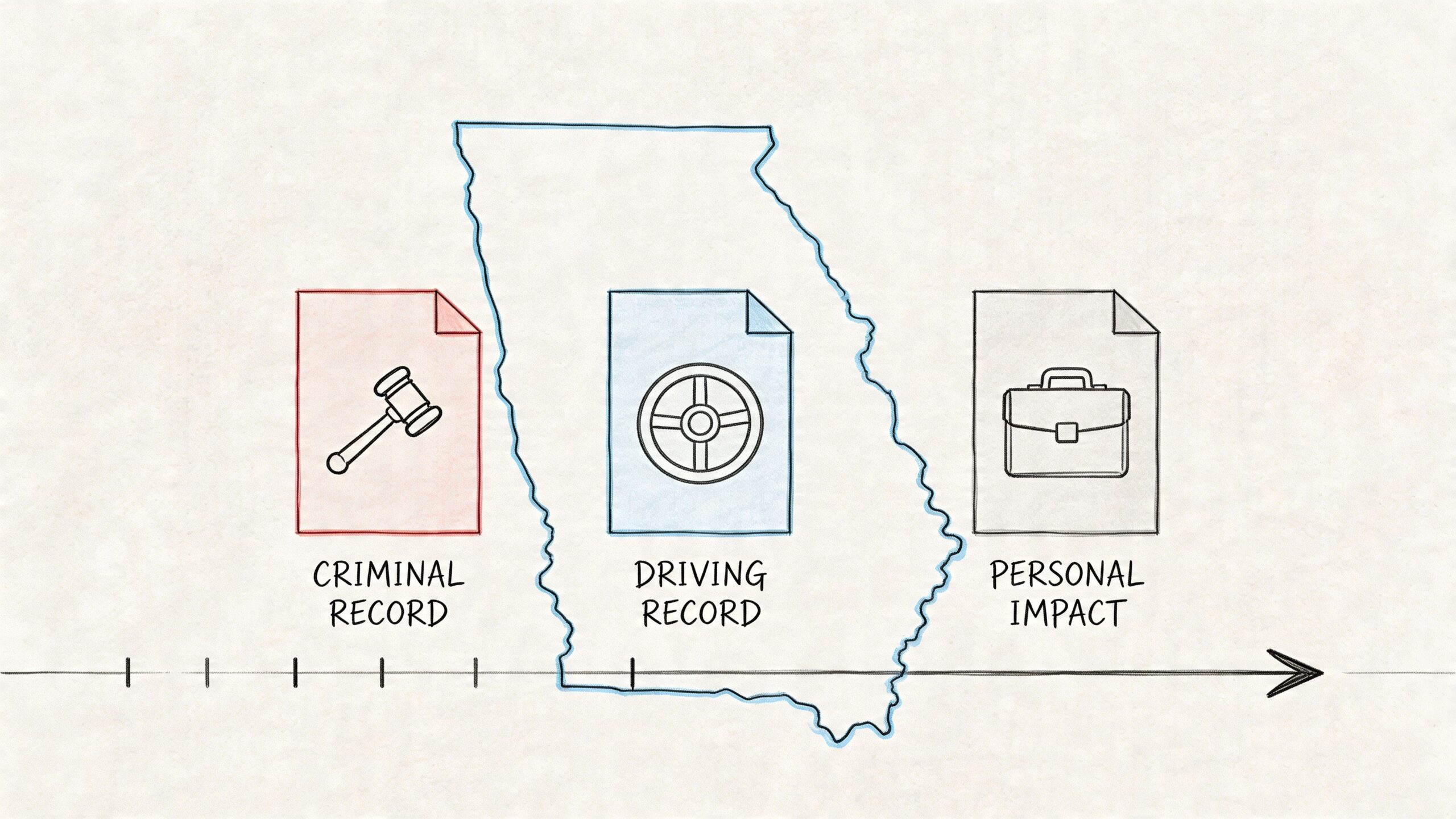
TL;DR: In Georgia, a DUI conviction stays on your criminal record forever and can't be expunged or sealed. People often get confused because a DUI can affect more than one kind of record at the same time, and those records don't all follow the same timeline.
The question usually comes up late at night or early the next morning. You were arrested, your car may have been towed, and now you're replaying every minute of the stop. Then the practical worries start. Will this show up at work? Will I lose my license? How long is this going to follow me?
Those are different questions, even though they feel like one big problem.
A Georgia DUI can touch your criminal record, your driving record, and your court record. Each one serves a different purpose. Each one is seen by different people. Each one affects a different part of your life.
That distinction matters. If you're trying to figure out how long does dui stay on record in georgia, the answer depends on which record you're asking about and what stage your case is in.
The Aftermath of a DUI Arrest in Georgia
A common Georgia scenario goes like this. Someone is stopped after dinner in Atlanta, pulled over on the way home in Gwinnett, or questioned at a checkpoint near Athens. By the next day, they're holding court paperwork, trying to understand license consequences, and searching for one simple answer.
There usually isn't a simple answer.
Right after an arrest, many people mix together three separate things. They think the arrest itself, the court case, and the driving consequences all live in one file. They don't. That's one reason DUI cases feel so confusing in the first week.
Why the first few days feel so overwhelming
You may hear words like suspension, conviction, restriction, reinstatement, evaluation, or Risk Reduction class before you even understand what record is being discussed. One office may talk about your license. Another may talk about court. An employer may later care about background checks.
That creates a practical question that keeps people up at night. How long does this stay with me?
Practical rule: After a Georgia DUI arrest, don't assume every consequence works on the same timeline. Criminal history, driving history, and court filings each operate differently.
A person charged in Cobb County can face the same kind of confusion as someone charged in DeKalb or Hall. The local courthouse may differ, but the stress is familiar across Georgia. Individuals aren't just worried about punishment. They're worried about everyday life, including work, family schedules, insurance, and whether they can legally drive next week.
If you want a broader overview of what can follow an arrest, this guide on Georgia DUI consequences helps frame the bigger picture.
The question behind the question
When people ask how long does dui stay on record in georgia, they usually mean one of these:
- Background checks: Will employers or licensing boards still see it?
- Driver history: How long will DDS and insurance care about it?
- Court visibility: Can other people still find the case?
- Reinstatement steps: What do I need to finish before I can move forward?
Those are the right questions. The key is separating them before you try to solve them.
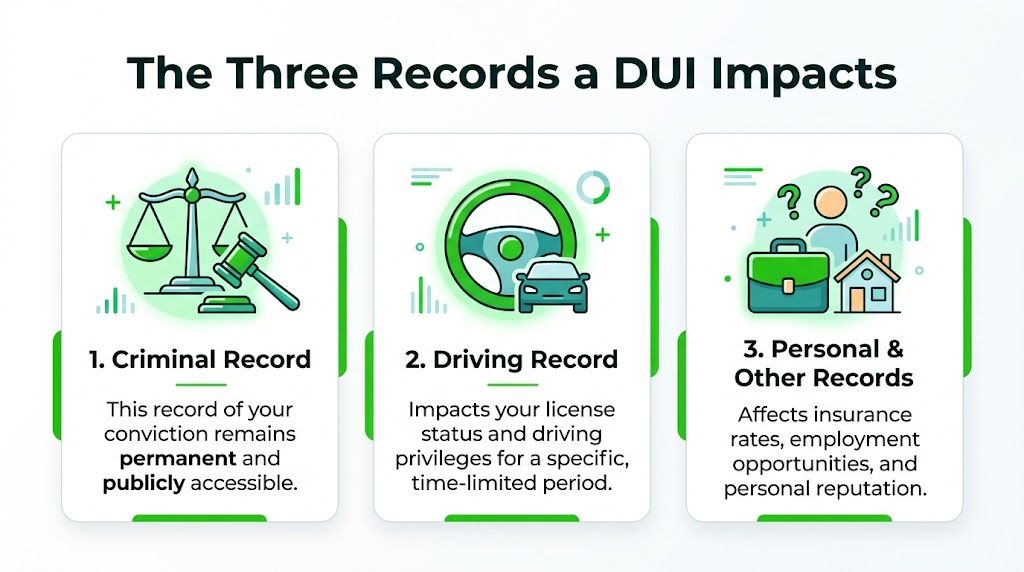
The Three Types of Records a DUI Impacts
Think of a DUI like a problem filed in three different cabinets.
One cabinet holds your criminal history. Another holds your driving history. A third holds the court case record. They overlap, but they aren't identical. That's why two people can say, "It's still on my record," and mean very different things.
Criminal record
Your criminal record is the part that matters most for background checks. If a DUI ends in a conviction, that conviction becomes part of your criminal history.
Employers may care about it. Licensing boards may care about it. Landlords, schools, and volunteer organizations may also care, depending on the situation. This record is less about whether you can drive today and more about what your history shows when someone investigates your past.
A useful way to think about it is a permanent transcript. It records the result, not just the event.
Driving record
Your driving record is different. This is the record connected to your status as a driver. It tracks issues that matter to the Georgia Department of Driver Services and often to insurance companies.
This is the record people usually mean when they ask about suspensions, reinstatement requirements, or whether a prior DUI still counts against them for driving purposes. It is tied to your privileges on the road, not just your history in the courthouse.
For many drivers, this is the most urgent record because it affects commuting, child pickup, work travel, and daily independence.
Court record
Your court record is the public case file created in the court handling the charge. It may include filings, hearing dates, accusations, and the final result of the case.
This record answers a different question. Not "what is on your criminal history?" but "what happened in this specific case?" Even when people casually say "record," they often don't realize they're referring to a court file that serves a different function from either criminal history or driving history.
A DUI case can appear in court records even before there's a conviction. That's one reason an arrest can feel public long before the case is finished.
Personal and practical consequences
A fourth category isn't always a formal record, but it matters. Your insurance file, your job application history, and your professional reputation may all be affected by what appears in those three official records.
That doesn't create a separate legal record. But it does create separate consequences.
Here is the cleanest way to compare them.
| Record Type | What It Shows | Who Sees It | How Long It Lasts |
|---|---|---|---|
| Criminal Record | Conviction history and criminal case outcomes | Employers, landlords, schools, licensing boards, background check agencies | A Georgia DUI conviction remains permanently on the criminal record |
| Driving Record | License status, driving-related history, and issues affecting driving privileges | DDS, insurers, some employers, attorneys, courts | Time-limited for driving and licensing purposes |
| Court Record | The public file for the case, including proceedings and outcome | Courts, attorneys, and often the public | Depends on court retention and public access practices |
Where readers get tripped up
People often ask, "If it drops off one record, is it gone everywhere?" Usually, no.
They also ask, "If I finished my class, is it removed?" Completion of required programs can help with compliance and reinstatement. It doesn't automatically erase every trace of the case.
That difference is the heart of the issue. To understand how long does dui stay on record in georgia, you have to stop treating "your record" as one thing.
A Georgia DUI Conviction on Your Criminal Record Is Permanent
This is the hardest part to hear, but it's the clearest.
In Georgia, a DUI conviction remains on your criminal record permanently and cannot be expunged or sealed. The conviction stays visible indefinitely on background checks, which is why the criminal record side of a DUI carries long-term weight, as explained by this Georgia DUI record overview.

What permanent means in real life
Permanent doesn't just mean "for a long time." It means the conviction doesn't age out of your criminal history the way many people assume it will.
If you apply for a job years later, the conviction may still appear. If you apply for housing, a landlord may still see it. If you pursue a professional license, the board reviewing your application may still ask about it. Teachers, nurses, contractors, real estate applicants, and other licensed professionals often run into this issue because background review is built into the licensing process.
For some people, the hardest part isn't the sentence. It's the ongoing need to explain the conviction after the case itself feels long over.
Why DUI is treated differently
Georgia treats DUI more strictly than many people expect. Some offenses may qualify for record restriction in certain situations. DUI convictions are specifically not eligible for expungement or record restriction under Georgia law, which is what makes this offense stand apart.
That distinction causes confusion. Someone may know another person who had a misdemeanor addressed through a restriction process and assume the same option exists for DUI. It usually doesn't when there is a conviction for DUI itself.
Here are the practical effects of that rule:
- Employment screening: A hiring manager may see the conviction during a background check and ask follow-up questions.
- Housing applications: A property manager may weigh the conviction when deciding whether to approve an applicant.
- School and volunteer settings: Some programs and organizations review criminal history before acceptance.
- Professional licensing: Boards may look beyond whether the case is old and focus on the fact that it still exists.
Key point: Finishing probation, paying fines, and completing required classes may satisfy the court or DDS. Those steps do not erase a DUI conviction from your criminal record.
Conviction versus charge
The specific terminology is important. A charge and a conviction aren't the same thing.
If a DUI charge is dismissed, reduced, or otherwise resolved without a DUI conviction, that can change the long-term consequences. By contrast, once there's a DUI conviction, the permanent criminal-record issue becomes the central reality.
That is why defense work early in the case matters so much. The most important moment for avoiding a permanent DUI conviction is often before the case reaches a final guilty outcome.
Why this surprises so many people
Many drivers assume a first offense will eventually "clear." They hear stories from other states, or they confuse criminal record rules with driving record timelines. Then they discover that Georgia draws a bright line around DUI convictions.
That line affects people in ordinary ways. A parent applying to volunteer at school may need to answer questions. A worker seeking a company vehicle position may be screened out. A person changing careers may face board review that brings an old conviction back into focus.
The permanent criminal-record consequence doesn't always hit all at once. It often appears in waves, each time a background check matters.
The instructional takeaway
If you're asking how long does dui stay on record in georgia from a criminal-history standpoint, the answer is direct. A Georgia DUI conviction stays there permanently. The only way to avoid that specific result is to avoid a DUI conviction in the first place through the outcome of the case.
That isn't meant to scare you. It's meant to help you ask better questions, earlier, while your options still exist.
How Long a DUI Affects Your Driving Record and License
The criminal record answer is permanent. The driving record answer works differently.
Your license status, your ability to reinstate, and the way agencies evaluate repeat issues all live in the driving side of the problem. This is often the initial impact, as not being able to drive can disrupt work, school, probation reporting, medical appointments, and family responsibilities immediately.
The difference between license action and conviction
A DUI can affect your license in more than one way.
One issue comes from the arrest process itself, where an administrative license problem may begin quickly. Another issue comes from the court outcome, where a conviction can trigger separate consequences. People often think one replaces the other. In practice, they can be related but distinct.
That distinction matters because a person can be dealing with DDS requirements while the court case is still moving forward.
What drivers usually need to handle
When people talk about the driving side of a DUI, they usually mean some combination of these:
- Suspension concerns: Whether they can legally drive now or soon.
- Reinstatement tasks: What DDS requires before driving privileges return.
- Repeat-offense consequences: Whether a prior DUI still counts against them.
- Proof and compliance: Whether they need classes, evaluations, filings, or other documents.
For readers who are also hearing employment-related terms, the SAP program explanation for return-to-duty cases can help clarify a separate process that sometimes overlaps with DUI-related concerns for safety-sensitive workers.
Reinstatement is usually a process, not one event
Drivers often hope reinstatement happens automatically after enough time passes. It usually doesn't work that way.
Georgia may require completion of a DUI/Risk Reduction Program before reinstatement. Some drivers also need a clinical evaluation based on the facts of the case, court orders, or reinstatement requirements. In more involved situations, the evaluation may recommend ASAM Level 1 treatment or additional steps before a person is considered compliant.
That means the practical question isn't only "How long does it stay on the driving record?" It's also "What must I finish before DDS will move me forward?"
Why the driving timeline still matters
Even though this article avoids repeating every legal counting rule as if they apply in every fact pattern, one point is important. Georgia treats prior DUI history as highly relevant when later driving issues arise. That is why older driving events can still matter when someone picks up another charge.
Here is the simplest way to think about the driving side:
- Short-term effect: Your immediate legal ability to drive may change fast.
- Administrative effect: DDS may require specific steps before reinstatement.
- Historical effect: Prior DUI-related entries can matter when later offenses are evaluated.
If you're trying to get back on the road, don't focus only on how long a DUI stays visible. Focus on what DDS or the court requires you to complete before you can legally drive again.
Common sources of confusion
A lot of drivers ask whether the court, DDS, and insurance company all use the exact same record and timeline. They don't.
Others assume that because they completed a class, every agency will update instantly. In reality, compliance often involves multiple moving parts, including proof of completion, case processing, and reinstatement review.
A practical checklist helps:
- Get your status confirmed: Don't guess whether your license is valid.
- Read every court and DDS notice carefully: The wording often tells you which agency is requiring what.
- Complete the required program with an approved provider: This is one of the most common reinstatement steps.
- Ask whether a clinical evaluation is required: Some drivers need more than the course alone.
- Keep copies of everything: Completion papers matter.
The driving consequences often feel temporary compared with the criminal record. But temporary doesn't mean minor. In daily life, losing the ability to drive can be the consequence that hurts the fastest.
Navigating Insurance and Employment After a DUI
A DUI record becomes most real when it affects your paycheck or monthly bills.
The legal language matters in court. Outside court, people usually notice two practical consequences first. Car insurance gets harder to manage, and job opportunities become less predictable.
Insurance consequences often outlast the court experience
Insurance companies care about driving risk. A DUI can change how an insurer sees you, whether you're shopping for a new policy or trying to keep the one you already have.
Some drivers also run into the requirement to file SR-22A paperwork. That's not an insurance policy by itself. It's a certificate tied to financial responsibility requirements. The paperwork can become one more administrative task layered on top of classes, court obligations, and reinstatement.
The confusion usually sounds like this: "My case is over, so why is insurance still treating this like a live issue?" The answer is that insurers evaluate driving history for their own underwriting reasons, not just based on whether your court date has passed.
If you're trying to reduce costs after a conviction or suspension period, these tips on lowering car insurance rates after a violation can help you think through practical next steps.
Employment depends on the kind of job
Not all jobs look at a DUI the same way.
A position that requires driving, access to a fleet vehicle, delivery work, or a commercial license will usually treat a DUI very differently from a desk job with no driving duties. A school transportation role, field technician position, or sales job involving company travel may raise concerns tied to both criminal history and driving history.
Office roles can still be affected, especially if the employer runs a background check and asks candidates to explain convictions. But the impact may be less automatic than it would be for a driving-heavy job.
Here are useful ways to think about employment risk:
- Jobs that require driving: Employers may look at both the DUI conviction and the practical issue of whether you can legally and reliably drive.
- Licensed professions: Boards and employers may focus on character, disclosure, and compliance history.
- General employment: The employer may care most about honesty, timing, and whether the job itself involves public trust or transportation.
An old DUI doesn't affect every job the same way. The closer the work is to driving, safety, or licensing, the more scrutiny you're likely to face.
What people can do now
You can't control every insurer or employer decision. You can control how prepared you are.
- Be accurate: If an application asks about convictions, answer truthfully.
- Know which record is being reviewed: Background checks and motor vehicle reports aren't the same thing.
- Document compliance: If you've completed required steps, keep proof organized.
- Avoid assumptions: One employer's policy may be very different from another's.
That last point matters a lot. People sometimes talk about a DUI as if every company reacts the same way. In practice, local businesses in places like Atlanta, Athens, Marietta, or Lawrenceville may each apply different internal standards.
Your Action Plan After a Georgia DUI Charge
After a DUI charge, your first job is to stop guessing and start organizing. Anxiety makes people freeze. The better approach is to work through the problem in order.

Step one is urgency
The earliest deadlines often matter the most. If your license is at risk, waiting can close off options.
Read every paper you received at arrest and after release. Look for any deadline tied to license action, court appearance, or required reporting. If something isn't clear, ask a qualified Georgia DUI attorney to review it with you quickly.
Step two is separating the problems
Don't throw every issue into one mental pile. Break them apart.
- Court problem: What charge are you facing, and what is the current status?
- License problem: Is your privilege to drive valid, suspended, or subject to reinstatement conditions?
- Compliance problem: What classes, evaluations, or treatment steps are required?
- Life problem: How will you handle transportation, work, family obligations, and deadlines?
This sounds basic, but it's what helps people move from panic to action.
Step three is getting legal advice early
A DUI charge is one of those cases where timing can shape the long-term outcome. If the charge is challenged effectively, reduced, or dismissed before a DUI conviction is entered, that can change the permanent consequences described earlier.
Local practice also matters. A case in Fulton may move differently from one in Cherokee or Clarke County. The underlying state law is the framework, but local courts and procedures shape the day-to-day reality.
Step four is completing required education promptly
For many drivers, the DUI/Risk Reduction Program becomes a required part of reinstatement or court compliance. The program includes two core parts:
- The NEEDS Assessment
- The intervention course
People sometimes delay this because they're hoping the case outcome will make the course unnecessary. Sometimes that delay only creates more stress later. If your attorney advises you to complete it, waiting can slow everything down.
Step five is addressing evaluation and treatment issues
Some drivers need more than the course. A clinical evaluation may be required by the court, probation, DDS, or another authority involved in the case.
The evaluation is not a punishment tool by itself. It's an assessment process used to determine whether additional services are recommended or required. In some cases, that can include ASAM Level 1 treatment.
A straightforward way to approach this is:
- Confirm the requirement in writing: Know who is requiring the evaluation.
- Schedule early: Delays can hold up reinstatement or case completion.
- Complete follow-through: If treatment is recommended or ordered, treat that as part of the compliance path, not an optional side issue.
The people who get through a DUI case most efficiently are usually the ones who stop waiting for clarity and start collecting documents, dates, and requirements immediately.
Step six is keeping records like they matter
Because they do.
Keep copies of class certificates, evaluation paperwork, treatment completion records, court orders, and any DDS correspondence. If you're ever asked to prove compliance, you'll want a clean file ready to go.
This is especially important if you're balancing multiple systems at once, such as court, probation, DDS, and an employer.
Step seven is planning for reinstatement, not just survival
A lot of drivers focus only on the next court date. That's understandable, but too narrow.
Think ahead. If your goal is to restore driving privileges, ask:
- What does DDS require from me?
- Have I completed the approved course?
- Do I need a clinical evaluation?
- Is any treatment required before I can move forward?
- Do I have proof of every completed step?
That mindset changes everything. Instead of reacting to each new notice, you begin building a reinstatement file on purpose.
Frequently Asked Questions About Georgia DUI Records
Can a DUI be removed if it was reduced to another charge
What matters is the final outcome. A DUI conviction carries the permanent criminal-record consequence discussed above. If the DUI charge is reduced and you are not convicted of DUI, the long-term record consequences may look different. The exact effect depends on the final charge and case disposition.
Is an arrest the same as a conviction on my record
No. An arrest and a conviction are not the same. This is one of the biggest points of confusion in Georgia DUI cases. The final result of the case matters.
Will an out-of-state DUI matter in Georgia
It can. Georgia drivers shouldn't assume another state's DUI history is invisible here. Driving and licensing systems often communicate across state lines, and prior history can become relevant when licensing or later charges are reviewed.
Is a felony DUI different from a misdemeanor DUI for long-term impact
Yes. Both are serious, but a felony record usually creates broader consequences for employment, licensing, and civic life. Even so, a misdemeanor DUI conviction in Georgia still has major long-term importance because of its criminal-record permanence.
How can I check my own records
Ask for the specific record you need. If you're checking license status, request your driving record from DDS. If you're trying to understand criminal history, request the appropriate criminal history information through the proper Georgia channels. If you need the public case details, contact the court that handled the matter.
Does finishing the class erase the DUI
No. Completing a required course can help you meet court or reinstatement requirements. It doesn't erase a DUI conviction from your criminal record.
If you need to meet Georgia DUI requirements and move toward reinstatement, the most relevant next step is enrolling in the Georgia DUI Risk Reduction Program at Georgia DUI Schools.