
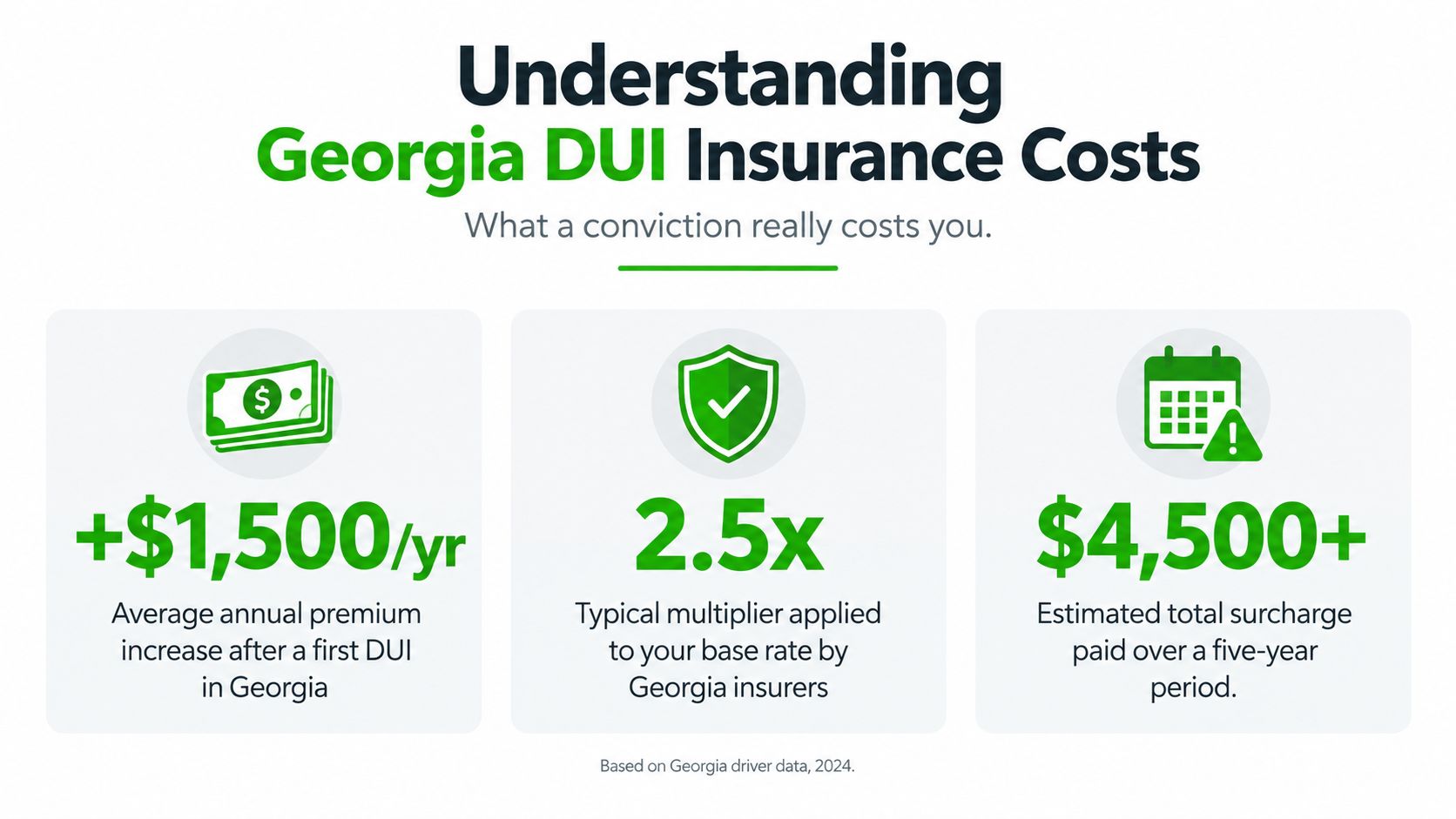
A DUI conviction can push Georgia auto insurance from about $133 a month to $278 a month, a jump of 109% or roughly $1,740 a year. If you've just opened a renewal notice and felt your stomach drop, that number is the reason.
The hard part is that there isn't one single price for everyone. Your quote depends on the car you drive, where you live, your age, your coverage limits, your prior record, and the company doing the underwriting.
Understanding Georgia DUI Insurance Costs
A DUI usually changes more than the monthly bill. It can also change how an insurer classifies your risk, which is why Georgia drivers often see a jump at renewal instead of a neat, one-time fee. In Georgia, the clearest benchmark is this, average full coverage premiums rise from about $133 per month for drivers with clean records to about $278 per month after a DUI conviction, a difference of roughly $145 a month or about $1,740 a year. That's a real increase, not a scare tactic, and it helps explain why the first renewal after a conviction feels so harsh. MoneyGeek's Georgia DUI insurance comparison
Why one statewide number never tells the whole story
Insurers do not price every DUI the same way. Two drivers can both have a conviction and still end up with very different quotes because underwriting looks at the vehicle, age, ZIP code, coverage limits, prior violations, and the insurer's own rating rules. The conviction matters, but it sits inside a larger risk profile.
Georgia also requires insurers to file many of their surcharge and rating methods with the state, so the extra cost is not random. It follows the company's approved pricing structure, which is why the same record can produce different results from one carrier to another. That is also where SR-22 confusion starts. An SR-22 is a filing requirement in some cases, not a separate insurance policy, and the filing itself is only one part of the total cost. If you need a closer look at that requirement, see this Georgia SR-22 insurance guide.
Georgia company pricing shows that spread clearly. Reported monthly DUI premiums range from about $189 with Progressive and $230 with Farm Bureau to $543 with GEICO and $551 with State Farm. Those figures show why shopping quotes matters after a DUI, because the carrier can change the number almost as much as the conviction does.
What that means when you are reviewing a renewal
A lower-value car, a lower coverage limit, and a cleaner neighborhood profile can keep the price closer to the bottom of the range. A newer vehicle, full coverage, or another violation on your record can push the premium higher very quickly.
The surcharge does not always look separate on the bill, which confuses a lot of drivers. Sometimes it appears folded into the new premium, so the increase feels larger than a simple line item. Completed DUI courses can also matter later, since insurers may consider them when you become eligible for discounts again, even if they do not erase the conviction itself. That is why the full cost after a DUI is more than one premium number. It includes how the insurer rates the offense, whether an SR-22 filing is required, and how soon you can work back toward better pricing.
Factors That Determine Your Premium Increase
A DUI does not raise every policy by the same amount. Insurers still look at the whole file, and the final quote reflects how risky the driver looks on paper, not just the conviction itself. A younger driver often sees a sharper jump than an older driver with the same offense, and a driver with more violations usually pays more still.
The four levers insurers use
Age matters because younger drivers are already priced as higher risk. A DUI adds another layer on top of that.
Prior driving history matters just as much. One DUI is serious. A DUI plus earlier tickets, claims, or another violation tells the insurer the pattern is not isolated.
Vehicle type changes the quote too. Expensive cars, newer cars, and high-performance models usually cost more to insure because they are more expensive to repair or replace.
Coverage choices can move the total a lot. Full coverage costs more than liability-only, but full coverage may still be necessary if the car is financed, leased, or valuable enough that losing it would create a real financial hit.
Georgia carrier comparisons show how wide the spread can be. Reported monthly DUI premiums run from about $189 with Progressive to $551 with State Farm, which shows that the company matters almost as much as the driver profile.
Different companies punish the same record in different ways. That is normal, and it is why the first quote is not the final answer.
What the first-year bill can really include
A quote is only part of the bill after a DUI. The premium increase may sit beside an SR-22 filing fee, court fines, and other required costs, so the first year can feel much heavier than the monthly payment suggests. A $300 fine and an SR-22 filing fee do not change the insurance rate itself, but they do change the amount you need to budget for right away.
That distinction matters because drivers often treat the filing like a separate policy. It is not. The filing is a requirement tied to keeping legal coverage in place, while the surcharge is the insurer's pricing response to the violation. One is administrative, the other is the rate you pay for risk.
Completion of a required DUI course can also matter later. It does not erase the conviction, but it can affect whether you become eligible for discounts again once the insurer is willing to review you for them.
A local example drivers recognize quickly
Two Atlanta drivers can leave the same court with very different insurance bills. One has a paid-off compact car and no other recent violations. The other has a newer SUV, full coverage, and a speeding ticket on record. The insurer is pricing both the driving record and the car, so the quotes can land far apart even before filing fees and other DUI-related costs enter the picture.
That is why I tell drivers to compare the full cost, not just the monthly premium. Ask whether the coverage still fits the car, whether the deductible still makes sense, and whether the policy leaves you protected if the vehicle is totaled. When you look at the whole bill, the decision becomes clearer.
How Long Do DUI Insurance Increases Last
Most Georgia drivers ask the same question after the court case ends: how long will the higher premium hang around? In many cases, the surcharge lasts for several renewal cycles, while the conviction can remain visible on the driving record much longer, as explained in our guide to how long a DUI stays on record in Georgia.
The insurance timeline and the SR-22 confusion
The SR-22 piece causes a lot of confusion. An SR-22 is a certificate the insurer files with the state, and the policy itself stays separate. In Georgia, that filing is generally required for three years after reinstatement. The filing requirement and the insurance surcharge follow different rules, even though they often start at the same time. Insurify's Georgia DUI insurance overview
Keep the policy active and keep the filing in force if the state requires it. A renewal notice can make the premium look like the only issue, but the administrative requirement matters just as much.
What usually changes over time
Carriers review your record during the surcharge period. A clean driving record gives the insurer less reason to keep pricing you as a higher-risk driver. That does not promise an immediate cut, because each company uses its own rating rules and review window, but better behavior usually improves your position over time.
A lapse in the filing can create a larger problem than the higher premium itself.
For drivers working through reinstatement, paperwork and coverage are different jobs. Georgia DUI Schools explains related requirements in its guide to SR-22 insurance in Georgia, which helps drivers separate what the state is tracking from what the insurer is charging.
The safest way to plan is to expect the higher price to last beyond one renewal. Budget for several cycles, check each notice carefully, and watch for any change after the insurer reviews your record again. If the premium drops, good. If it does not, the bill will still make sense because you planned for the full run of the surcharge.
Total Cost of a Georgia DUI Beyond Insurance
A DUI bill can start before the insurer ever sends a renewal notice. Georgia's mandatory DUI/Risk Reduction program costs $360 in total, broken into a $100 NEEDS assessment, a $235 intervention course, and a $25 workbook. Those charges sit alongside insurance, court fines, and reinstatement fees. Georgia DDS DUI FAQs
The state-required costs you can plan for
First-offense penalties in Georgia can include up to one year in jail, a minimum $300 fine, up to one year of license suspension, at least 40 hours of community service, 12 months of probation, and completion of the DUI Alcohol/Drug Risk Reduction Program at the offender's expense. DDS also lists a $210 license-reinstatement fee and says a clinical evaluation may be required at the offender's expense. Georgia DDS first-offense DUI guidance
That is the full price tag many drivers miss. Insurance is one line item, but the heavier burden is spread across court consequences, reinstatement charges, required education, and a higher rate that can last for years.
For a county-level example of how quickly the cash outlay can begin, DUI bail costs in Forsyth County may be part of the immediate picture too. Bail is separate from insurance, yet it can hit before any premium increase becomes visible.
A simple three-year framework
If you use the Georgia average premium increase of about the $1,740 annual increase cited earlier, the added insurance alone can total about $5,220 over three years. That comes before the required program cost, the reinstatement fee, court costs, or any treatment or evaluation fees. MoneyGeek's Georgia DUI insurance comparison
Georgia DUI Schools also breaks out related court costs and other legal expenses in its guide to DUI fines in Georgia, which helps explain why the smaller charges matter. A lot of drivers focus on the premium and forget how many fees arrive first.
A practical first-year budget can look like this:
- Month 1: $360 program cost, plus the $210 reinstatement fee if you are already at the reinstatement stage.
- Month 2 through Month 12: about $145 more each month from the higher premium.
- By the end of year one: the extra insurance alone has added up to a meaningful part of the bill, before court or evaluation costs are counted.
That breakdown makes the order of expenses easier to see. The premium matters, but the program, reinstatement, and court-related charges often land first.
Steps to Lower Your Insurance After a DUI
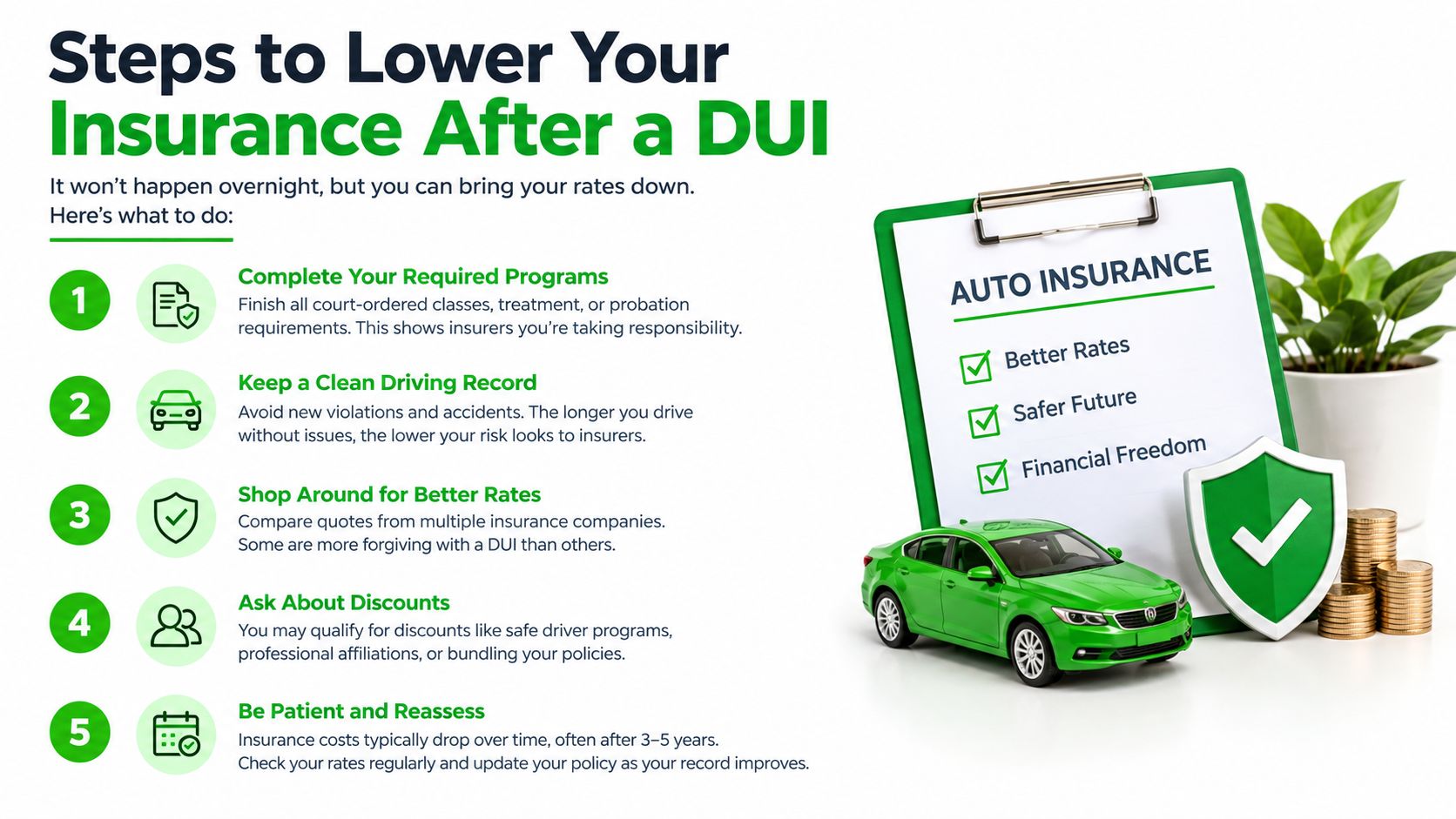
Call at least three carriers before you call your current insurer. After a DUI, one company may keep you with a higher premium, another may decline renewal, and a third may quote a rate that is easier to live with. The first quote you hear is often not the one you should accept.
Start with the coverage that fits the car, not your pride
If the car is older and paid off, liability-only coverage may fit better than full coverage. If the car is financed or leased, you usually do not get that choice. Full coverage still matters when the lender requires it or when the vehicle has enough value that a total loss would hurt you.
The difference can be large. Liability-only quotes after a DUI are typically a fraction of full-coverage quotes, so the car's value and your deductible should guide the decision, not habit.
Ask every carrier the same questions
You will get cleaner comparisons when you ask direct questions instead of saying only, “What's the rate?”
- Ask about surcharge duration. Find out how long the DUI will affect the quote.
- Ask about discount eligibility. Some carriers still offer savings for bundling or qualifying behaviors.
- Ask about non-renewal policy. A low quote is not useful if the insurer plans to drop you later.
- Ask whether the filing affects the price. If you need an SR-22-related filing, make sure the quote includes the actual cost.
- Ask what changes after a clean renewal cycle. Some insurers re-evaluate risk faster than others.
Defensive-driving education can help with point reduction or with eligibility for certain discounts in some situations, but it does not automatically erase a DUI-related underwriting surcharge. That difference matters. A course may improve your standing, but it does not make the conviction disappear from the insurer's view.
Georgia drivers who need state-mandated education should use a DDS-certified provider, because the state will not accept uncertified DUI program work. Georgia DUI Schools provides state-approved DUI/Risk Reduction education, defensive driving formats, and related support services, so drivers can handle required steps while they shop for quotes.
Your Path Forward After a Georgia DUI
The next step is usually not the insurance quote. It is the paperwork trail. Bring proof of completion for the DUI/Risk Reduction program, any court or DDS documents you were given, and the money set aside for reinstatement, because missing one item can slow the whole process. The earlier figures still matter, but they are only part of the bill.
A clean year helps more than many drivers expect. Once your record starts to settle and your carrier has fresh driving history to review, ask for a re-rate instead of assuming the old surcharge will stay forever. That request works best when you have kept every requirement current and can show you finished the required course.
Georgia drivers who need state-mandated education should use a DDS-certified provider, because the state will not accept uncertified DUI program work. That step and your insurance review should happen together, since compliance often decides how fast you can get back to normal rates.
If you are organizing your records, keep one folder with completion certificates, reinstatement receipts, and policy notes. It saves time at the counter and during your next quote review.