

You've just left court in Georgia with a stack of paperwork, a suspended license, and one urgent question: How long are DUI classes for a first offense, and what must you finish before you can drive again? The answer isn't limited to a classroom. Georgia handles a first DUI through both a court track and a Georgia Department of Driver Services, or DDS, reinstatement track. Finishing probation or paying a fine doesn't automatically restore your driving privileges.
For many first-time drivers, the practical gateway is the DDS-approved DUI Alcohol or Drug Use Risk Reduction Program. It combines a 130-question assessment with a 20-hour group intervention course, and the completion certificate can become the document that leads to the next reinstatement step. Your assessment result may also determine whether education is enough or whether you need a separate clinical evaluation and treatment referral.
What Happens After a First DUI in Georgia
Consider a driver in Atlanta who has never faced a DUI charge before. After the arrest and court process, that driver may assume the case is finished once the judge orders classes, probation, or other conditions. Then a DDS requirement appears: the license cannot move through reinstatement until the required Risk Reduction Program is completed and documented.
That's why the first question shouldn't be only, “How many hours is DUI school?” It should be, “Which requirements apply to my court case, and which requirements apply to my license?” A useful overview of what to do after a DUI arrest can help organize the immediate legal and administrative issues, but Georgia drivers still need to confirm their own deadlines with their attorney, probation officer, court, and DDS.
Two tracks create one practical deadline
The court track may include sentencing conditions, probation instructions, fines, and other orders. The DDS track focuses on license status and reinstatement eligibility. These tracks can overlap, but completing one doesn't necessarily satisfy the other.
A first-offense driver should gather:
- Court paperwork: Review the sentencing order for class, evaluation, treatment, or panel requirements.
- DDS information: Confirm what the agency requires before reinstatement or permit eligibility.
- Completion deadlines: Write every deadline on one calendar, including any date given by the court or probation.
- Provider approval: Make sure the school is authorized to issue the certificate Georgia DDS will accept.
Georgia's Risk Reduction Program is different from ordinary driver education. It isn't a general class for learning traffic signs or preparing for a driving test. It's a state-required intervention built around alcohol and drug risk, decision-making, and preventing another impaired-driving event. The distinction matters because a generic defensive driving course won't replace the mandated program.
Practical rule: Treat the Risk Reduction certificate as a reinstatement document, not just proof that you attended a class.
Drivers often feel embarrassed, angry, or overwhelmed at this stage. That reaction is common, but the process becomes more manageable when you separate the requirements, verify the provider, and handle the certificate as early as your paperwork allows. The broader consequences of a DUI can affect licensing, insurance, employment, and finances, so a written compliance checklist is more reliable than memory.
Understanding Georgia DUI Risk Reduction Requirements
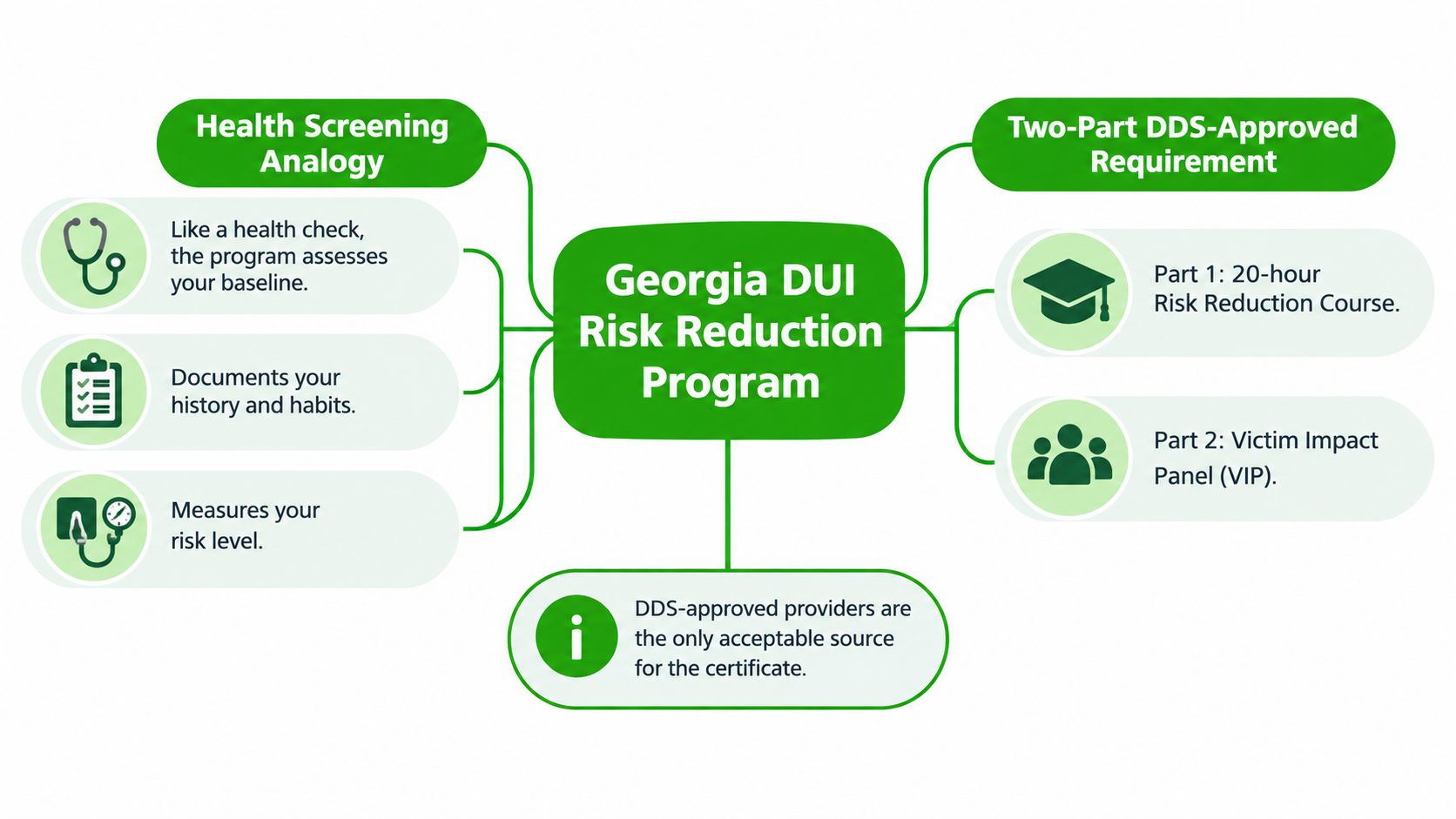
Georgia's first-offense program is easiest to understand as a health screening followed by an intervention. A doctor may begin with questions and a screening tool before deciding whether a patient needs basic guidance, additional testing, or treatment. Georgia's DUI process uses a similar logic, although the setting is a DDS-approved Risk Reduction Program.
Part one is the assessment
The first component is a 130-question assessment. It examines information related to alcohol or drug use, personal history, habits, and risk indicators. The assessment isn't a quiz that you pass by choosing the “right” answers. Its purpose is to create a structured picture of your situation.
Answer truthfully. Trying to minimize answers can create confusion later if your paperwork, court history, or clinical interview presents a different picture. The assessment helps identify whether a person appears suitable for education-focused intervention or may need a closer clinical review.
Part two is the group intervention
The second component is a 20-hour group intervention course. It focuses on the risks and consequences of impaired driving, behavior patterns, personal responsibility, and strategies intended to prevent repeat offenses. Attendance and completion matter because the program produces documentation for the administrative process.
The assessment and intervention work together. The course gives every participant a structured educational response, while the assessment can identify circumstances that call for more than education alone. A lower-risk result may leave the driver with the course and ordinary administrative compliance. A higher-risk result can lead to a separate clinical evaluation or treatment recommendation.
Why the certificate matters
Georgia ties completion to license reinstatement and permit eligibility, not merely to the educational portion of a sentence. That creates the bottleneck many first offenders miss. Even when the criminal side of the case feels limited, the license may remain unavailable until the approved program is complete and the certificate is accepted.
Choose a provider before paying. Confirm that the program is DDS-approved, ask how the assessment is scheduled, and learn how the certificate is issued. The Georgia Risk Reduction course certificate should be treated as formal compliance paperwork, not an informal attendance receipt.
The course format can affect scheduling, but format doesn't change the underlying obligation. Ask whether your specific circumstances allow classroom, live virtual, or another approved delivery method. If your court order includes additional services, completing the 20-hour course alone may not close the entire case.
How Georgia Compares to Other States for First Offense Classes
People searching for “DUI classes first offense” often compare Georgia with a program they found online from another state. That comparison can be useful, but it can also create the wrong expectation. First offense describes the driver's record. It doesn't create one national course length or guarantee that a short substitute will satisfy Georgia DDS.
Neutral summaries place first-offense DUI education in a broad range, commonly 12 to 30 hours overall, with some summaries using a wider 8-to-24-hour range. The exact requirement can depend on jurisdiction, BAC, and risk level, as outlined in this overview of DUI school and alcohol treatment.
| State program | Required hours and format | Applies to |
|---|---|---|
| Georgia DUI Alcohol or Drug Use Risk Reduction Program | 20-hour group intervention, combined with a 130-question assessment | Georgia drivers completing the DDS reinstatement pathway after a DUI |
| California AB 541 first-offender program | 30 hours over about 3 months, commonly delivered in 10 to 15 weekly classes | A common California first-offender structure |
| California higher-BAC first-offender track | 60 hours over 9 months | First offenses involving BAC of 0.20 or higher |
| Florida Level I course | 12 hours | Florida first offenders assigned the Level I course |
California's structure shows why BAC can change the intervention dose. A first offense with a lower BAC may lead to the commonly cited 30-hour, 3-month program, while a BAC of 0.20 or higher can result in 60 hours over 9 months, according to the California DUI school information from the state health care services department. Florida's 12-hour Level I course demonstrates that another major state may use a shorter baseline.
Georgia sits between those examples in total intervention hours, but the assessment is a critical difference. The driver isn't choosing the shortest class from a national menu. Georgia requires a DDS-approved program and a completion certificate before the relevant reinstatement step.
A course can be legitimate in another state and still be unacceptable for a Georgia license.
This is also why “Can I substitute an online class?” needs a precise answer. The question isn't whether an online provider advertises a DUI certificate. The question is whether the delivery format and provider meet the requirements attached to your Georgia case. Verify before enrolling, especially if a court, probation officer, or DDS representative has given you specific instructions.
Clinical Evaluation Treatment and Victim Impact Panel Explained
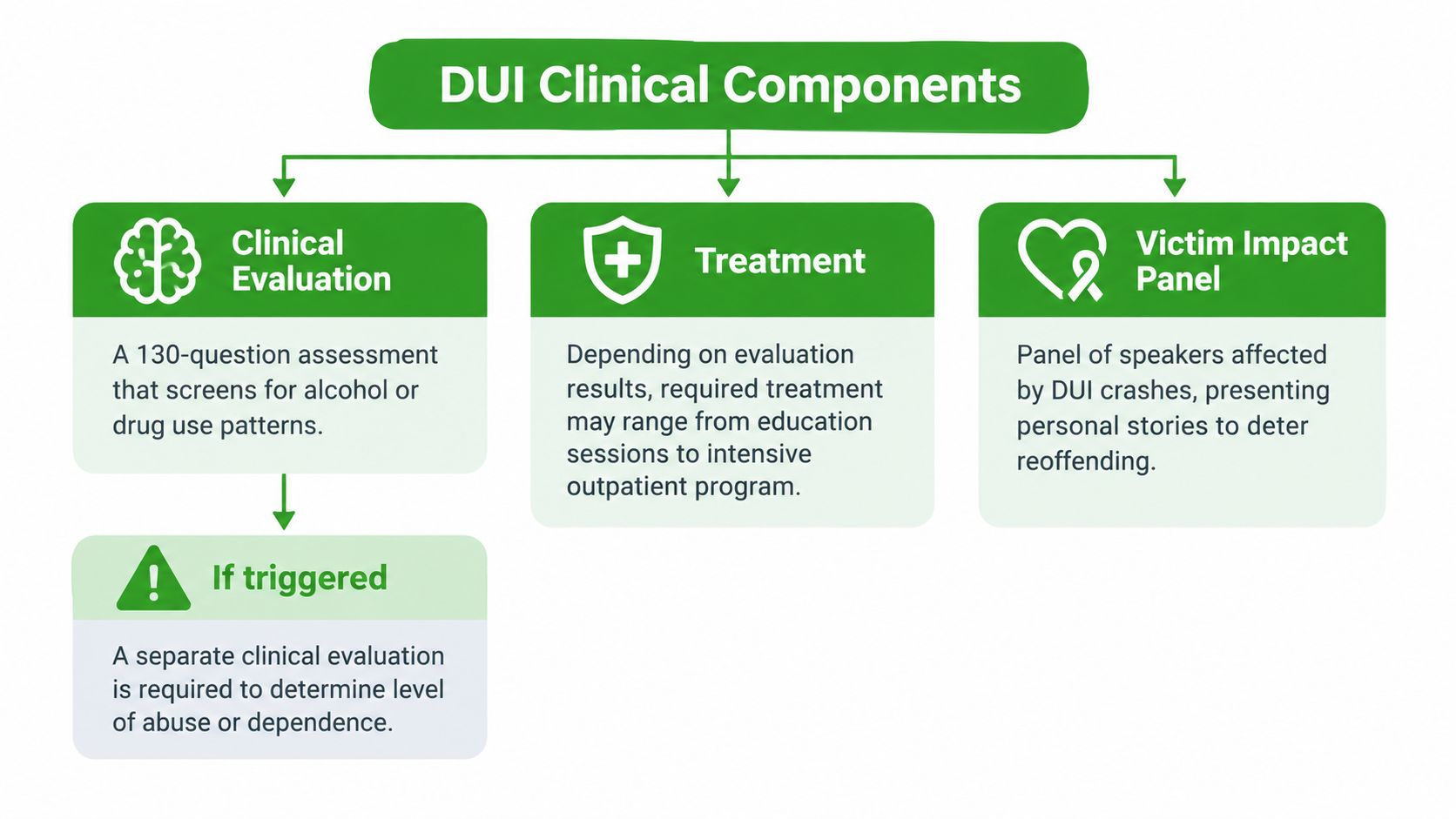
A driver can finish the classroom requirement and still face another reinstatement step. Georgia's 130-question assessment helps determine whether the first-offense path remains education-focused or leads to a separate clinical evaluation. If the screening suggests possible severity, review what is involved in a drug and alcohol evaluation before scheduling the appointment.
The assessment is part of the Risk Reduction Program. It is not automatically a full clinical evaluation. The screening works like a checkpoint: a lower-risk result may support education and administrative compliance, while a higher-risk result can send the driver to a qualified professional for a closer review of alcohol or drug use.
How clinical follow-up fits
A clinical evaluation examines information beyond the classroom. The clinician may review use patterns, prior incidents, consequences, health history, and other factors that affect treatment intensity. The purpose is to identify an appropriate level of care, not to punish someone for needing support.
Follow-up may involve education or counseling. Some drivers may be directed toward ASAM Level 1 treatment or another more intensive service when the evaluation supports that recommendation. A lower-risk result may allow the driver to remain on an education and administrative-compliance path.
The evaluating professional and the applicable court or probation instructions control the recommendation. A first offense does not guarantee an education-only outcome, especially when the file includes a high BAC, a prior incident, or other aggravating information.
What the Victim Impact Panel does
A Victim Impact Panel, often called a VIP, is separate from both the assessment and the group intervention. Attendees typically hear personal accounts from people affected by impaired-driving crashes. Those accounts connect the driving decision to its human consequences and reinforce the need to avoid another offense.
Georgia does not list VIP attendance as a mandatory statutory DUI penalty, but a court may order it as a probation condition. Read the sentencing paperwork and ask an attorney or probation officer whether a panel applies to your case.
One Georgia defense summary states that the Risk Reduction Program must be completed within 120 days from conviction, or within 90 days after release if the person is incarcerated, as described in this Georgia DUI Victim Impact Panel explanation. Confirm the deadline written in your order.
Put the course, any clinical evaluation or treatment, and VIP attendance on one compliance calendar. Separate appointments and certificates can delay reinstatement when a driver assumes the 20-hour intervention completes every obligation.
How to Enroll and Complete Your Course Step by Step
The smoothest enrollment process starts with paperwork, not a browser search. A first offender in Atlanta may have different deadlines or additional conditions than someone in Athens, even though both need a Georgia-compliant path. Use this sequence to prevent a missing document or an incorrect course from delaying reinstatement.
1. Verify the requirements
Read the court order, probation instructions, and DDS correspondence together. Look for references to Risk Reduction, an assessment, clinical evaluation, ASAM treatment, VIP attendance, certificate delivery, and deadlines.
Create a simple checklist with three columns: requirement, provider or office, and completion proof. If the paperwork conflicts or uses unclear language, ask your attorney, probation officer, court clerk, or DDS before registering.
2. Select a permitted format
Georgia DUI Schools offers classroom locations in 18 metro Atlanta and Athens areas, as well as live virtual Zoom options and self-paced online defensive driving where that format is permitted for the particular requirement. Classroom and virtual choices can help people plan around work, school, childcare, and probation appointments.
Don't assume that a self-paced defensive driving course satisfies Risk Reduction. Defensive driving and DUI Risk Reduction serve different purposes. Confirm the precise course name and approval status before you pay.
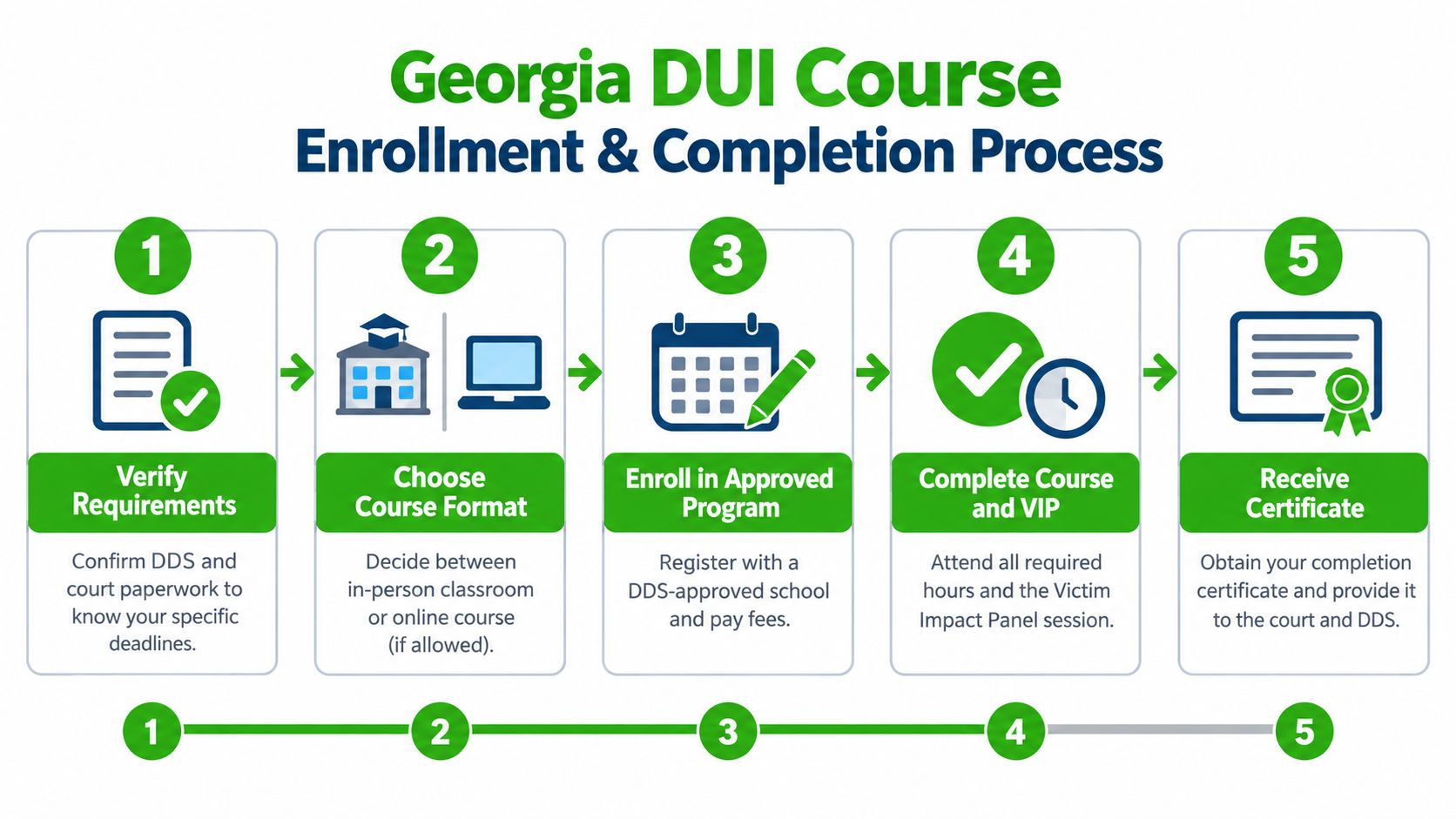
3. Schedule the assessment before the intervention
Ask the provider how the 130-question assessment is completed and whether it must occur before the group sessions. Scheduling this first helps identify whether you need a clinical appointment in addition to the educational course.
Bring identification and any paperwork the school requests. Keep copies or digital scans of court orders, prior certificates, evaluation referrals, and payment records. The provider may have its own document list, so confirm it before your first appointment.
4. Attend every required session
The intervention course requires 20 hours. Georgia DUI Schools lists weekday and weekend scheduling, with courses operating seven days a week, which can help a driver in Atlanta or Athens choose a workable schedule. Attend the complete schedule and follow the provider's rules for arrival, participation, make-up sessions, and technology if you're attending virtually.
If a VIP, evaluation, or treatment referral appears after the assessment, schedule it promptly rather than waiting until the course ends. A certificate from the intervention won't replace a separate document that your court or probation officer requires.
5. Collect and submit completion proof
Before leaving the final session, ask how and when the completion certificate is issued. Check your name, case information, course description, and completion status for accuracy.
Then provide the certificate wherever your instructions require, which may include DDS, the court, probation, or your attorney. Keep the original and a copy. Reinstatement processing can involve more than one office, so maintaining your own compliance file protects you if someone later asks for proof.
Costs Points and Insurance After a First Offense
A first DUI can create several separate financial categories. The Risk Reduction Program is only one possible expense. Depending on the case, a driver may also face court fines, reinstatement charges, clinical evaluation costs, treatment expenses, and a VIP fee if a panel is ordered.
The available verified information doesn't establish a universal Georgia price list for those services, so ask each provider and office for a written quote. Costs can vary based on the program, evaluation needs, court orders, and the services required after screening.
Keep the programs separate
A defensive driving course can help with a driving record, but it doesn't substitute for DUI Risk Reduction. Georgia allows a DDS-certified defensive driving course to remove up to 7 points once every 5 years, according to this Georgia defensive driving course explanation. That's a separate point-management option, not a replacement for the assessment and intervention required for DUI reinstatement.
The same source states that defensive driving is also used for insurance savings that are often 10% or more for 3 years. Contact your insurer before enrolling and ask whether it accepts the specific course and what documentation it needs. Insurers set their own rules, so a course doesn't guarantee a particular premium change.
Build a complete cost picture
Write down each possible category:
- Risk Reduction: Ask for the full fee for the assessment and 20-hour intervention.
- Clinical services: Confirm the price of any evaluation, ASAM Level 1 treatment, or follow-up counseling.
- Court obligations: Review your sentencing paperwork for fines, administrative charges, and other conditions.
- License reinstatement: Ask DDS which fees and documents apply to your license status.
- Defensive driving: Consider it separately if you need point reduction or your insurer confirms an approved discount path.
The most expensive mistake is often enrolling in the wrong course and having to repeat the process. Confirm approval first, then compare schedules and total fees. Keep every receipt and certificate with your court paperwork.
Get Back on the Road With the Right Georgia Course
For a Georgia first offense, the path is more precise than “take a DUI class and wait.” You'll generally begin with the assessment and the 20-hour DDS-approved Risk Reduction intervention. The assessment may leave you with education and administrative compliance, or it may lead to a clinical evaluation and treatment recommendation. A Victim Impact Panel may also be required if the court makes it a probation condition.
Defensive driving belongs on a separate track. It may help remove points or support an insurance request, but it doesn't satisfy the DUI Risk Reduction requirement. Make your decisions from the paperwork attached to your case, not from a national course advertisement.
Georgia DUI Schools has served drivers for more than 38 years and guided more than 100,000 participants through the state-required Risk Reduction course. With classroom options around Atlanta and Athens, virtual instruction, and scheduling available seven days a week, drivers can choose a format that fits their work and probation commitments while keeping the required steps organized.
Georgia DUI Schools offers the DDS-approved Risk Reduction Program, assessment support, clinical evaluations, ASAM Level 1 treatment, and Victim Impact Panels for drivers whose cases require additional services. Visit Georgia DUI Schools to choose an appropriate Georgia course format, check scheduling, and start the reinstatement process with the correct paperwork.