
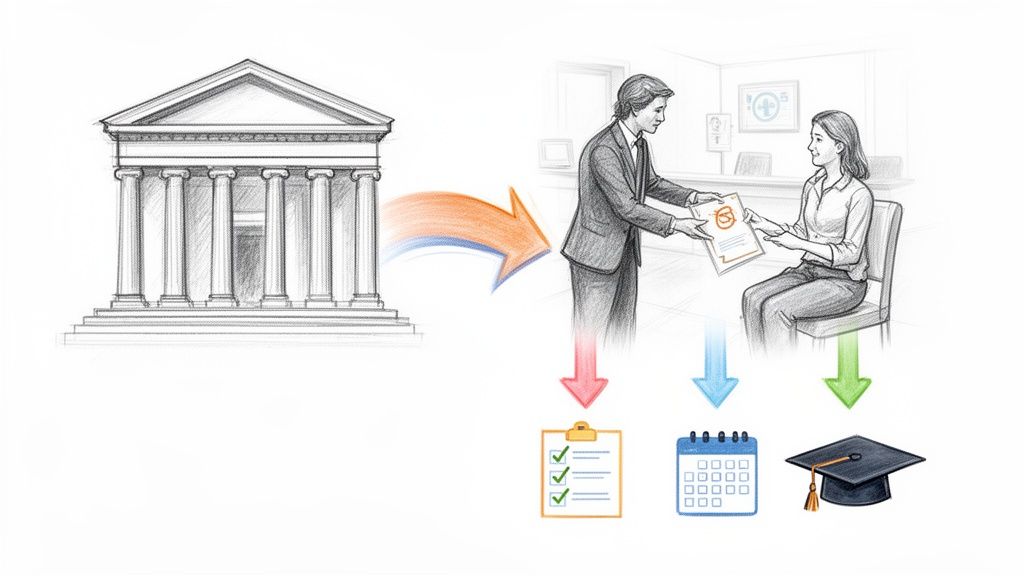
If a Georgia court has ordered you to get a substance abuse evaluation after a DUI or other offense, you’re probably feeling a little lost and uncertain. It’s completely normal.
The first thing to know is that a court-ordered substance abuse evaluation isn't a punishment. Think of it as a confidential, professional check-up to figure out if substance use played a role in your legal situation and what the best next step is—which is often just an educational course.
Your Guide to Georgia's Court-Ordered Evaluations

When a judge in Georgia orders one of these evaluations, it's a standard part of the legal process, especially for cases involving a DUI or drug possession. The goal isn’t to slap you with more penalties; it's to give the court an unbiased clinical perspective to help them make an informed decision about your case.
It’s a lot like going to the doctor. A doctor has to diagnose the issue before they can prescribe the right treatment. In the same way, a clinical evaluator assesses your situation to recommend the most helpful and effective path forward. The focus here is on education and getting things back on track, not punishment.
Why Your Evaluation Must Be State-Approved
Here’s a critical detail you absolutely cannot miss: your court-ordered substance abuse evaluation must be done by a provider approved by the Georgia Department of Behavioral Health and Developmental Disabilities (DBHDD). It also has to be recognized by the Department of Driver Services (DDS).
Choosing an unapproved provider is a common and costly mistake. The court, your probation officer, and the DDS will reject any evaluation that doesn't come from a state-approved source, forcing you to start over and pay for a second evaluation.
This rule exists to make sure every evaluation across the state meets the same professional standards. By choosing a trusted, multi-location provider like Georgia DUI Schools, you can be confident your certificate will be accepted by courts throughout the Atlanta, Athens, Lawrenceville, and Marietta metro areas, preventing any frustrating delays in your case.
Common Reasons for a Court-Ordered Evaluation in Georgia
While DUI is the most common reason, it’s not the only one. A judge might order an evaluation for several other offenses to better understand the circumstances.
Here's a quick look at some of the most frequent situations that trigger a mandatory evaluation in Georgia.
| Offense Type | Common Scenarios | Why It's Required |
|---|---|---|
| DUI (Driving Under the Influence) | An arrest for driving under the influence of alcohol or drugs, even before a conviction. | A standard requirement for license reinstatement and to complete the DUI/Risk Reduction Program. |
| Drug-Related Offenses | Possession of controlled substances or Minor in Possession (MIP) charges. | Used as a condition of probation or sentencing to assess dependency risk and guide rehabilitation. |
| Disorderly Conduct | Offenses like public intoxication where substance use was a clear contributing factor. | A judge orders it to see if an underlying substance use issue needs professional attention. |
| Family Court Proceedings | Child custody or visitation disputes where substance use by a parent is a concern. | To help the court make decisions that ensure the safety and well-being of the children involved. |
Seeing your specific situation on this list can help you reframe the evaluation not as a hurdle, but as a constructive step toward resolving your legal matter for good.
What to Expect During Your Clinical Evaluation
It's completely normal to feel nervous about a court ordered substance abuse evaluation. Most people imagine an intense interrogation, but that’s not what this is. Think of it as a structured, one-on-one conversation with a professional. The entire point is to get an accurate snapshot of your situation so the court gets a fair recommendation.
In Georgia, the whole thing usually takes between 60 and 90 minutes. You'll sit down with a state-approved clinician whose only job is to gather the facts. They aren't there to judge you—they're there to complete a specific task required by the court and the Georgia Department of Driver Services (DDS).
The Interview Itself
To make sure everyone gets a fair shake, clinicians use a standardized process. This isn't just a random chat; it's a comprehensive interview that looks at the big picture of your life, not just the incident that landed you here.
You can expect the conversation to cover a few key areas:
- Substance Use History: You’ll talk about your past and current use of alcohol or other drugs, including how much and how often.
- Medical and Mental Health: The clinician will ask about your overall physical and mental health.
- Employment and Support: Your job, education, and living situation all help paint a picture of your daily life and stability.
- Family and Social Relationships: This part is about understanding your support system, like family and friends.
- Legal History: Be ready to discuss the current charge and any past legal issues.
Being upfront and honest is the best thing you can do. The goal is an accurate recommendation. If you hold back or aren't truthful, it can raise red flags and might lead to a more intensive recommendation than you actually need.
Why They Use Standardized Tools
Clinicians don’t just wing it. They use proven, evidence-based tools like the Addiction Severity Index (ASI) to guide the interview. This ensures the evaluation is objective and based on facts, not feelings. For example, local data from many Georgia courts shows that alcohol is a factor in over 90% of DUI cases, which is why these evaluations are so thorough.
Using a structured approach means your assessment is based on the same clinical guidelines as everyone else's. It takes the guesswork out of the equation. To get a better sense of the specifics, you can learn more about how our clinical evaluations work and meet all of Georgia's legal requirements.
How to Prepare
Coming prepared makes the entire process go much more smoothly. The most important thing you can do is get your paperwork in order before you show up.
Make sure you bring these items with you:
- A valid photo ID (like a driver's license or passport).
- Your arrest report or citation for the current offense.
- Any court documents that officially order the evaluation.
- Your driving record (MVR), which you can usually get from the DDS website.
Having these documents ready to go proves you're taking this seriously. It also helps the clinician complete your report quickly and without any missing information, which gets you one step closer to putting this behind you.
Understanding Your Evaluation Recommendations
Once your court-ordered substance abuse evaluation is finished, the clinician will give you a formal recommendation. This isn't a grade or a personal judgment. It's simply a professional opinion on the best next step for your specific situation, based on a standardized system used nationwide.
Think of it like a doctor writing a prescription—it's tailored to you.
The system used for these recommendations is the American Society of Addiction Medicine (ASAM) Criteria. This framework gives evaluators and the courts a shared, consistent way to talk about the appropriate level of care, from low-intensity education to more involved treatment programs.
What Is ASAM Level 1
For most people facing a first DUI in Georgia, the most common recommendation is ASAM Level 1 Outpatient Services. Hearing the word "treatment" can sound intimidating, but don't worry—Level 1 is the least intensive form of care available. It’s not a disruptive, live-in program.
Think of ASAM Level 1 not as intensive therapy, but as a specialized class. Its main goal is education and prevention, designed to satisfy the court while giving you the tools to avoid future problems.
Typically, it means you'll attend a certain number of weekly sessions, which might be group discussions or one-on-one meetings with a counselor. The focus is on practical goals like:
- Understanding the real risks of substance use and driving.
- Learning better decision-making and coping skills.
- Creating a personal plan to keep this from happening again.
The total number of hours or sessions is based on your evaluation results, but the program is specifically designed so you can complete it while keeping up with your normal work and life schedule.
Other Possible ASAM Levels of Care
While ASAM Level 1 is the most frequent outcome for a first-time offense, it’s good to know what other recommendations are possible. This helps you understand where your own recommendation fits in the bigger picture. If the evaluation points to more significant risk factors—like a history of multiple offenses or signs of dependency—the clinician may recommend a higher level of care.
A higher level just means more frequent sessions or a more structured setting. For example, ASAM Level 2, or Intensive Outpatient, involves more hours per week than Level 1. In very rare situations involving a DUI evaluation, an inpatient or residential setting might be suggested if there are severe, co-occurring health issues that need to be addressed.
It's important to know that these higher-level recommendations are always based on specific clinical signs identified during your evaluation. The evaluator’s job is to match your needs to the right level of support defined by the ASAM criteria. If you have questions about the different levels, our guide to the Substance Abuse Professional (SAP) program offers more context on these types of structured programs.
Ultimately, the recommendation from your court ordered substance abuse evaluation gives you a clear, straightforward path to resolving your legal case. By understanding what the ASAM levels mean, you can tackle your next steps with confidence.
Finding a State-Approved Provider in Georgia
This is one step you absolutely cannot get wrong. Your evaluation will only be accepted by the court and the Georgia Department of Driver Services (DDS) if it’s done by a state-approved provider. Picking the wrong one is a surefire way to waste your time, money, and a lot of effort.
Think about it: a court-ordered evaluation has zero legal weight unless the person who signs off on it is on Georgia's official list. Imagine going through the entire process, getting your certificate, and then having the court clerk in Fulton County or your probation officer in Gwinnett County tell you it’s useless. You’d have to start all over again and pay for a second evaluation. It’s a frustrating—and completely avoidable—mistake.
How to Verify Your Provider
The Georgia Department of Behavioral Health and Developmental Disabilities (DBHDD) keeps the official registry of all approved Clinical Evaluators. This is the only list that matters. Before you even think about scheduling an appointment, you have to check that the provider is on it.
You should also keep an eye out for a few red flags that often point to an unapproved or sketchy provider.
- Be suspicious of anyone who "guarantees" a certain outcome. A real evaluator can’t promise a specific recommendation before they’ve even spoken to you.
- Watch out for providers advertising prices way below the state-regulated fee. This is a huge red flag that they aren't on the approved list.
- If a provider isn't on the official DBHDD registry, walk away. It doesn't matter what they promise you; the court will reject their evaluation every time.
Your main goal here is compliance. Make sure every step you take is exactly what the state requires.
The Advantage of a One-Stop-Shop Provider
To make things much easier on yourself, look for a provider that offers everything you need in one place. After your evaluation, you'll get a recommendation, which is usually for ASAM Level 1 treatment or the 20-hour Risk Reduction Program. Finding a provider that offers both the evaluation and the required classes saves you the headache of searching for another approved facility.
This "one-stop-shop" approach has some clear benefits:
- Continuity: The same trusted organization guides you from the very beginning to the very end.
- Efficiency: No need to send paperwork to different offices or keep track of multiple contacts.
- Peace of Mind: Everything is handled within one compliant system. This ensures the court and DDS get all the right documents without any frustrating delays.
Choosing a well-known provider with multiple locations, like Georgia DUI Schools, ensures your evaluation certificate will be accepted by courts and probation officers anywhere in the state, from Atlanta to Athens. Since we can handle both your assessment and any follow-up classes, we can help you get through this process with less stress.
If you’re ready to get this done, you can schedule your state-approved online drug and alcohol evaluation right now and take the next step toward resolving your case.
How Evaluations Help Stop a DUI from Happening Again
So, why does the court insist on a court-ordered substance abuse evaluation? It’s not just about satisfying a legal requirement or checking a box. The whole point is to figure out why the incident happened and give you the tools to make sure it never happens again.
Think of it this way: a judge giving everyone the same penalty for a DUI is like a doctor giving every sick patient the same medicine. It might work for some, but it’s not a very smart approach. The evaluation is the diagnosis. It allows the court to recommend a path forward that’s actually effective for your specific situation.
Getting to the Root of the Problem
This approach is all about creating real, long-term change. Instead of just handing out fines or jail time and hoping for the best, the system connects you with the right level of support. This could be an educational course or a brief treatment program.
The goal isn't to punish you—it's to equip you. By addressing the underlying reasons for the arrest, you’re far less likely to find yourself in the same situation down the road. It’s a proactive strategy focused on preventing another DUI, which keeps both you and the community safer.
Studies on similar programs back this up. For instance, Accountability Courts in Georgia, which use evaluations just like this, consistently show a reduction in repeat offenses among participants who complete the program.
Data on recidivism reduction from Georgia’s Accountability Courts shows that graduates are significantly less likely to be rearrested. This confirms that when people get the right support based on a professional evaluation, they are far less likely to re-offend.
The data is clear: this process works. It's about education and prevention, not just punishment.
How It Works in Georgia
After a DUI arrest in Georgia, the evaluation is your first step. Based on the results, you'll get a recommendation for a specific program. For most people, this ends up being the 20-hour DUI/Risk Reduction course or a short ASAM Level 1 outpatient program.
Completing your recommended program does more than just get the court off your back. It gives you real skills to prevent another DUI. Here’s how:
- Education: You’ll get a no-nonsense look at how alcohol and drugs actually affect your brain, judgment, and ability to drive safely.
- Self-Awareness: The process forces you to take an honest look at the choices that led to your arrest.
- New Skills: You’ll learn better ways to handle stress or social situations without getting behind the wheel when you shouldn’t.
Ultimately, the evaluation is a key part of making sure this experience is a one-time event. When you complete the process, you're not just a fulfilling a legal requirement—you're taking a concrete step to protect your future.
Ready to get started? You can schedule your state-approved DUI Risk Reduction Program with us today and begin the path toward putting this behind you.
Your Action Plan After the Evaluation
Getting your court-ordered substance abuse evaluation done is a huge step, but what comes next is what really matters. The recommendation you receive is your specific plan for satisfying the court and the Georgia DDS. Your job now is to follow that plan to the letter.
Think of it this way: the evaluation gives you the instructions, and now you have to build the project. Whether you're pointed toward a 20-hour DUI/Risk Reduction course, ASAM Level 1 treatment, or a MADD Victim Impact Panel, you need to get enrolled and get it done. Dropping the ball here can have serious legal consequences.
This process is designed to be a clear path from diagnosis to treatment, ultimately ensuring public safety while helping you resolve your case.
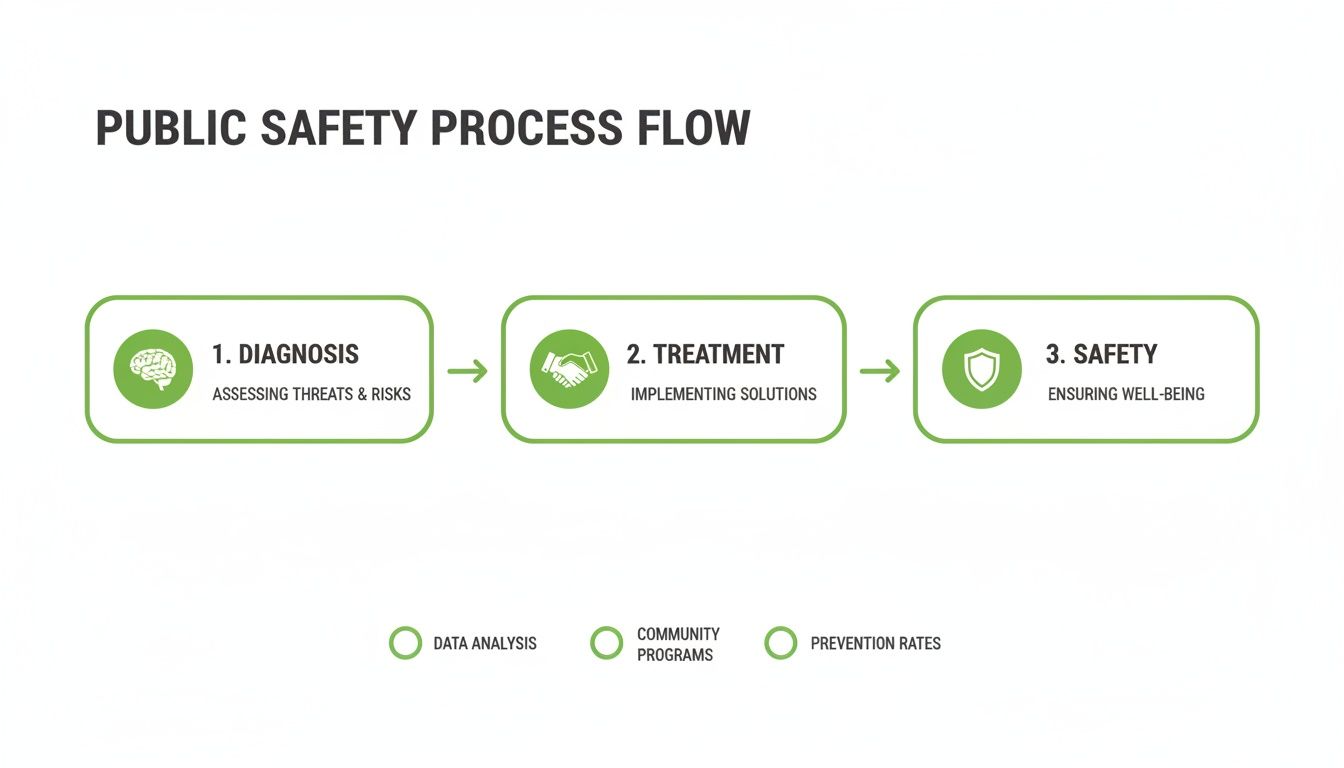
As you can see, connecting the right diagnosis with the right treatment is the whole point. It's a system proven to work.
Enrolling in Your Required Program
With your recommendation in hand, it’s time to act. The court gives you a firm deadline to complete any required programs. Waiting until the last minute is a recipe for disaster.
Here’s what to do right away:
- Enroll Immediately: Don’t put this off. Call a state-approved provider and sign up for your class or treatment. If you wait, you might find that classes are full or that you can’t finish before your court date.
- Know the Details: Make sure you understand exactly what’s required. Is it a 20-hour program like the Georgia DUI/Risk Reduction course, or is it a custom ASAM Level 1 treatment plan? Get the specifics.
- Put It on Your Calendar: Get your sessions scheduled, whether they're online or in person. Good providers, like Georgia DUI Schools, offer evening and weekend classes so you can work around your job and family life.
This model of connecting a clinical evaluation to a specific program isn't new; it has a proven track record. These types of court-ordered programs became widespread in the 1990s and have been shown to effectively reduce both crime and substance misuse. For instance, data from New York's drug courts highlighted how this system helps people with significant histories (62% had prior treatment). This is the same proven model we use right here in Georgia's own accountability courts. You can read the full research on adult drug court evaluations to see the national data for yourself.
Reporting Your Completion Correctly
Finishing your program is great, but you have to prove it. When you’re done, you’ll get an official Certificate of Completion. This piece of paper is your proof.
CRITICAL: Just having the certificate isn't enough. It's your responsibility to make sure it gets filed with everyone who needs to see it. If it’s not filed, it’s like you never did the program at all.
Make sure your certificate is submitted to:
- The Court: File it directly with the clerk of the court that is handling your case.
- Your Probation Officer: Give a copy to your PO to show you're following the rules.
- The Georgia DDS: Your provider usually handles this part electronically, but you should always follow up and confirm it was done. This is crucial for getting your license back.
The Consequences of Non-Compliance
Blowing past your court-mandated deadline is a big mistake. The fallout can make your legal situation much worse, costing you more time, money, and stress.
If you don't comply, you can expect:
- Probation Violations: This could mean more fines, a longer probation period, or even time in jail.
- License Reinstatement Delays: The DDS won’t give you your license back until they have proof you finished the program.
- A Bad Look in Court: It tells the judge you aren’t taking your situation seriously, which never helps your case.
The path from your evaluation to your final certificate is laid out to be as clear as possible. If you act quickly and stay organized, you can put this behind you and get on with your life.
Georgia DUI Schools can help you finish the process. With 18 locations plus online options for both evaluations and courses, we give you a clear, supportive way to meet your legal requirements. Take the next step and enroll in your required Georgia DUI/Risk Reduction Program today.
Georgia Evaluation FAQs
If you’ve been ordered to get a substance abuse evaluation, you probably have a lot of questions. That's completely normal. Getting clear answers is the first step to handling this without extra stress.
Here are some of the most common questions we hear about the evaluation process in Georgia.
How Much Does a Court-Ordered Substance Abuse Evaluation Cost in Georgia?
The price for a clinical evaluation is set by the state of Georgia. This is done to make sure the cost is fair and the same everywhere you go.
The Georgia Department of Behavioral Health and Developmental Disabilities (DBHDD) determines the official fee. That means every single state-approved provider will charge the same amount. Be very careful if you see a provider advertising a super low price—it’s a major red flag they aren't on the state's approved list, and the court will almost certainly reject their evaluation.
Are My Evaluation Results Confidential?
Yes, your evaluation is a private medical appointment, and your information is protected by federal privacy laws like HIPAA. What you tell the clinician stays between you and them. But there's one big exception you need to know about.
Since the court ordered the evaluation, you’ll have to sign a consent form. This form gives the evaluator permission to send the results and any treatment recommendations to the court, your probation officer, or the Georgia DDS—whoever ordered it.
This is just to prove you followed the court's order. Your detailed clinical information isn’t shared with the public.
What if I Disagree with My Evaluation's Recommendation?
If you feel the recommendation you received is wrong or unfair, you can get a second opinion. You are allowed to schedule another court ordered substance abuse evaluation with a different approved provider, but you will have to pay for the second one out-of-pocket.
Talk to your attorney before you do anything. They can give you the best advice for your specific situation. Usually, both evaluation reports will be sent to the judge, who then decides which recommendation to follow.
How Long Do I Have to Complete Everything?
The court or your probation officer will give you a hard deadline to finish the evaluation and any treatment they recommend. Do not miss this date. Waiting until the last minute is one of the worst mistakes you can make.
Missing your deadline can lead to serious problems, like:
- Probation violations, which can mean more fines or jail time.
- A warrant for your arrest.
- Major delays in getting your driver’s license back from the Georgia DDS.
You should book your evaluation right after the court orders it. This ensures you have more than enough time to complete any required programs, like a DUI/Risk Reduction course or ASAM Level 1 treatment, long before your deadline arrives.
At Georgia DUI Schools, we make it simple to handle your legal requirements. Our state-approved evaluators are ready to provide the assessment you need. We also offer the DUI/Risk Reduction courses and ASAM Level 1 treatment, so you can get everything done in one place. Get started now by enrolling in our Georgia DUI/Risk Reduction Program.