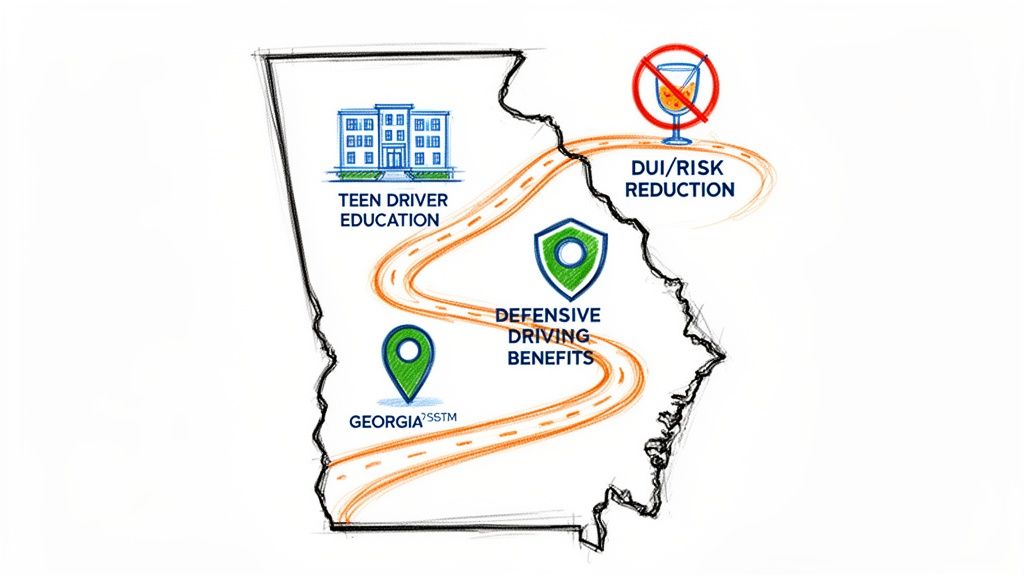
Navigating the different state-mandated driving courses in Georgia can get confusing, fast. The right course for you isn't a one-size-fits-all solution—it depends completely on your legal situation.
A driver facing a DUI in Atlanta needs a completely different class than a motorist in Savannah trying to reduce points on their license. Likewise, someone ordered by a court in Macon for a speeding ticket will have a different path.
Your Roadmap to Georgia Driving Courses
Think of Georgia's driving courses as different tools for different jobs. Some are mandatory to get your license back after a serious offense like a DUI, while others are voluntary options to clean up your driving record or satisfy a court order for a minor ticket.
This guide focuses on the main courses for adults involved in DUI, Risk Reduction, and Defensive Driving:
- DUI/Risk Reduction Programs: These are mandatory if your license was suspended or revoked for a DUI, drug charge, habitual violator status, or other major violation. You must complete this program to legally get back on the road.
- Defensive Driving Courses (DDC): These are usually taken to reduce points on your record, satisfy a court order for a minor traffic violation, or get a car insurance discount.
This flowchart breaks down which path you might need to follow.
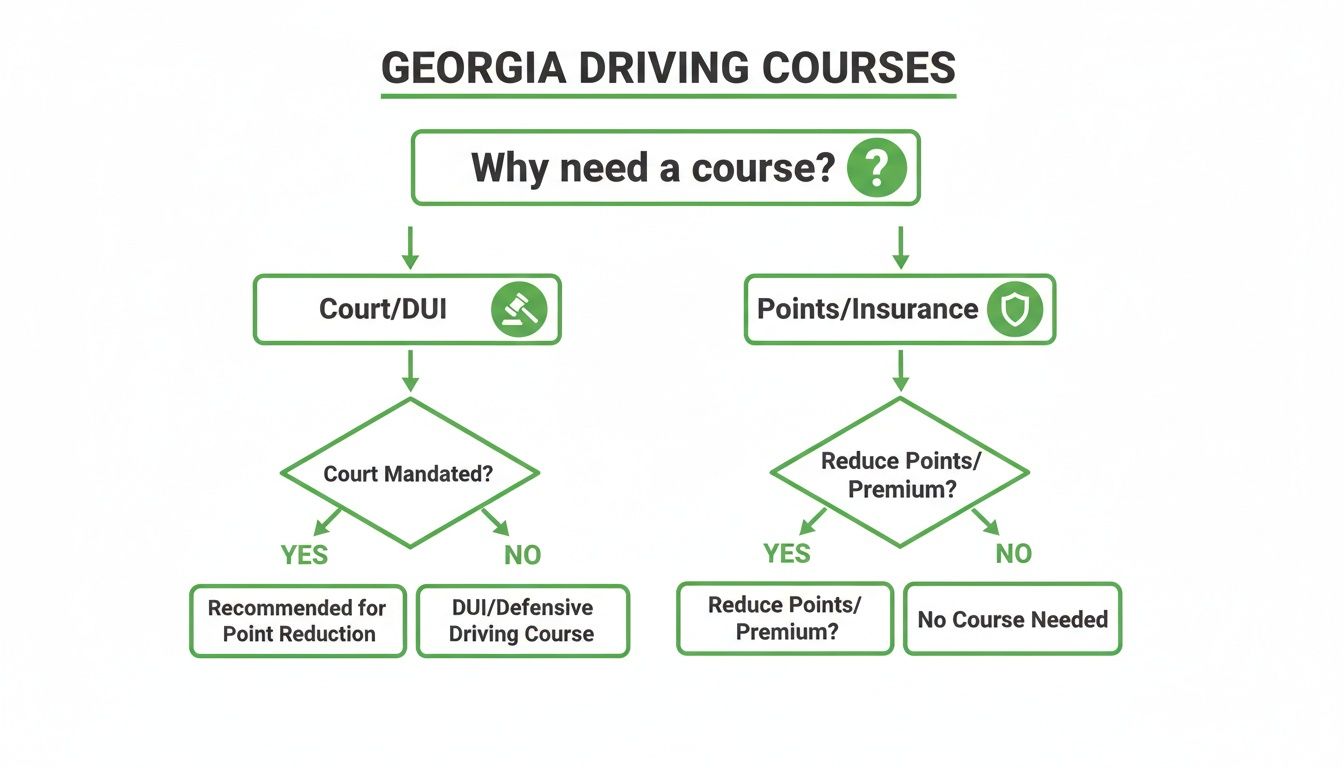
As you can see, the first question is always why you need the class. Your answer—whether it's a court order for a DUI or a ticket for reckless driving—will point you to the right program.
DUI Program vs. Defensive Driving: A Quick Comparison
To help you find the right fit, here is a quick comparison of Georgia's main court-related driving courses.
Which Georgia Driving Course Do You Need?
| Course Type | Primary Purpose | Who It's For |
|---|---|---|
| DUI/Risk Reduction | License reinstatement after a serious offense. | Drivers with a DUI, drug charge, habitual violator status, or other major violations requiring a state-mandated program. |
| Defensive Driving | Point reduction, insurance discounts, or satisfying a court order for a minor ticket. | Drivers who want to voluntarily improve their record, lower insurance rates, or were ordered by a court for a non-DUI offense. |
The key difference is what the state requires from you.
The DUI/Risk Reduction program is a specific, state-regulated process. It involves an assessment and a 20-hour course designed to address high-risk behavior. It's a legal requirement for certain offenses, and you absolutely cannot substitute a defensive driving class for it.
A Defensive Driving Course, on the other hand, is a much shorter 6-hour program. Its main goals are to sharpen your safe driving skills, reduce points on your license, and often secure a 10% or greater discount on your auto insurance. A judge might order it for a speeding ticket, but it is not sufficient for a DUI.
Key Takeaway: If your license is suspended for a DUI, drug possession, or because you are a habitual violator, you must take the DUI/Risk Reduction program. If you need to satisfy a court order for a minor ticket or want to lower points, the Defensive Driving Course is your answer. They are not interchangeable.
By understanding this core difference, you can choose the right program with confidence and avoid wasting time. Identifying your need correctly is the first step toward getting compliant and becoming a safer driver. To see exactly how a DDC can help your driving record, check out our guide on the benefits of defensive driving.
Understanding Georgia's DUI Risk Reduction Program
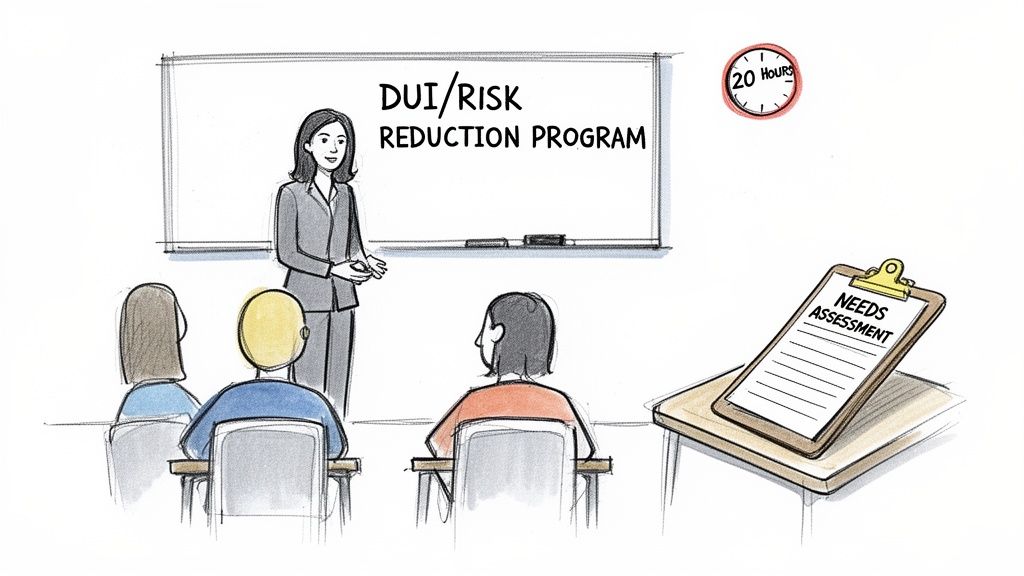
If you're facing a license suspension in Georgia from a DUI, drug possession, or another serious offense, you'll need to complete the DUI/Risk Reduction Program. This isn't just any driving class—it's a very specific, two-part process required by the Georgia Department of Driver Services (DDS) to get your license back.
Think of it as the official path to getting back on the road legally. This program is mandatory for certain violations, including for those declared Habitual Violators. It’s built to show you the real-world consequences of high-risk driving and give you the tools to make safer decisions.
The whole thing is standardized by the state. Whether you take the class in Atlanta or Augusta, every certified school follows the same two-step process.
Component One: The Needs Assessment
Your first step is always the NEEDS Assessment. This is a required 130-question survey you have to finish before you can even start the main course. It's important to know this isn't a test you can pass or fail.
Its real purpose is to build a confidential profile of your personal views and habits around driving and substance use. The results simply help the instructor tailor the conversation during the class; they are kept private.
Important Note: The Georgia DDS sets the fee for the NEEDS Assessment at $100. This price is the same at every certified DUI school and must be paid before you can take the assessment and sign up for the course.
You have to complete the assessment in person at a certified school location. Once that's done, you're officially ready to register for the second part of the program.
Component Two: The 20-Hour Course
With the assessment out of the way, you'll move on to the 20-hour classroom course. State law is very clear on this: the course must be completed in-person with a live, certified instructor. You cannot take it online, which is a key difference from other types of driver's ed in Georgia.
The 20 hours are usually broken up into a few sessions to fit a typical work week. For instance, a school in Marietta or Cumming might run a class on a Friday evening, then all day Saturday and Sunday.
The curriculum is strictly regulated by the DDS and covers critical topics, including:
- Georgia DUI Laws and Consequences: A full breakdown of the legal and financial fallout from an impaired driving conviction, like fines, potential jail time, and license suspension rules under habitual offender laws.
- The Effects of Drugs and Alcohol: Clear information on how different substances wreck your judgment, coordination, and reaction time.
- Personal Risk Factors: This helps you identify the personal choices and habits that can put you in high-risk situations behind the wheel.
- Strategies for Risk Reduction: You'll walk away with practical plans for avoiding impaired driving and making responsible choices, including attending a Victim Impact Panel if required.
The cost for the 20-hour course is also set by the state at $260, which includes a $235 class fee and a $25 workbook fee. All in, the total mandatory cost for the DUI/Risk Reduction Program is $360.
After you finish, you'll get an official Certificate of Completion. This is the document you'll need to provide to the DDS or the court to prove you've met your requirements.
Ready to take the first step toward getting your license back? You can learn more about the specifics and find a convenient location by reviewing our Georgia DUI/Risk Reduction course details.
The Next Steps: Clinical Evaluations and ASAM Level 1 Treatment
So you’ve wrapped up the 20-hour DUI/Risk Reduction course. That's a huge step, but don't be surprised if it's not the final one. Many drivers are caught off guard when a court or the Georgia Department of Driver Services (DDS) also requires a Clinical Evaluation after a DUI.
This isn't meant to be another penalty. Think of it as a confidential, professional assessment to see if there’s an underlying substance use issue that needs attention. It’s a separate, more in-depth process than the initial screening you did for the DUI class.
Understanding what comes next is key to navigating a DUI in Georgia, whether you're in Marietta or Macon. Getting this done right helps you meet all state requirements and get your license back without any frustrating delays.
What Is a Clinical Evaluation?
A Clinical Evaluation is a private, one-on-one session with a DHR/DBHDD (Department of Behavioral Health and Developmental Disabilities) approved clinical evaluator. These are licensed professionals trained specifically to assess for substance use disorders.
During the meeting, the evaluator will ask you questions about your history with alcohol or drugs, your lifestyle, and what led to your DUI. The goal is simply to get a full, honest picture of your situation so they can make a professional recommendation.
This isn’t just a casual chat—it’s a structured interview. Based on your conversation, the clinician determines if treatment is needed and, if so, what kind is the best fit.
Key Insight: A Clinical Evaluation is a health assessment, not a legal one. Its purpose is to check for potential health issues and recommend a path forward. The court and DDS require this to see that any root causes of the DUI are being properly addressed.
The entire process is completely confidential, just like an appointment with your doctor. The results are only shared with you. With your written permission, they can also be sent to the court or probation office that requested the evaluation.
Understanding ASAM Level 1 Treatment
If the evaluation recommends further steps, one of the most common is ASAM Level 1 Treatment. ASAM stands for the American Society of Addiction Medicine, which sets the standards for placing patients in the right level of care.
ASAM Level 1 is an outpatient treatment program. It's built for people who may have a mild to moderate substance use disorder but don't need intensive, residential care. The program gives you valuable tools and support while helping you satisfy your legal requirements.
This treatment usually includes:
- Group Counseling: You’ll meet regularly in a small group led by a certified counselor. It’s a supportive space to talk about challenges and learn new coping skills from others in a similar situation.
- Individual Counseling: Some programs offer one-on-one sessions to discuss personal goals and track your progress privately.
- Education: The classes focus on understanding addiction, learning to recognize your personal triggers, and building practical skills for long-term success.
The length and schedule for ASAM Level 1 Treatment can vary, but it often involves a few hours of sessions per week for 6 to 12 weeks.
Finishing an ASAM Level 1 program shows the court you’ve taken the recommendation seriously and are working to address the issues behind your DUI. It’s a critical piece of the puzzle for getting your life and your license back.
If you’ve been ordered to get an evaluation or need to complete treatment, choosing a state-approved provider is a must. You can learn more about our certified clinical services and get started on our Clinical Evaluation and ASAM Level 1 Treatment page.
Lowering Points and Insurance Costs with Defensive Driving
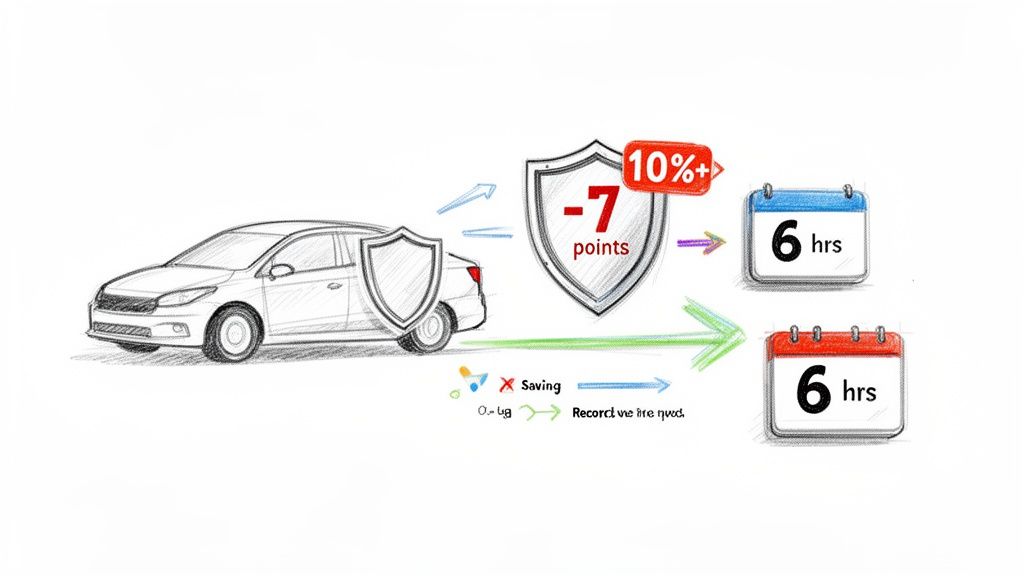
While many drivers take our courses to satisfy a DUI mandate, another critical program is the Defensive Driving Course (DDC).
This 6-hour program is a fantastic tool for any licensed driver who wants to sharpen their road skills, handle a minor traffic ticket, or just save some serious cash. Whether a judge in Decatur ordered you to take it for a speeding ticket or you're a safe driver in Alpharetta trying to lower your insurance bill, a DDC is the answer.
Reduce Points on Your Driving Record
Getting too many points on your Georgia license is a quick way to a suspension. A Defensive Driving Course is your best tool for managing your driving record.
After completing a DDS-approved 6-hour DDC, you can knock up to 7 points off your record. That’s a huge deal and can be the one thing that keeps your license from being suspended after a few minor tickets.
Important Rule: Under Georgia law, you can only take a Defensive Driving Course for point reduction once every five years. It's a powerful tool, so you’ll want to use it when it counts the most.
Earn Significant Insurance Discounts
Aside from points, the most popular reason to take a DDC is for the insurance discount. Almost every Georgia auto insurer offers a nice discount to drivers who voluntarily complete a certified course.
How much? Typically 10% or more, and that discount can apply every year for up to three years. Think about it: if your annual premium is $1,800, a 10% discount saves you $180 a year. That adds up to $540 over three years—way more than the cost of the class itself.
Who Should Take a Defensive Driving Course
This course is a great fit for almost any driver in Georgia. You should definitely sign up if you want to:
- Reduce Points: Proactively clean up your record by removing up to 7 points.
- Lower Insurance Costs: Get a discount of 10% or more on your car insurance.
- Satisfy a Court Order: Fulfill a judge's requirement for a non-DUI ticket, like speeding or running a red light.
- Reinstate a License: A DDC might be required to get your license back for certain minor offenses, such as accumulating too many points.
Flexible Learning Options for Any Schedule
We get it—life is busy. That's why we offer our Defensive Driving Courses in a few different formats, so you can always find one that fits your schedule.
- Self-Paced Online: The ultimate in flexibility. Complete the course from anywhere in Georgia, entirely on your own time.
- Live Virtual (Zoom): Want a live instructor without the drive? Join a scheduled class from home and get real-time interaction.
- In-Person Classroom: If you prefer a traditional classroom, you can join us at one of our many locations, from Lawrenceville to Gainesville.
Whether you're being proactive about savings or need to take care of a ticket, a DDC is a smart move. You can learn more about the benefits of defensive driving and how it can help you.
A Critical Look at Georgia's Teen Driver Education
While our main focus is on adult programs like DUI/Risk Reduction and Defensive Driving, you can't talk about road safety in Georgia without looking at how we teach our teens to drive. The state has standards, sure, but a closer look shows a system that’s falling behind, putting our most inexperienced drivers in real danger.
To get a Class D license at 16 or 17, a teen has to meet the Joshua's Law requirements. This usually means a DDS-approved course with 30 hours of classroom instruction and 6 hours of behind-the-wheel training from a certified instructor. It's meant to build a solid foundation.
The Problem of an Outdated Curriculum
Here’s the issue: that foundation is shaky because the curriculum is dangerously out of date. The standards for what's taught in these classes haven't really changed in over a decade. That’s a massive problem when you think about how much Georgia’s roads have changed—from the nightmare traffic in metro Atlanta to the constant distraction of smartphones in every car.
A shocking 2024 state audit laid it all out, finding that Georgia's driver education standards haven't been updated in more than 12 years. Think about that. And consider this: in 2021, drivers aged 15-20 made up 7.9% of all licensed drivers in the state. The results are tragic. Between 2012 and 2022, the number of drivers aged 15-17 involved in fatal crashes here shot up by 56%—a rate that’s much worse than national trends. You can read the grim details in the state auditors' report on Georgia's drivers ed program.
The Stark Reality: An unchanged curriculum means today’s teens are learning to drive with a 2012 playbook. It doesn’t properly prepare them for modern challenges like advanced safety tech in new cars, navigating crazy urban areas like Atlanta, or the huge danger of digital distraction.
This creates a major safety gap. The state-mandated basics just aren't enough to prepare a new driver for the reality of I-75 at rush hour or the busy streets of cities like Athens and Cumming.
Professional Instruction vs. Parent-Led Training
To meet the Joshua's Law requirement, some parents choose a parent-taught option, where they oversee the 40 hours of supervised driving. While parents absolutely need to be involved, relying only on them can be a risky replacement for professional training.
There are some big differences:
- Spotting Bad Habits: A professional instructor is trained to catch and fix small, risky habits—like rolling stops or adding a few MPH over the speed limit—that parents might not even realize they do themselves.
- Teaching Modern Techniques: Certified instructors are up-to-date on defensive driving methods that simply weren't common when parents learned to drive.
- Handling High-Stress Scenarios: A pro instructor's car with a dual-control brake pedal creates a safe space for teens to practice things that are too risky to try with a parent, like emergency braking or handling chaotic intersections.
This combination of an outdated curriculum and too much reliance on parent training creates a perfect storm for tragic results. While we specialize in adult courses, our commitment to road safety is for everyone. Making sure teens get modern, relevant, and professional drivers education classes in Georgia is key to protecting us all.
A strong driving foundation starts early. For parents and teens just getting started, the first step is understanding what the path to getting a license looks like. You can get a good overview of the requirements and what to expect from our guide to the Joshua's Law test.
Your Simple Guide to Enrolling and Completing Your Course
Alright, let's get this done. Whether you need a DUI/Risk Reduction course to get your license back or a Defensive Driving class to knock some points off your record, the process is straightforward.
We've laid out the exact steps below. Follow this guide to make sure you sign up for the right program, meet all the requirements, and get back on the road without any extra headaches.
Step 1: Confirm Exactly Which Course You Need
First things first: you have to know which course you're required to take. These programs are not the same, and picking the wrong one is a mistake that will cost you time and money.
- DUI/Risk Reduction Program: This is the mandatory 20-hour course if you're facing a DUI, drug possession, or another major violation that suspended your license. The state requires this program for you to be reinstated.
- Defensive Driving Course (DDC): This is the voluntary 6-hour class for drivers looking to reduce points, get an insurance discount, or satisfy a court order for something like speeding or another traffic ticket.
Pro Tip: Look at your paperwork. Any court order, notice from your probation officer, or letter from the Georgia DDS will tell you exactly which course you need to complete. It will specify either "DUI/Risk Reduction" or "Defensive Driving."
Step 2: Choose Your Class Format and Schedule
We know you're busy, so we offer a few different ways to get your class done. For Defensive Driving, you've got options. Just remember, Georgia law requires the DUI/Risk Reduction course to be completed in person with a live instructor.
- In-Person Classroom: The traditional classroom setting. We have 18 locations across Georgia, from Lawrenceville to Gainesville, so you can find one near you.
- Live Virtual (Zoom): For Defensive Driving only. This gives you the interaction of a live class but from your own home.
- Self-Paced Online: Also for Defensive Driving only. This is your most flexible option, allowing you to finish the material completely on your own time.
Step 3: Register and Show Up
After you've picked your course and format, signing up is simple. You can register online or just give us a call to save your spot. Have your driver's license number and payment info ready.
On class day, just be there on time and ready to go. You'll need your photo ID and any other papers the court required you to bring. Our certified instructors will take it from there, making sure you understand the material and get your questions answered.
Step 4: Get Your Certificate of Completion
Once you finish the course, you'll receive an official Certificate of Completion. This is the document you need.
You'll give this certificate to the court, the DDS, or your probation officer as proof that you've met your requirement.
Following these steps takes all the guesswork out of the process so you can get this handled and move on. The path to a driver's license involves several steps, and for those just starting out, it's helpful to understand the full journey. For a deeper dive into the initial stages, you might be interested in our guide on how to get a learner's permit in Georgia.
Answering Your Top Questions About Georgia Driving Courses
Navigating the rules for driver's courses can feel like a maze. We get it. To help you find your way, we've put together answers to the most common questions we hear every single day from drivers across Georgia.
How Do I Know Which Class I Need?
The best way to know for sure is to look at your official paperwork. Any documents from the court, a probation officer, or the Georgia Department of Driver Services (DDS) will spell out exactly which course you need to take.
Keep an eye out for these phrases:
- "DUI/Risk Reduction Program": This is the state-mandated 20-hour course required to get your license back after a DUI or another serious offense.
- "Defensive Driving Course": This refers to the 6-hour class, which is usually for handling a traffic ticket, getting points off your license, or earning an insurance discount.
It's critical to understand that these two programs are not interchangeable. Enrolling in the wrong one is a costly mistake, so checking your paperwork first is the most important step you can take.
Can I Take the DUI/Risk Reduction Course Online?
No. Georgia state law is crystal clear on this: the 20-hour DUI/Risk Reduction course must be completed in person with a live, certified instructor. There are absolutely no online or virtual options for this specific program.
Defensive Driving Courses, on the other hand, offer much more flexibility. For those, you can often pick between in-person classes, live virtual sessions on Zoom, or even a completely self-paced online format that fits your schedule.
What Happens After My Clinical Evaluation?
Once you complete a Clinical Evaluation, the clinician will give you their professional recommendation.
If they find that no further treatment is necessary, you’ll get paperwork stating that. You can then provide this to the court or DDS to show you've met the requirement.
If the evaluator recommends a treatment program, like ASAM Level 1, you will have to enroll in and complete it to satisfy the court's order. Your evaluation is confidential and only shared with you, but you'll need to grant permission for the results to be sent to your probation officer or the court.
How Quickly Do I Get My Certificate?
You get your official Certificate of Completion immediately after finishing your course.
Whether you're in the DUI/Risk Reduction Program or a Defensive Driving Course, your instructor will issue your certificate right there on-site as soon as you've completed all the hours and class requirements. No waiting period involved.
At Georgia DUI Schools, we provide DDS-approved courses and clinical services to help you meet every state and court mandate. Our goal is to make this process as clear and simple as possible so you can get back on the road safely. To find a class and get started, check out our Georgia DUI/Risk Reduction course schedule.