Getting that learner's permit is a huge step, but it’s not a free pass to drive solo. The rules for driving with a permit in GA are strict and clear: you must always have a qualified supervising adult in the front seat, log your driving hours, and follow limits on passengers and phone use before you can even think about getting your provisional license.
Your Guide to Georgia's Permit Driving Rules
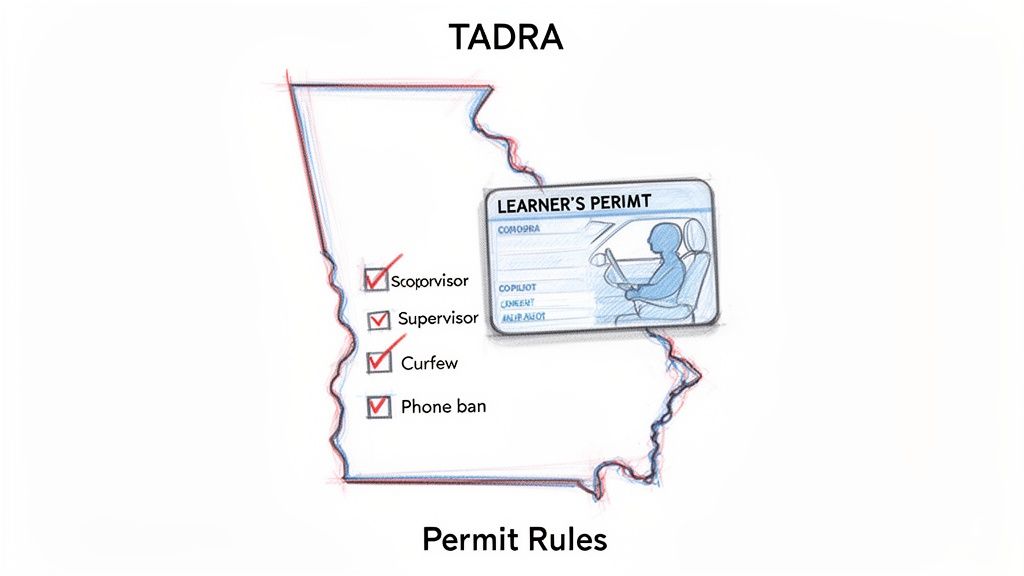
It’s best to think of your new Georgia learner's permit as a structured training period with a mandatory co-pilot. This whole system is managed by the Teenage and Adult Driver Responsibility Act (TADRA), a set of laws specifically designed to ease new drivers onto the road and reduce the risks that come with inexperience.
TADRA and Joshua's Law
Under TADRA, the learner's permit rules for 15-year-olds are non-negotiable. The law was put in place to cut down on teen accidents by making sure there's always supervision. That means a licensed adult who is at least 21 years old must be in the front passenger seat, alert and ready to take control of the wheel at a moment's notice.
These rules work hand-in-hand with Joshua's Law, which lays out the specific driver education you need. To move on to your provisional license, you have to complete 40 hours of supervised driving, and at least 6 of those hours must be at night.
If you go a different route, you can complete a 30-hour approved driver ed course plus 6 hours of professional behind-the-wheel training. You can find all the official details on the Georgia DDS website.
Quick Summary of Permit Rules
To keep things simple, here’s a quick-glance table of the main rules for a Class CP Instructional Permit in Georgia. Breaking any of these can lead to fines and, worse, a delay in getting your next-level license.
Here are the essentials you absolutely must follow.
Georgia Learner's Permit (Class CP) At a Glance
| Requirement or Restriction | What You Need to Know |
|---|---|
| Supervising Driver | Must be a licensed adult 21+ in the front seat at all times. |
| Driving Alone | Strictly prohibited. No exceptions. |
| Driving Hours | Must complete 40 hours (6 at night) of supervised driving. |
| Passengers | Generally limited to your supervising driver and immediate family. |
| Device Use | Absolutely no holding or using a phone or any other device. |
These rules are there for a reason—to keep you and everyone else safe while you learn.
If you hit a snag and end up with a traffic ticket or a court order, a state-approved Defensive Driving course is often the next step. Learn more about the Georgia DUI Schools Defensive Driving course and how it can help you get back on track.
How to Get Your Georgia Learner's Permit
So, you're ready to get behind the wheel in Georgia. That's a huge milestone! The very first step on your journey to driving solo is getting your learner's permit, officially known as a Class CP Instructional Permit.
Before you can even think about driving, though, you need to be eligible. The main rule? You must be at least 15 years old. If you've hit that age, your next stop is preparing for a trip to the local Department of Driver Services (DDS) office. Think of it as a bit of homework you have to do before you can start the fun part.
Required Documents and School Enrollment
Heading to the DDS without the right paperwork is one of the most common mistakes people make. It’s a surefire way to get turned away and have to come back another day. Don't let that be you!
Here’s the checklist of what you absolutely must bring with you:
- Proof of Identity: An original or certified copy of your birth certificate or a valid U.S. Passport. No photocopies!
- Proof of Social Security Number: Bring your original Social Security card or a W-2 that shows your number.
- Proof of Georgia Residency: You’ll need two documents with your family's address. Things like utility bills, lease agreements, or bank statements work great.
- Georgia Certificate of School Enrollment (DS-1): This form has to be signed and dated by your school within the last 30 days.
Getting all of this organized ahead of time makes the whole process a lot less stressful. For a complete list of accepted documents, you can learn more about how to get your learner's permit in Georgia to make sure you're fully prepared.
Passing the DDS Knowledge Exam
Once an employee at the DDS verifies all your documents, it's time for the Knowledge Exam. This isn't just one test; it's split into two separate parts, and you have to pass both to walk out with your permit.
The exam covers:
- The Road Signs Test: This part tests how well you can identify traffic signs just by their shape, color, and the symbols on them.
- The Road Rules Test: This section is all about Georgia's traffic laws, safe driving techniques, and the specific rules for driving with a permit in GA.
To pass, you need to get at least 15 out of 20 questions right on each section. Your best bet is to really study the official Georgia Driver's Manual before you go.
The permit itself costs $10, which you'll pay at the DDS office. And if you don't pass the first time, it's not the end of the world. You can take it again, though you might have to wait a day and pay the fee again. Prepare well, and you'll be walking out with that permit, ready for your first supervised drive.
Mastering the Road with a Supervisor
When you have a Georgia learner's permit, there’s one rule that trumps all others: you can never drive alone. This is the absolute most important thing to remember. Think of your supervisor less like a passenger and more like your co-pilot—an experienced guide who’s there to teach and take over if things get tricky.
That co-pilot must be a licensed driver who is 21 years of age or older. They have to be in the front passenger seat, awake, and focused on the road with you. They can’t be texting, napping, or distracted in any way, because their job is to be ready to physically control the car in an emergency.
Logging Your Driving Hours Under Joshua's Law
On top of having a supervisor, you’ll also need to track your driving time. This is a key part of Joshua's Law, which sets up specific training requirements you have to meet before you can even think about getting your provisional (Class D) license. The whole point is to make sure you get real-world experience in all sorts of driving situations.
Under Joshua's Law, you are required to log:
- A grand total of 40 hours of supervised driving.
- At least 6 of those 40 hours must be at night.
If you go another route, you can complete an approved 30-hour driver education course plus 6 hours of in-car training with a DDS-certified instructor. This focus on structured practice has made a huge difference.
The results of laws like TADRA and Joshua's Law speak for themselves. Before these rules were fully in place around 2007, Georgia had over 180 traffic deaths each year involving teens aged 15-17. By 2010, that number had plummeted by 35%. Today, the state issues more than 150,000 learner's permits annually under these life-saving guidelines. You can see more teen driver safety stats directly from the Georgia Department of Driver Services.
This flowchart gives you a simple look at the journey to getting your permit.
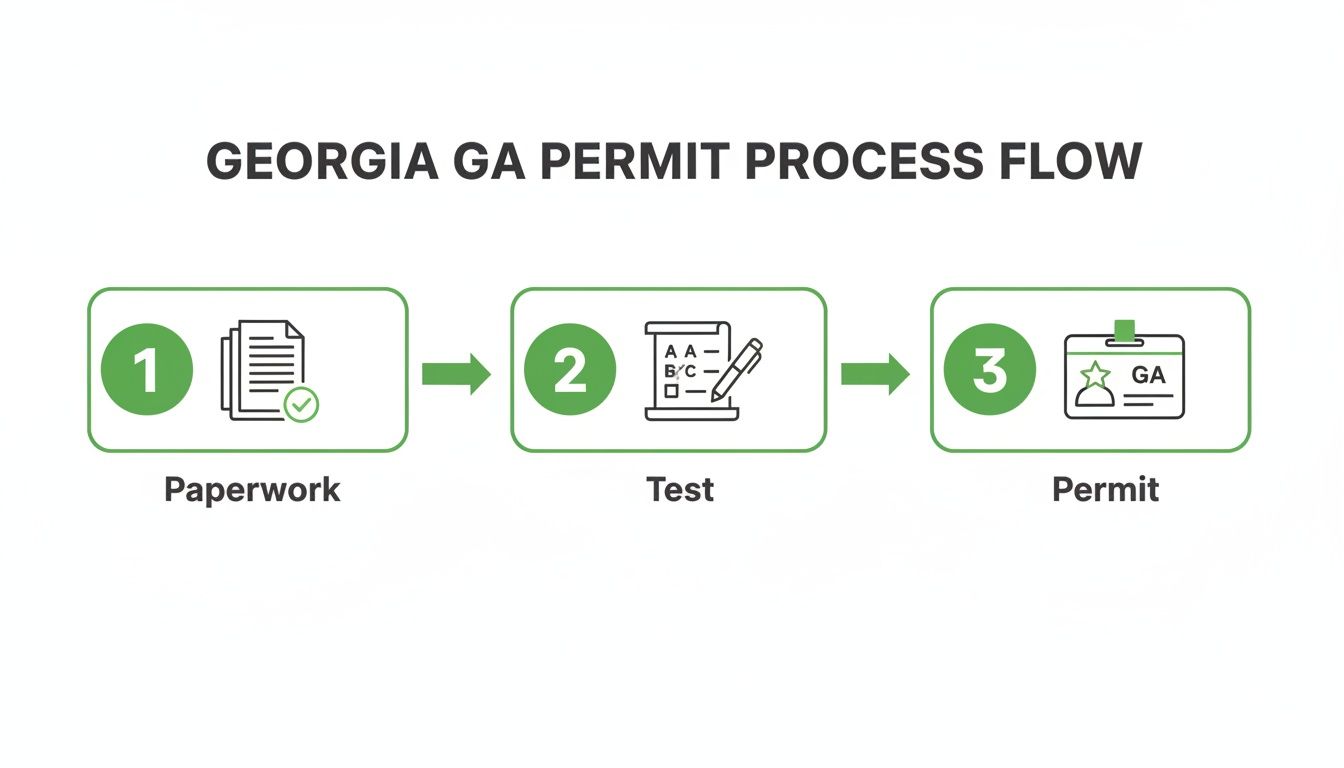
As you can see, it's a clear path that involves getting your documents in order, passing the test, and then getting the official permit.
Tips for Supervising Parents and Guardians
For parents and guardians, logging these hours is your chance to build a safe, confident driver from the ground up. Don't just check a box.
Start small in empty parking lots and quiet local streets. As they get more comfortable, slowly introduce tougher scenarios. Think rush hour on Atlanta's I-285, navigating the roundabouts in Roswell, or practicing tight parallel parking in downtown Savannah. Document every drive and remember these skills are the foundation for a lifetime of safe driving. It's also a great time to explore the benefits of defensive driving to refresh your own skills and be a better teacher.
Understanding Curfews, Passengers, and Device Bans
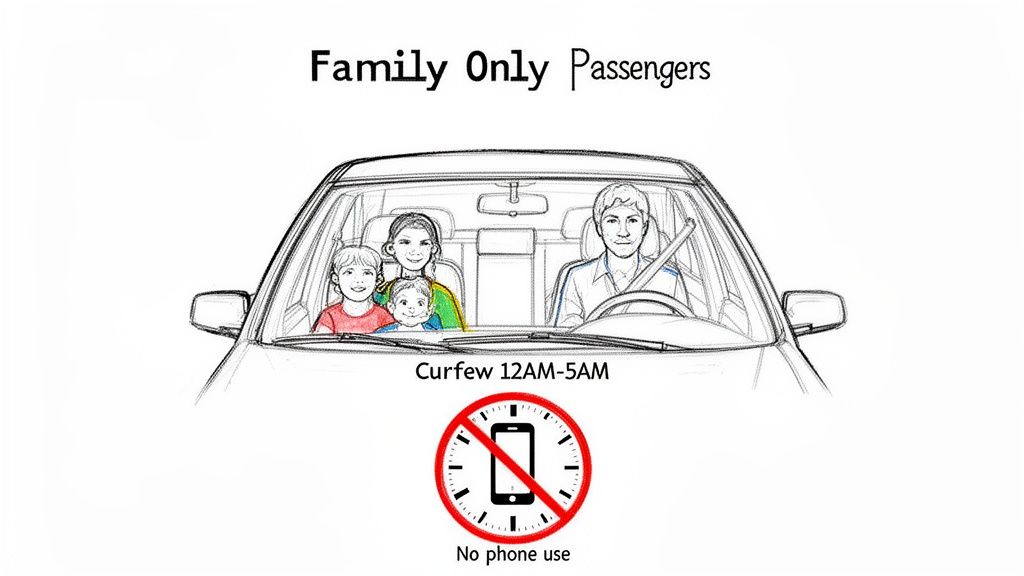
While having a qualified adult in the passenger seat is the biggest rule, Georgia’s TADRA laws also put strict limits on phones, passengers, and driving times. These aren’t punishments. Think of them as essential safety measures to help new drivers build good habits right from the start.
One of the most important rules is about your phone. Georgia's hands-free law applies to everyone, but for drivers under 18, it's a zero-tolerance policy. You cannot hold, support, or use a wireless device for any reason while driving.
The Strict Ban on All Device Use
It doesn’t matter if you’re trying to make a call, send a quick text, or just glance at GPS directions. If that phone is in your hand, you're breaking the law.
Why is this rule so strict? Because distracted driving is a leading cause of teen accidents. Taking your eyes off the road for just five seconds while going 55 mph is like driving the entire length of a football field with your eyes closed.
The penalties are serious and immediate. A single conviction for using your phone illegally adds points to your license and comes with some hefty fines. For a new driver, those points can easily lead to a license suspension, which pushes your goal of getting a provisional license much further away.
Passenger and Curfew Rules for Permit Holders
The law is also very specific about who can be in the car with you. If you have a Class CP learner’s permit, your passenger list is short. The only people allowed in the vehicle are your supervising driver and your immediate family members. This means no driving friends to school, the movies, or anywhere else.
This rule prepares you for the next stage. Once you have a provisional license, you’ll still face limits on non-family passengers. The data is clear: a teen driver's risk of a fatal crash goes up with every non-family teen they have in the car.
Finally, you need to be aware of the upcoming curfew. While the learner's permit itself doesn't have a driving curfew, your very next license—the Class D provisional license—does. You will be prohibited from driving between 12:00 AM and 5:00 AM, with very few exceptions. Following all these rules for driving with a permit in GA is non-negotiable.
Mistakes can happen. If you get a ticket and are facing points or a court order, a state-approved Defensive Driving course is often the best solution. Our Georgia Defensive Driving course is designed to help you satisfy court requirements and get back on track.
The High Cost of Breaking Permit Rules
Think the rules for a Georgia learner's permit are just suggestions? Think again.
Ignoring the restrictions isn't a minor slip-up—it's a fast track to serious trouble. The Teenage and Adult Driver Responsibility Act (TADRA) was designed to be strict for a reason, and violations for things like driving alone, using a phone, or having friends in the car come with heavy penalties that can slam the brakes on your journey to a full license.
These aren't just slaps on the wrist. We're talking fines, driver's license points, and even a suspended permit. For new drivers, the system has very little patience for mistakes, so it's critical to follow every rule to the letter.
Fines, Points, and Automatic Suspension
Georgia’s point system is especially unforgiving for young drivers. For anyone under 18, racking up just 4 or more points in any 12-month period triggers an automatic license suspension. It’s a lot easier to hit that number than you might think.
A single conviction for reckless driving or even speeding 24 mph or more over the limit will get you those 4 points and an instant suspension. Something as simple as using your phone while driving also carries a hefty penalty. Georgia has a zero-tolerance policy for drivers under 18, with fines between $150 and $300 for a cell phone ticket. With over 7,000 of these tickets issued to teens annually in places like Fulton and Gwinnett counties, it's a common and costly mistake.
These rules exist because the statistics are sobering: nearly 1 in 5 teen drivers will be in a crash during their first year. You can learn more about these teen driving laws and their consequences on hasnerlaw.com. On top of the legal trouble, these violations will almost certainly cause your family's car insurance rates to skyrocket for years to come.
When a Course Becomes Mandatory
If you do get a ticket, the consequences often go beyond just the fine and points. A judge can order you to complete a state-approved course to address the violation.
These programs are built for specific situations:
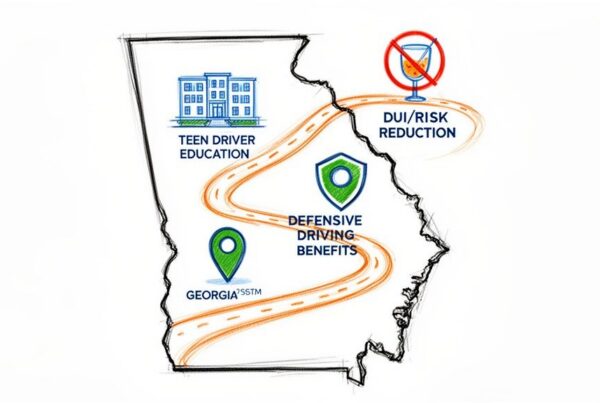
- Defensive Driving Course: This is often required for minor traffic violations to reduce points or satisfy a court order.
- DUI/Risk Reduction Course: If the violation involves alcohol or drugs, this more intensive program is mandatory to get your license reinstated.
Getting a court order can feel overwhelming, but these courses are designed to be the solution. They give you the education needed to meet legal requirements, reinforce safe driving habits, and get you back on the road to earning your license.
Following the law is always the best move. But if a mistake happens, you need to know how to handle Georgia's penalty system. For those who need to satisfy a court order or reduce points, our state-approved Defensive Driving course provides a clear path forward.
Graduating to Your Provisional Class D License
Think of your learner's permit as the training wheels. It’s a critical time for learning the ropes under supervision, but it’s not meant to last forever. The next big step is earning your Class D Provisional License.
This moves you a lot closer to full driving freedom, but it comes with its own rulebook. These requirements are all designed to keep building on the safe habits you started with your permit.
Meeting the Class D License Requirements
Before you can even think about scheduling your road test, you’ve got to check off a few key boxes under Georgia’s TADRA laws.
You must:
- Be 16 or 17 years old.
- Hold your learner's permit for at least one year and one day without any major traffic violations.
- Complete all Joshua's Law requirements, including your 40 hours of supervised driving (with 6 at night).
- Pass the official road skills test with a Georgia DDS examiner.
That one-year holding period is non-negotiable. It’s there to make sure you have plenty of time to practice in all kinds of conditions—from a sunny afternoon on a quiet Cumming road to a rainy night on the Connector. That experience is what really counts.
If you need a refresher on the details, you can find a complete breakdown in our guide to the Joshua's Law test.
The Road Test and New Restrictions
Passing the road skills test is the final hurdle. The examiner will be watching to see if you can safely control your car, obey traffic signs and signals, and handle basic maneuvers like parallel parking and making a quick, controlled stop.
Most teens who fail make simple mistakes. Forgetting to check a blind spot, not yielding the right-of-way, or making a turn that’s way too wide are some of the most common reasons.
Once you pass, you’ll get your Class D license, but the training wheels aren’t completely off just yet. This provisional license has its own set of restrictions that build on the permit rules.
You'll now have a strict curfew, meaning you cannot be on the road between 12:00 AM and 5:00 AM. No exceptions.
On top of that, for the first six months, you can’t have any non-family passengers. It’s all part of a gradual process designed to minimize high-risk situations while you get comfortable driving solo.
Georgia Permit Rules FAQ
When you're a new driver in Georgia, the rules for a learner's permit can feel a little confusing. Let's clear up some of the most common questions we hear from teens and their parents.
Can I Drive My Friends to School with My Permit?
The short answer is no. When you have a Class CP learner’s permit, you can only drive with a qualified supervising adult sitting right next to you in the front passenger seat.
Generally, your only other passengers can be your immediate family members. The privilege of driving friends doesn't come until you've earned your Class D provisional license, and even then, you'll have to follow strict passenger limits for the first year.
What if My Supervising Adult Is on Their Phone?
This is a big one. While Georgia’s hands-free law is aimed at the driver, your supervisor has a legal responsibility to be alert and ready to take control of the car at a moment's notice.
If your supervisor is texting, scrolling, or otherwise distracted, they aren't doing their job. Think of them as your co-pilot. If something went wrong while they were looking at their phone, it puts everyone in danger and could lead to serious legal trouble. The rule of thumb is simple: everyone in the front seat focuses on the road.
The whole point of supervised driving is to have an active teacher and a safety net. A distracted supervisor takes that net away, leaving an inexperienced driver in a very risky spot.
Do I Still Need to Hold a Permit for a Year if I’m 18?
Nope. The one-year-and-a-day holding period and all the Joshua’s Law requirements are specifically for teen drivers under the age of 18.
If you're 18 or older when you apply for your first license, you can actually get your learner’s permit and take your road test on the very same day, as long as you pass all the required exams.
How Does a Ticket on My Permit Affect Getting My License?
A ticket can completely derail your progress. For any driver under 18, getting 4 or more points from traffic tickets in any 12-month period means your permit will be automatically suspended.
Even worse, if you're convicted of a major violation like a DUI, reckless driving, or fleeing from an officer, you won't be able to get your Class D license for 12 months from the date of that conviction. Keeping your driving record clean isn't just a good idea—it's essential.
If you've received a ticket and are facing court requirements, Georgia DUI Schools can help. We offer state-approved Defensive Driving courses that can help you reduce points, satisfy the court, and get back on the right path. Check out our Georgia Defensive Driving course to find a flexible class that fits your schedule.