When Georgia teens get ready to start driving, one of the first things they hear about is the "Joshua's Law test." It sounds intimidating, but let's clear up the confusion right away.
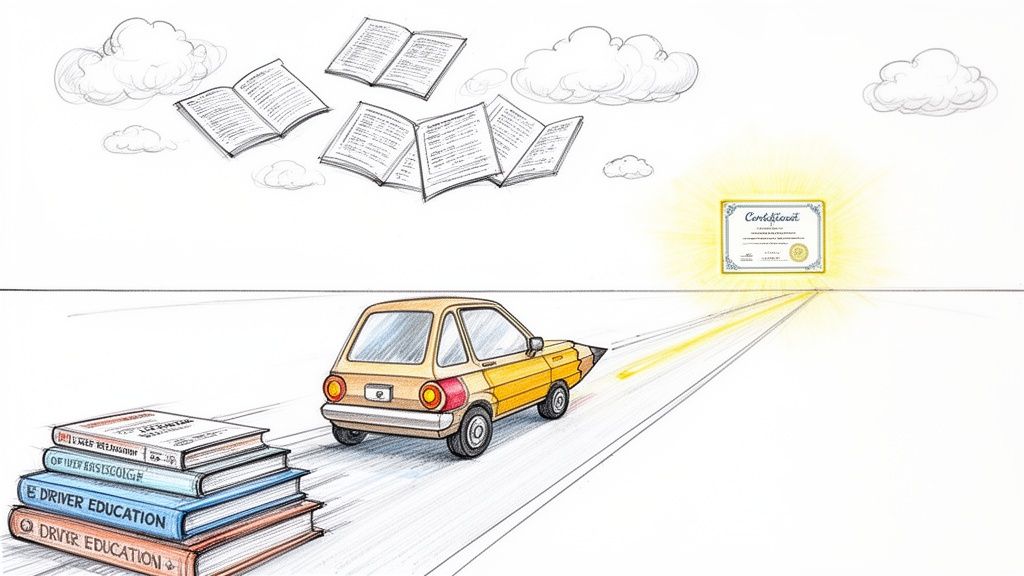
The "test" isn't a single, final exam you cram for. Instead, think of it as earning a certificate for completing a full driver education program. It's a required step for teens who want to get their license, put in place to build safe habits from the very beginning.
What Fulfilling Joshua's Law Actually Means
So, what does it take to meet the requirements? It boils down to a two-part educational journey. You need both classroom knowledge and real-world driving experience before you can get that Class D provisional license.
These aren't optional steps. Both are mandatory for teens aged 16 and 17 who want to drive.
- A 30-Hour Course: This is the classroom part, which you can do online or in person. The course has to be certified by the Georgia Department of Driver Services (DDS). It will walk you through traffic laws, defensive driving skills, and the real dangers of driving distracted or impaired.
- 40 Hours of Supervised Driving: This is where you put what you learned into practice. You'll need to log 40 hours of driving with a parent, guardian, or certified instructor. A critical part of this is that at least six of those hours must be at night.
This path ensures every new driver has a solid foundation. The flowchart below gives you a clear visual of how it works depending on your age.
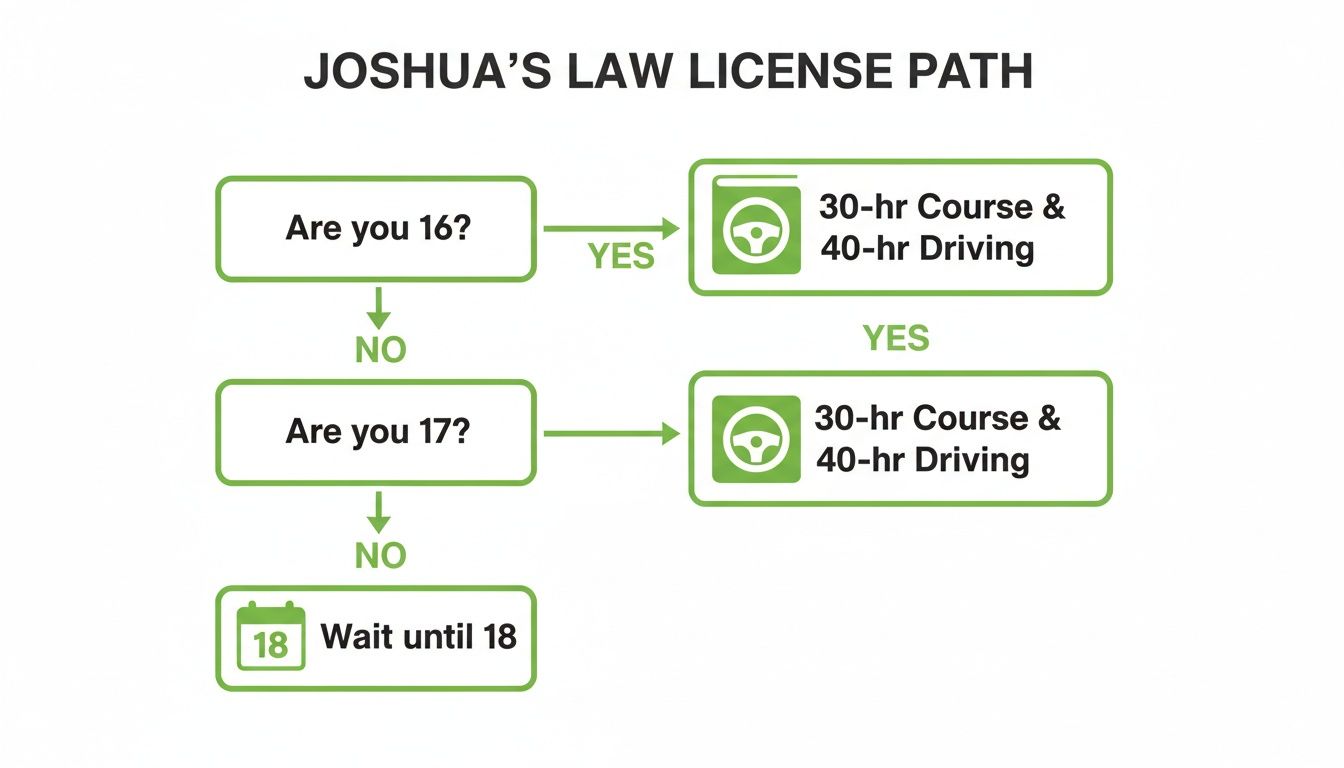
As you can see, the core requirements—the 30-hour course and 40 hours of supervised practice—are the same for both 16 and 17-year-olds.
Joshua's Law Requirements at a Glance
Even though the main educational pieces are the same, there are a few small differences depending on when you apply for your license. Knowing these details ahead of time will make the process at the DDS much smoother.
This table breaks down exactly what's required for each age group.
| Requirement | For 16-Year-Olds | For 17-Year-Olds |
|---|---|---|
| Learner's Permit | Must hold for 1 year and 1 day. | Must hold for 1 year and 1 day. |
| Driver's Ed Course | Mandatory: 30-hour DDS-approved course. | Mandatory: 30-hour DDS-approved course. |
| Supervised Driving | Mandatory: 40 hours total, with 6 at night. | Mandatory: 40 hours total, with 6 at night. |
| Road Test | Eligible to take the road skills test. | Eligible to take the road skills test. |
Of course, if you wait until you turn 18, you are no longer required to complete Joshua's Law. However, the training is still an incredibly valuable way to build confidence and stay safe on the road.
The key thing to remember is that you're not studying for one test. You're completing a program designed to make you a safer, more aware driver for life.
Ready to get started? You can learn more about our DDS-approved online Joshua's Law course and begin your journey to getting licensed today.
The Story Behind Joshua's Law and Why It Matters
Joshua's Law isn't just another rule on the path to getting your license. It’s a critical safety initiative born from a Georgia family's tragic loss, and understanding its story gives real meaning to every hour you spend learning to drive.
The law is more than just checking off boxes—it's about honoring a legacy and building a generation of safer, more aware drivers.

This law is named for Joshua Brown, a 17-year-old high school senior from Cartersville. In July 2003, his vehicle hydroplaned on a wet road during a storm, and he was killed in a single-car crash.
A Father's Mission for Safer Roads
After this devastating loss, Joshua’s father, Alan Brown, channeled his grief into a powerful mission. He knew his son's inexperience was a key factor in the accident and became a determined advocate for better driver education for Georgia's teens.
His goal was simple: prevent other families from going through the same heartbreak.
His tireless work led to Senate Bill 226, which Georgia's General Assembly passed in 2005. The legislation, which went into full effect on January 1, 2007, is what we now know as Joshua's Law. You can read more about its history in this detailed guide for teen drivers in Georgia.
Knowing this story changes everything. Your 30-hour course and 40 hours of supervised driving are about building the skills that Joshua Brown never had the chance to master.
This law is a living memorial to a young life lost too soon. Every teen who completes the program is not just earning a license; they are actively participating in a statewide effort to save lives and honor the memory of Joshua Brown.
More Than a Requirement—A Responsibility
The "Joshua's Law test" isn't a single exam. It's a commitment to learning the skills needed to handle the immense responsibility of driving.
The curriculum was built to address the biggest dangers for teen drivers, turning tragic statistics into preventable situations.
Structured Education: The 30-hour course is all about defensive driving, the dangers of impairment, and handling Georgia-specific hazards like sudden thunderstorms or tricky Atlanta interchanges.
Practical Experience: The 40 hours of supervised driving put you in real-world scenarios with an experienced driver right there to help. This includes six hours at night, building the muscle memory you need to make smart decisions in a controlled environment.
When you understand the why behind the law, driver's ed stops being an obstacle. It becomes a partnership between teens, parents, and instructors to build a foundation of safety that will last a lifetime.
Fulfilling the Joshua's Law requirements is your first step on that journey and a direct contribution to safer roads for everyone in Georgia.
Our DDS-approved online course instills these core safety principles while meeting every state requirement. Get started on the path to becoming a safe, confident driver by enrolling in our online Joshua's Law course today.
Your 30-Hour Joshua's Law Course
The first big step in satisfying Joshua's Law is completing the 30-hour educational course. This isn't just about learning road signs; it's designed to give you the critical knowledge for making smart, safe decisions behind the wheel.
The Georgia Department of Driver Services (DDS) gives you two approved ways to get this done: a self-paced online course or a traditional in-person class. Both teach the exact same state-required material, but the experience is very different. You just need to choose the one that works best for you.
Online Course vs. In-Person Classroom
For today's teens juggling school, sports in places like Marietta or Alpharetta, and a packed schedule, the online option is often a perfect fit. It lets you work from home, whenever you have time.
On the other hand, in-person classes offer a more structured setting. You get direct access to an instructor for instant feedback and can learn alongside other students.
Here’s a quick comparison:
| Feature | DDS-Approved Online Course | Traditional In-Person Classroom |
|---|---|---|
| Schedule | Very flexible; complete it anytime, from anywhere. | A fixed schedule with set class days and times. |
| Pacing | Self-paced; you control how fast or slow you go. | Instructor-paced; the entire class moves at the same speed. |
| Interaction | Interactive online modules, quizzes, and driving simulations. | Direct Q&A with your teacher and discussions with classmates. |
| Environment | Learn from the comfort of your own home. | A structured classroom without distractions from home. |
| Best For | Students who are self-motivated and have busy schedules. | Students who prefer structure and face-to-face interaction. |
No matter which path you take, the mission is the same: to give you the knowledge you need to handle the very real challenges of driving.
What the 30-Hour Course Teaches
The Joshua's Law curriculum was built to tackle the leading causes of car accidents involving teenagers. It goes way beyond basic traffic laws to instill a mindset of defensive driving and constant risk awareness. This is practical knowledge for surviving on Georgia's roads.
You will cover essential topics that every new driver needs to master:
- Defensive Driving Tactics: Learn how to anticipate what other drivers might do, keep a safe following distance, and spot potential dangers before they turn into emergencies.
- Consequences of DUI: The course breaks down the serious legal, financial, and personal fallout of driving under the influence of alcohol or drugs in Georgia.
- Dangers of Distracted Driving: You'll see the real-world results of texting, talking on the phone, or even eating while driving—a major cause of teen accidents.
- Managing Road Conditions: The course teaches you how to handle situations specific to Georgia, like hydroplaning in a sudden Cobb County thunderstorm or driving through thick fog in the North Georgia mountains.
Think of this 30-hour course as building your "driver's brain." It's the knowledge base that your 40 hours of supervised practice will turn into real-world skill and muscle memory.
For example, an online course might put you in a virtual simulation where a car suddenly pulls out in front of you on a street like Peachtree Road, forcing you to choose the right defensive move. In a classroom, an instructor might use a dangerous local intersection in Savannah or Augusta as an example to start a discussion about right-of-way and scanning the road.
This course is the first and most critical step in your driving journey. It provides the foundation for every decision you'll make on the road for the rest of your life. For a simple and effective way to get this done, check out our DDS-approved online driver's ed course in Georgia and start building your safety foundation today.
Mastering Your 40 Hours of Supervised Driving
Once you’ve finished the 30-hour course, it’s time to apply that knowledge on the road. The next step is to log 40 hours of supervised driving, with at least six of those hours happening after sunset. This is where theory meets reality, turning classroom lessons into real-world driving skills.
This isn’t just about putting in the time. This phase is designed to build your confidence and skill in a structured way. You'll start in simple, controlled environments and gradually move to more complex driving situations, all with an experienced adult by your side.
A Step-by-Step Training Plan
Breaking down the 40 hours into manageable steps is the key to success. The goal is to master one driving environment before moving on to the next, much like learning to swim by starting in the shallow end of the pool.
Here’s a practical plan to follow:
- The Safe Zone (Hours 1-5): Begin in a completely controlled area, like a large, empty parking lot. This is the place to get a feel for the car and practice the basics—accelerating, braking, turning, and parking—with zero traffic.
- Quiet Neighborhoods (Hours 6-15): Once you feel comfortable, move to quiet residential streets. Here, you can practice handling stop signs, watching for pedestrians, and holding a steady speed on roads with very little traffic.
- Moderate Traffic (Hours 16-30): Now it’s time to increase the complexity. Drive on busier city streets during off-peak hours. This is your chance to practice managing multiple lanes, navigating traffic lights, and safely driving with more cars around you.
- Highway Driving (Hours 31-40): The final step is tackling major highways like GA-400 or I-285. With your supervisor, you’ll master critical skills like merging into traffic, changing lanes at high speeds, and anticipating the actions of other drivers.
This progressive approach ensures you have a strong foundation before you face Georgia's most challenging driving conditions.
Tips for Success
The 40 hours are a partnership between the new driver and the supervising adult. A calm, supportive environment is essential for learning.
For the supervising parent or adult:
- Be Calm and Clear: Give instructions well in advance. Instead of a sudden "Brake!", try, "The light up ahead is turning red, so let's start to slow down."
- Give Constructive Feedback: Focus on one or two skills per driving session. Afterward, talk about what went well and what can be improved for next time.
For the teen driver:
- Ask Questions: If you’re ever unsure what to do, just ask. It’s always better to clarify than to make a mistake.
- Stay Calm: It's completely normal to feel nervous. If you get overwhelmed, ask your supervisor to pull over in a safe place so you can take a moment.
How to Log Your Hours
The Georgia DDS requires you to document all 40 hours of supervised driving. You can do this using the official DDS Parent/Teen Driving Guide, a dedicated app, or even a simple notebook. It’s critical that your log is accurate.
Your driving log is more than just a piece of paper—it's a legal document. When you and your parent sign the driving affidavit at the DDS, you are legally certifying that all 40 hours of driving, including the six nighttime hours, were completed.
For each entry, be sure to record the date, how long you drove, the time of day, and what skills you practiced. For example: "October 26th – 1 hour, 7-8 PM. Practiced merging on I-75 and driving in the rain."
Before you can start logging these hours, you must have a learner's permit. You can find everything you need to know in our guide on how to get your learner's permit in Georgia.
How We Help You Meet Joshua's Law Requirements
Getting a driver's license in Georgia can feel like a maze of rules and paperwork. We're here to clear things up and give you a straight path forward. Fulfilling Joshua's Law isn't just about checking a box; it's about building the skills for a lifetime of safe driving. Think of us as your guide from the very first lesson to the day you pass your road test.
For most teens, the best place to start is our DDS-approved online Joshua's Law course. It’s designed for busy schedules, letting you complete the required 30-hour educational component at your own pace. Whether you're in Atlanta or a quieter town like Cumming, our entire curriculum is available right from your computer.

The course covers every single topic the state requires, making sure you're ready for the Joshua's Law test and, more importantly, the real world.
We Take Safety Seriously
Here at Georgia DUI Schools, we’ve been teaching driver safety for over 38 years. Our background is in showing drivers the real—and often harsh—consequences of making bad decisions on the road, including through our state-certified Risk Reduction (DUI) courses.
We bring that same seriousness and real-world perspective to our teen driving courses. It’s what makes our program different. We don't just explain the rules; we explain why they exist.
- Understanding the Risks: We share lessons from our DUI programs to make the dangers of distracted or impaired driving crystal clear. It’s not just a lecture; it’s about showing the real legal and personal consequences.
- Driving Defensively, Not Reactively: We teach the same proactive, defensive driving skills we teach in our advanced Defensive Driving courses. Your teen will learn to spot and avoid trouble before it even starts.
By weaving these lessons in, we help new drivers build a mature, responsible mindset right from the start.
Our goal is simple: We want to help create a new generation of safe, smart, and responsible drivers who truly understand what it means to be behind the wheel.
Your Partner for the Whole Journey
Our help doesn't stop once the 30-hour course is done. We know that learning to drive safely is a process.
That’s why our other programs are a perfect follow-up. A Defensive Driving course, for instance, is a great next step for a newly licensed teen. It reinforces good habits and can even help lower insurance rates. These classes are also fantastic for parents who want to sharpen their own skills before supervising the 40 hours of practice driving.
From the first online class to mastering advanced driving skills, we have everything your family needs to build a foundation for safe driving. We’re here to be your trusted resource every step of the way.
Ready to get started? Our DDS-approved online course is the simplest and most effective way to meet your Joshua's Law requirement. Enroll in our proven online Joshua's Law course today and take the first step toward getting your license.
Preparing for Your Georgia Road Test
You’ve done the coursework and put in the hours behind the wheel. Now comes the final step: the Georgia road test. This isn't some surprise quiz; it's your chance to show the Department of Driver Services (DDS) examiner that you're a safe, confident driver.
Think of it as the moment to demonstrate all the skills you've worked so hard to master. The test covers everything from basic vehicle checks to specific on-the-road maneuvers.
The Pre-Test Vehicle Inspection
Before you even turn the key, the examiner will conduct a pre-test vehicle inspection. You have to show up in a car that's in good working order and legally registered.
If your vehicle fails this inspection, you won't be allowed to take the road test. It's a quick check, but it's critical.
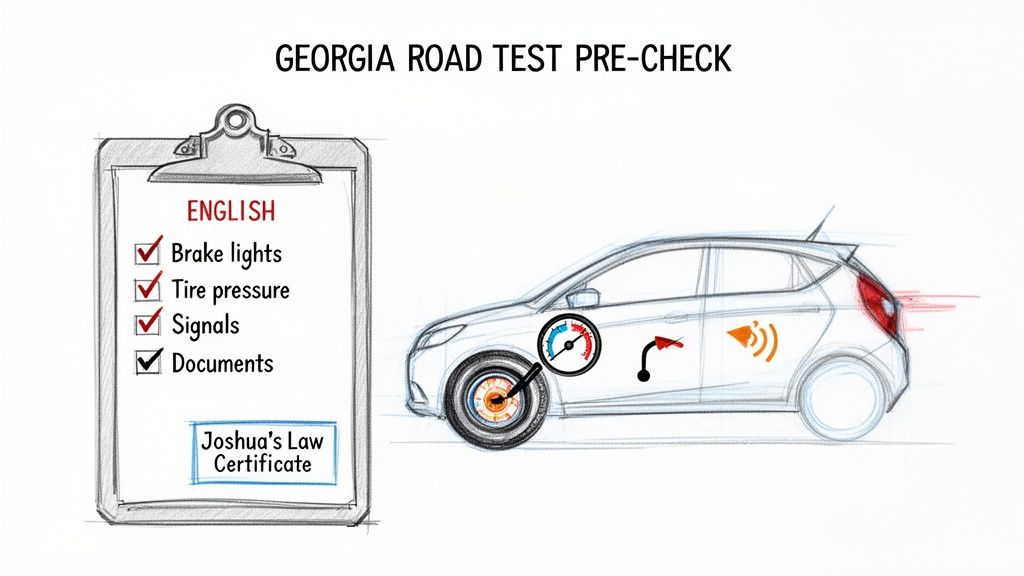
- Lights: Make sure your brake lights, headlights (both high and low beams), and all your turn signals work.
- Horn: The examiner will ask you to honk it.
- Tires: Your tires need to have good tread and be properly inflated. Bald tires are a no-go.
- Windshield: The windshield must be clean and free of any large cracks that block your view.
Passing this part shows the examiner that you understand vehicle maintenance is a core part of road safety.
Key Maneuvers on the Georgia Road Test
During the driving portion, you’ll be graded on how well you perform several key maneuvers. While the exact route can vary, you should be ready to handle these common tasks:
- Quick Stop: You’ll be asked to stop the car quickly and safely, proving you can react to a sudden hazard.
- Three-Point Turn: This shows you can turn the car around completely in a narrow space without hitting the curb.
- Parallel Parking: It makes a lot of people nervous, but with practice, it’s just a test of your spatial awareness and control.
- Backing Up: You will need to back up in a straight line for about 50 feet, looking over your right shoulder.
- Following the Rules of the Road: This is huge. The examiner is watching to see if you make complete stops at stop signs, yield correctly, and stay in your lane.
The most common reasons people fail aren't from a lack of fancy skills. It's the simple stuff. Running a stop sign, not yielding, or causing an accident are instant fails. Safe, predictable, and lawful driving is what they're looking for.
Essential Documents for Your Test Day
Showing up at the DDS without the right paperwork is one of the most frustrating ways to get sent home. Make a checklist and check it twice before you leave. You must bring:
- Your valid Georgia Learner’s Permit
- Proof of your school attendance or graduation
- Your Joshua’s Law Certificate of Completion from an approved course
- The signed Parent/Teen Driving Affidavit that confirms your 40 hours of supervised driving
- Proof of your vehicle’s registration and insurance
Managing test-day nerves is just as important. Get a good night’s sleep, have a decent meal, and get to the DDS a little early so you're not rushing. Remember, your coursework and all those hours of practice have prepared you for this. The road test is just your opportunity to prove it.
Don't forget, the test also covers your knowledge of road signs and traffic signals. For a good refresher, check out our guide on the Georgia road sign test, which will give you a big head start.
Frequently Asked Questions About Joshua's Law
We get it—even with a step-by-step guide, the details of Joshua's Law can still feel a bit confusing. Let’s clear up some of the most common questions we hear from teens and parents so you can head to the DDS with confidence.
Do I Have To Complete Joshua's Law if I Wait Until I'm 18?
No. The Joshua's Law requirements—the 30-hour course and 40 hours of supervised driving—only apply to teens aged 16 and 17. Once you turn 18, you are no longer required to complete the program to get your license.
But that doesn't mean you should skip it. A new driver of any age can benefit hugely from the defensive driving skills and risk awareness taught in a real driver's ed course.
Can I Use a National Online Course for Joshua's Law?
This is a big one, so listen up: No. This is a mistake that can cost you a lot of time and frustration.
Your 30-hour course must come from a provider that is officially certified by the Georgia Department of Driver Services (DDS). Plenty of national online driving courses don't have this specific Georgia certification.
If you use a non-certified course, the DDS won't accept your Certificate of Completion. You’ll have to do the entire 30 hours all over again with an approved school. Always, always check that your chosen provider is on the DDS-approved list before you pay for anything.
The proof is in the numbers. Since Joshua's Law was enacted in 2007, teen driver fatalities in Georgia have dropped by a staggering 60%. That translates to over 180 teenage lives saved every single year. You can learn more about the life-saving impact of this law in Georgia.
What Happens if I Don't Complete the 6 Nighttime Driving Hours?
The 6 hours of supervised nighttime driving are a non-negotiable part of the 40-hour requirement. When you and your parent sign that driving affidavit for the DDS, you are legally swearing that you completed every single required hour.
Not completing the night hours means you haven’t met the legal requirement for a Class D license. More importantly, it means you’re missing out on vital practice for dealing with low visibility, headlight glare, and other hazards that are common on Georgia's roads after dark.
At Georgia DUI Schools, we offer a DDS-approved online course that checks off the 30-hour educational requirement for Joshua's Law. We're here to give your teen the knowledge they need for a lifetime of safe driving. Enroll in our online Joshua's Law course today and get started.