
Got a few points on your Georgia license? You’re not alone, and the good news is you have options. The most straightforward way to clean up your record is by completing a state-approved Defensive Driving course.
This isn’t just about becoming a safer driver—it’s a strategic move. A Georgia DDS-approved course can knock up to seven points off your record, an option you can use once every five years. It’s the best tool you have to avoid a license suspension and maybe even keep your insurance rates from climbing.
Understanding the Georgia Driver’s Point System
Before you can tackle the points, you need to know how they got there. The Georgia Department of Driver Services (DDS) uses a point system to keep track of moving violations. Think of it as a running tab—every ticket adds points, and hitting the limit comes with serious consequences.
This isn’t just bureaucracy. For drivers age 21 and over, racking up 15 or more points within any 24-month period means an automatic license suspension. The DDS is always watching that rolling two-year window, starting from the date of each conviction.
How Different Violations Add Up
Not all tickets carry the same weight. The number of points you get is tied directly to how serious the violation is. A small mistake might only add a point or two, but a major one can push you dangerously close to that suspension threshold.
Let’s say you get caught going 20 mph over the limit on I-285. That’s 3 points. A few months later, you’re cited for an improper pass on a two-lane road in Athens—that adds another 4 points. Just like that, you’re at seven points, nearly halfway to losing your license.
To give you a better idea, here’s a quick look at how points are assigned for some common violations.
| Violation | Points Assigned |
|---|---|
| Aggressive Driving | 6 points |
| Unlawful Passing of a School Bus | 6 points |
| Reckless Driving | 4 points |
| Improper Passing on a Hill or Curve | 4 points |
| Following Too Closely | 3 points |
| Failure to Obey a Traffic Control Device | 3 points |
| Speeding (15-18 mph over) | 2 points |
| Speeding (19-23 mph over) | 3 points |
| Speeding (24-33 mph over) | 4 points |
| Speeding (34+ mph over) | 6 points |
As you can see, a few bad decisions behind the wheel can add up quickly. Understanding this math is the first step to protecting your driving privileges.
The Georgia point system is unforgiving, especially for younger drivers. For those under 21, getting a conviction for any single offense worth 4 or more points results in an immediate license suspension.
The Stricter Rules for Younger Drivers
The state holds drivers under 21 to a much higher standard. For them, it’s not about hitting that 15-point total. A single serious ticket can be enough to get their license suspended.
For example, a ticket for speeding 24 mph over the limit is a 4-point offense. For an 18-year-old, that one ticket triggers an automatic suspension. There’s no warning and no second chance.
The rules are even tougher for drivers under 18. If they accumulate just four points within any 12-month period, their license is suspended. This zero-tolerance approach is designed to make sure new drivers take safety seriously, whether they’re in Savannah or Gainesville. Knowing these rules is critical before you even think about how to get points off your record.
Your Best Option: Taking a Defensive Driving Course

For most Georgia drivers feeling the pressure of a few points on their record, a defensive driving course is the most direct and powerful tool you have. Think of it as more than just a refresher on road rules—it’s the state’s official method for point reduction.
By completing a course certified by the Georgia Department of Driver Services (DDS), you can wipe away up to seven points from your license. That’s a significant chunk.
This one proactive step can be the difference-maker, keeping your license active and avoiding a suspension. It’s the perfect fix if a couple of speeding tickets on I-75 have you worried. Just keep one critical rule in mind: you can only use this benefit once every five years.
Who Is Eligible for Point Reduction?
Not just anyone with points on their record can sign up and get them erased. The DDS has specific rules to make sure the program works as intended.
The main idea is that this is a preventative tool, not a last-minute fix. If you’ve already hit the 15-point mark and received a suspension notice, it’s too late to use the course to undo it. You have to act before you reach that critical point.
To be eligible, you generally need to meet these criteria:
- You must hold a valid Georgia driver’s license.
- You have not taken a defensive driving course for point reduction in the last five years.
- You must be taking the course voluntarily for point reduction, not because a judge ordered it for a specific ticket. (Though in some cases, it might satisfy both—always confirm with the court first).
Finding the Right Course Format for You
Long gone are the days of being forced into a stuffy classroom all weekend. DDS-approved providers like Georgia DUI Schools now offer flexible formats to fit just about any schedule or learning style. This makes it easier than ever to get it done without turning your life upside down.
You’ve got options:
- Self-Paced Online Courses: The perfect solution if your schedule is unpredictable. Log in and work through the material whenever you have a spare moment, day or night.
- Live Virtual Classes (Zoom): Want the structure of a classroom with the comfort of home? These instructor-led online sessions let you interact with the teacher and other students in real-time.
- In-Person Classroom Sessions: For those who learn best in a traditional environment, many schools still offer classic in-person classes at locations across the state, from Dalton to Valdosta.
Remember, this isn’t just about checking a box. The course arms you with practical defensive driving skills that can help you avoid future tickets and accidents. It’s a genuine investment in your safety.
The Point Reduction Process Step-by-Step
Once you’ve picked a course, the rest is simple. First, you’ll register and pay the fee. After you finish the required hours and pass the course, you’ll be issued a certificate of completion. Hold onto this—it’s your golden ticket.
Next, you need to submit that certificate to the DDS to officially request the point reduction. You can usually do this in person at a DDS customer service center or mail it in. Once they process it, they’ll credit your record, and up to seven points will disappear.
For a deeper dive into what these courses cover, check out the full benefits of defensive driving courses.
Georgia’s approach is right in line with other states that value driver education. California, for example, allows drivers to complete a similar course to dismiss a ticket and avoid a point, preventing insurance hikes for thousands. In 2023 alone, over 500,000 Californians used traffic school to manage their records, saving an estimated $200 million in insurance costs. You can learn more about how different states handle point reduction at MyImprov.com.
Handling Serious Offenses With a Risk Reduction Program
When you’re dealing with points from a minor traffic ticket, a defensive driving course is usually the answer. But for a DUI or other serious drug-related driving offense, the playbook is completely different.
In these cases, Georgia law doesn’t just suggest a course—it demands one. You’ll be required to complete a state-approved DUI/Risk Reduction Program. This isn’t an optional class to shave off a few points; it’s a mandatory step for getting your license back.
A conviction for Driving Under the Influence (DUI) automatically triggers a license suspension. To even start the reinstatement process, you have to enroll in and finish this program. The goal isn’t just about points; it’s about meeting a critical legal requirement from the court and the Georgia Department of Driver Services (DDS).
The Two Core Components of the Program
The DUI/Risk Reduction program is broken down into two mandatory parts. You have to finish both to get your Certificate of Completion.
First up is the Assessment Component. This is a 130-question evaluation that takes a look at your personal history with alcohol and drugs. You must complete the assessment before you can begin the classroom portion. It’s a foundational step that sets the stage for the intervention course.
Next is the 20-Hour Intervention Course. This is an instructor-led class, usually held over a weekend. The entire point is to educate you on the serious risks of driving under the influence and help you develop strategies to make better decisions down the road.
Completing the DUI/Risk Reduction program is how you directly address the consequences of a serious driving offense. It’s the state’s way of ensuring drivers who’ve made these mistakes truly understand the gravity of their actions before getting back behind the wheel.
Finding a State-Approved School Is Essential
You can’t just take this class anywhere. It absolutely must be done at a school certified by the Georgia DDS.
Providers like Georgia DUI Schools, with 18 locations across the state, are fully authorized to administer both the assessment and the 20-hour course. If you sign up for an unapproved program, it simply won’t count, and you’ll have wasted your time and money.
Once you’ve finished both parts, you’ll be issued an official DDS Certificate of Completion. This is the document you need to prove you’ve met the state’s requirement. You’ll have to present this certificate to the DDS to move forward with reinstating your license.
Navigating Beyond the Course
Sometimes, the Risk Reduction program isn’t the final step. Depending on the details of your case, the court or DDS might also require a Clinical Evaluation.
This is a separate, more in-depth assessment with a certified professional to see if you need further substance abuse treatment. You can learn more about what that process involves by reading about the Substance Abuse Professional (SAP) Program.
Georgia’s approach isn’t unique; it’s a proven system. For example, Germany uses a similar model where completing a risk reduction course is crucial for getting driving privileges back after a serious violation. For over 38 years, Georgia DUI Schools has helped more than 100,000 people navigate these exact requirements, proving just how important this education is for clearing records and keeping roads safe. You can learn more about global point systems and their effectiveness on Wikipedia).
Exploring Legal Avenues to Avoid Points
Taking a defensive driving course is a great way to handle points already on your record, but the best strategy is to stop them from ever getting there. When you get a traffic ticket, just paying the fine isn’t your only move—it’s an admission of guilt.
By going to court, you open up other options that could protect your driving record and keep your insurance rates down. For many minor violations, a little proactive effort can make all the difference.
Pleading Nolo Contendere or No Contest
Georgia has a unique plea called nolo contendere, which is Latin for “no contest.” Pleading nolo means you aren’t admitting you’re guilty, but you are accepting the conviction and agreeing to pay the fine. The biggest advantage? For most minor tickets, a nolo plea stops the Georgia DDS from adding points to your license.
But you can’t use it whenever you want. This plea has some serious limitations:
- You can only plead nolo contendere once every five years.
- It’s not an option for serious offenses like DUI, reckless driving, or aggressive driving.
- Drivers under 21 can’t use it to avoid points for any violation.
Think of it as a one-time pass for a small mistake. Say you got a ticket for following too closely in Cobb County. Using a nolo plea could prevent those 3 points from ever hitting your record, but you won’t be able to use that option again for another five years.
Negotiating with the Prosecutor for a Reduced Charge
Another smart move is to talk directly with the prosecutor, which usually happens on your court date before the judge calls your case. The goal here is simple: convince the prosecutor to reduce your ticket to a different offense that doesn’t carry any points.
This is a common practice in local courts, like the Macon-Bibb County Municipal Court. For instance, if you were ticketed for speeding 19 mph over the limit (a 3-point offense), you might negotiate to have it changed to a “Basic Rules Violation” or a lower-speed infraction with zero points.
Your driving history is your biggest bargaining chip here. A prosecutor is much more likely to cut a deal with someone who has a clean record than a driver with a history of violations.
To give yourself the best shot, show up to court early, dress like you’re taking it seriously, and be respectful to everyone. When you get a moment with the prosecutor, calmly explain what happened and show them your clean driving record. That simple conversation could be all it takes to keep your license clean.
However, for a serious offense like a DUI, negotiation isn’t on the table. The path to getting your license back is mandatory and non-negotiable.
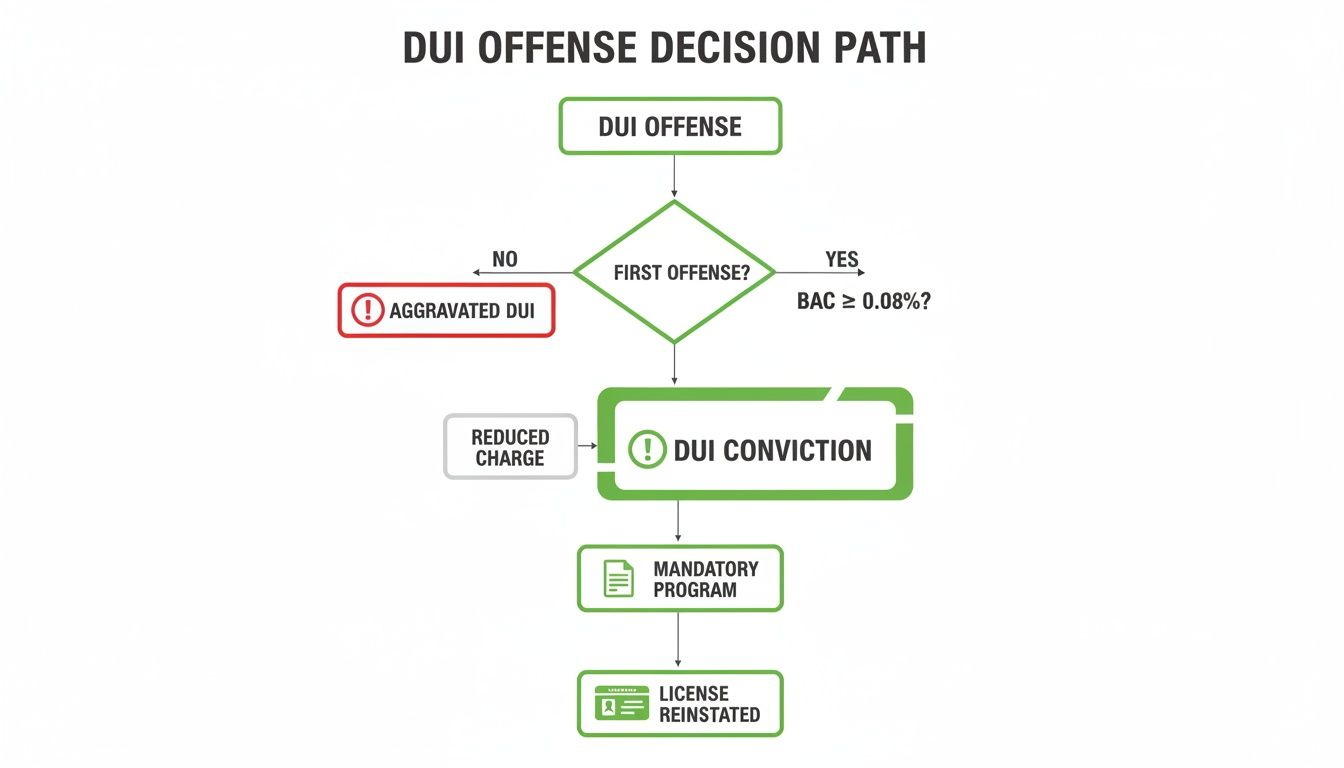
This flowchart shows that while you can often work something out for a minor ticket, a DUI conviction means you must complete a state-approved program to restore your driving privileges.
Preparing for Your Day in Court
If you decide to fight your ticket or negotiate a plea, walking in unprepared is a recipe for failure. A few simple steps can dramatically improve your odds.
Here’s a quick checklist to get ready:
- Get Your MVR: Before your court date, order your 7-year Motor Vehicle Report from the Georgia DDS website. A clean MVR is your best piece of evidence.
- Bring Any Proof: If you have photos, diagrams of the scene, or witness contact info that helps your case, bring it with you.
- Show Up Early and Dress Well: First impressions count. Show the court you’re taking this seriously.
- Be Polite and Patient: Courtrooms are chaotic. A respectful attitude toward the staff and prosecutor will only help you.
Putting in this extra effort takes more time than just mailing a check, but it’s worth it. Keeping points off your license saves you a fortune on insurance and gives you the peace of mind of a clean record. For serious violations, remember the path is set, and completing a course at a DUI/Risk Reduction School may be your only option.
Letting Time Work in Your Favor
Sometimes, the best strategy is simply to wait it out. If taking a course or heading to court isn’t in the cards for you right now, you can let the calendar do the work.
In Georgia, points on your driving record have an expiration date. They automatically fall off your record 24 months from the date you were convicted of the violation. So, a speeding ticket from May 10, 2024, will see its points vanish on May 10, 2026. This happens on its own—no forms to fill out, no one to call.
But don’t get too comfortable. This hands-off approach has a major catch that trips up a lot of drivers.
The Violation vs. The Points
Here’s something a lot of people don’t realize: the points disappearing is not the same as the violation being erased.
Even after those two years are up and the points are gone, the conviction itself stays on your official Motor Vehicle Report (MVR) for much longer. That means when your insurance company pulls your record, they still see that speeding ticket from three years ago. It might have zero points attached, but it can absolutely still affect your insurance rates.
Think of it this way: expired points save you from a DDS license suspension. They don’t hide the original offense from your insurance provider.
Is Waiting Always the Best Strategy?
Relying on time is free, but it’s a gamble. Let’s say you’re sitting at 12 points from a few different tickets. Waiting for them to expire one by one is risky business.
Any new ticket, even for a minor offense, could easily push you over Georgia’s 15-point limit and trigger an automatic license suspension. In a situation like that, being proactive is your best defense. Taking a defensive driving course can knock off up to seven points right away, giving you a safety buffer that patience alone just can’t provide.
So, how do these options really stack up? Let’s break it down.
Comparing Georgia’s Point Removal Strategies
Choosing how to handle points on your license depends entirely on your situation—your current point total, your budget, and how much risk you’re willing to take. This table compares the two main approaches.
| Method | Best For | Typical Timeline | Key Benefit |
|---|---|---|---|
| Defensive Driving Course | Drivers close to the 15-point limit or those wanting immediate insurance discounts. | 6 hours | Immediate point reduction and potential insurance savings. |
| Letting Points Expire | Drivers with few points and a clean recent history who are not at risk of suspension. | 24 months per violation | No cost or effort required; points eventually disappear. |
At the end of the day, waiting is a calculated risk. It can work if you only have a few points and feel confident you can drive perfectly for the next two years. For everyone else, taking control of the situation with a certified course is the smarter, safer move.
If you want to protect your license and possibly lower your insurance premiums now, enrolling in a DDS-approved course is the most reliable path. Learn more about our Defensive Driving courses and take control of your record today.
Common Questions About Cleaning Your Georgia Driving Record
Let’s tackle some of the most common questions Georgia drivers have about their driving records. Getting straight answers is the first step to confidently handling points and moving forward.
From checking your status to understanding what a defensive driving course really does, we’ll clear up the confusion.
How Can I Check the Points on My Georgia License?
If you want to know exactly where you stand, you need to pull your official Motor Vehicle Report (MVR). The only place to get the real deal is directly from the Georgia Department of Driver Services (DDS). You can request it right on the DDS website.
To get your MVR, you’ll need to have a few things handy:
- Your Georgia driver’s license number
- Your date of birth
- Your Social Security number
It costs a small fee, usually between $6 and $8, to download a certified copy. This report is your single source of truth—it shows every active violation and the exact number of points you have. Always start here before making any decisions.
Does a Defensive Driving Course Remove the Ticket from My Record?
This is a big one, and it’s a common point of confusion. The answer is no. In Georgia, completing a DDS-approved defensive driving course removes up to seven points from your total, but it does not erase the ticket or violation from your MVR.
Think of it this way: the course takes care of the immediate danger—the points that lead to suspension. However, the conviction itself remains on your record and is visible to insurance companies for several years.
The real benefits of the course are avoiding a license suspension and possibly getting an insurance discount. The ticket stays put, but the points associated with it will no longer count toward the 15-point suspension limit.
This is a critical distinction. While the course protects your driving privileges, the violation can still affect your insurance rates. If you’re trying to keep those costs down, check out our guide on how to lower car insurance rates.
My License Was Suspended for Points. What Do I Do?
If you’ve already hit 15 or more points and your license is suspended, there’s a specific path you have to follow. First, you must serve the full suspension period mandated by the DDS.
During or after the suspension, you’ll be required to complete a state-approved driver improvement program. This could be a Defensive Driving course for a standard point suspension or a DUI/Risk Reduction program if a DUI was involved.
Once you pass the course, you’ll get a Certificate of Completion. You’ll need to take that certificate to the DDS, pay the required reinstatement fees, and then you can officially apply to get your driving privileges back.
Can I Take a Georgia Course for an Out-of-State Ticket?
This gets a little tricky. Since Georgia is part of the Driver License Compact, most states share driver information. That means a ticket you get in Florida or Tennessee will likely get reported back to Georgia, and points will be added to your Georgia license.
Your first step should always be to contact the court in the state where you got the ticket. Ask them if they will accept a Georgia defensive driving course to dismiss the ticket or satisfy their requirements.
If they say no, you still have options. You can take a Georgia DDS-approved course to reduce the points on your Georgia license after they’ve been added. It won’t do anything for the out-of-state ticket, but it will help you manage your point total here at home.
Time to Take Control of Your Driving Record
Look, points on your Georgia license are more than just a number—they can directly hit your wallet through higher insurance rates and even put your driving privileges at risk. A couple of speeding tickets in Atlanta or a rolling stop in Augusta shouldn’t have to cause that much trouble.
The good news is you don’t have to just sit back and wait.
Enrolling in a Georgia DDS-approved defensive driving course is the single best way to get ahead of the problem. Sure, you can wait years for points to fall off your record, but that leaves you in a vulnerable spot if you get another ticket. Taking a class now is a proactive move that provides a buffer against a potential license suspension.
Think of it this way: cleaning up your driving record is an investment. It keeps you on the road legally, saves you real money on insurance, and honestly, it makes you a safer driver for everyone around you.
We get that you’re busy. That’s why our courses are designed to fit your life, with online, virtual, and in-person options available. Take the first real step toward a cleaner record and lower insurance bills.
Ready to clear up your MVR? Georgia DUI Schools offers the DDS-approved courses you need to get it done. Enroll in a Defensive Driving Course and protect your license today.