A letter from the court. A notice from DDS. A probation instruction that uses terms nobody explained. That is where a lot of Georgia drivers start.
If that is you, slow down and get organized. You do not need “some driving class.” You need the right state-approved course for the problem you have.
That distinction matters. A DUI case in Fulton County, a reckless driving order in Athens-Clarke, and a point problem after tickets in multiple counties do not send you down the same path. People lose time when they enroll in the wrong class, show up with the wrong paperwork, or assume any “ga drivers education courses” result will satisfy a court or DDS requirement. It will not.
I’ll be direct. If your issue involves DUI, drug possession tied to driving consequences, license reinstatement, point reduction, or a court order, skip the teen-driver chatter and focus on the remedial programs Georgia recognizes for adults. That means DUI Risk Reduction or Defensive Driving, and sometimes extra requirements such as a clinical evaluation or a Victim Impact Panel.
The good news is that Georgia’s process is structured. Once you identify which track applies to you, the next steps become manageable.
Navigating Your Path Back to the Road in Georgia
A common Georgia story goes like this. You got stopped in Atlanta, your case moved through court, and now you are holding paperwork that mentions classes, deadlines, reinstatement, or probation terms. Or maybe you live outside metro Atlanta, got a ticket in another county, and only realized the damage when DDS flagged your record.
That stress is real, but the path forward is usually simpler than people think.
The first thing I tell drivers is this. Do not guess. Georgia uses different courses for different legal problems. The class that helps one driver remove points will do nothing for another driver trying to satisfy a DUI-related requirement. The class that meets a court order for a non-DUI violation may not help with reinstatement after an alcohol or drug offense.
What most drivers need to know
For adults dealing with license trouble, the main question is not “What driver’s ed should I take?” It is one of these:
- DUI-related issue: Do I need the DUI Risk Reduction Program to satisfy court, probation, or DDS?
- Traffic violation issue: Do I need a Defensive Driving or Driver Improvement course for points, a judge’s order, or insurance savings?
- Extra compliance issue: Do I also need a clinical evaluation, treatment, or a Victim Impact Panel before I can move forward?
Tip: If your paperwork mentions DUI, alcohol, drugs, habitual violator status, reinstatement, or probation, do not enroll in a generic driver improvement class first. Confirm whether the state expects the DUI Risk Reduction path.
Georgia drivers from places like Atlanta, Athens, Marietta, Gainesville, and smaller rural counties all run into the same confusion. The county changes. The rules do not. Your job is to match the requirement to the course, complete it correctly, and keep every completion document.
Understanding Georgia's Two Main Driver Education Tracks
Most confusion around ga drivers education courses comes from one mistake. People lump every class into one bucket.
Georgia does not.
There are two main remedial tracks for adults, and they are not interchangeable. One addresses DUI and substance-related legal consequences. The other addresses broader traffic behavior, point reduction, and some court orders for non-DUI violations.
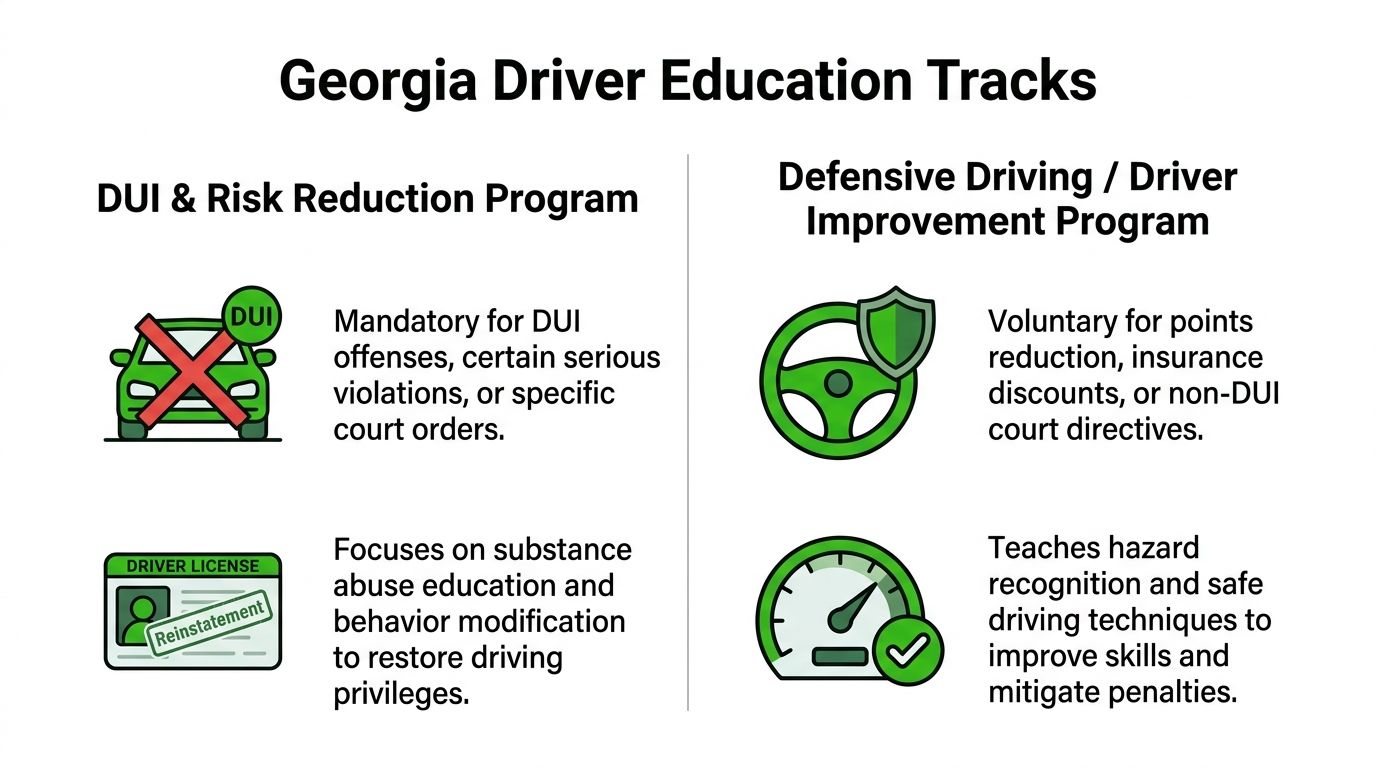
DUI Risk Reduction is the compliance track
If your case involves alcohol or drugs, this is usually the course that matters.
Think of DUI Risk Reduction as a targeted intervention. Courts and DDS use it when a driver’s issue is not just bad driving technique, but decision-making tied to substance use and public safety. This is the class tied to DUI consequences, some drug-related cases, and many reinstatement situations.
It is not optional when it is ordered. It is not interchangeable with defensive driving. And it is often only the first item on a larger compliance checklist.
A driver in DeKalb County with a DUI and a suspended license is dealing with this track. A driver in Hall County trying to clear a probation condition after a substance-related offense is likely dealing with this track too.
Defensive Driving is the record-improvement track
Defensive Driving, often called Driver Improvement, serves a different purpose.
This course is used when a driver needs to improve the driving record, respond to a non-DUI court directive, or seek insurance benefits recognized by the insurer. It is often the practical choice for people with speeding, reckless driving, or point-related concerns.
This track is more flexible. Some drivers take it because a judge ordered it. Others take it before points stack up. Others are focused on insurance costs and want a recognized course on file.
Side-by-side comparison
| Course type | Best fit | Typical reason |
|---|---|---|
| DUI Risk Reduction | DUI or substance-related case | Court order, probation term, reinstatement path |
| Defensive Driving | Non-DUI traffic issue | Point reduction, court order, insurance recognition |
Do not mix them up
I see the same bad assumption all the time. A driver hears “state-approved class” and signs up for the first course with weekend availability. That can waste days or weeks.
Use this simple rule:
- Alcohol or drug offense involved: Start by verifying whether DUI Risk Reduction is required.
- No DUI, but points or a traffic citation problem: Defensive Driving is usually the right lane.
- Court paperwork is unclear: Call the clerk, probation officer, or DDS before paying for anything.
Key takeaway: DUI Risk Reduction is about legal compliance after a substance-related problem. Defensive Driving is about improving your record and reducing future consequences from non-DUI violations.
The Georgia DUI and Risk Reduction Program Explained
If you have a DUI-related requirement in Georgia, stop searching broadly for ga drivers education courses and zero in on the DUI Risk Reduction Program. That is the program courts, probation officers, and DDS usually care about in these cases.
This course is not ordinary driver training. It is a state-regulated remedial program built for drivers whose conduct raised substance-use concerns or triggered serious legal consequences.
Who usually needs this program
In practical terms, this course often applies to drivers dealing with:
- A DUI case: First-time or repeat situations where the court, probation, or DDS requires completion
- A drug-related driving consequence: Some cases involving possession or related charges can trigger similar requirements
- License reinstatement steps: Drivers trying to restore driving privileges after a suspension or revocation often start here
- Habitual violator complications: If DDS has flagged you as an habitual violator, this program may be one piece of a larger reinstatement process
A driver in Atlanta may need it after a DUI arrest. A driver in a smaller county may not realize the requirement matters until DDS refuses to clear the license issue. Either way, the fix starts with the same principle. Complete the exact state-approved program, then address the rest of the checklist.
What the program includes
Georgia’s DUI Risk Reduction path has two core parts:
- The NEEDS Assessment
- The classroom component
The assessment comes first. Then you complete the class. That sequence matters.
The class itself is not just about road signs and traffic laws. It focuses on risk awareness, impaired driving behavior, and decision-making. If your goal is reinstatement or court compliance, you need to complete the full process exactly as required.
The course is often only one piece of the case
The course is often only one piece of the case. Drivers get blindsided when they finish the class and assume they are done.
Often, they are not.
Depending on your court order, probation terms, or DDS file, you may also need:
- A clinical evaluation
- Recommended treatment after that evaluation
- A Victim Impact Panel
- Additional reinstatement paperwork or fees through DDS
- Proof submitted within a deadline set by the court or probation
That is why it helps to understand the bigger compliance picture, including related services such as the SAP program in Georgia, when treatment or evaluation issues overlap with your driving case.
Tip: Ask one direct question before you register. “Is the DUI Risk Reduction course the only thing I need, or do I also need an evaluation, treatment, a Victim Impact Panel, or other reinstatement steps?”
Access is broader than it used to be
Provider options have changed. Georgia moved from a system built around traditional in-person schools to one that now includes many virtual options across the state. A news report summarizing a state audit noted that the older model included around 280 traditional brick-and-mortar schools and 150 high-school based programs, while today dozens of virtual providers expand access across Georgia’s 159 counties (Georgia audit coverage).
For adults balancing work, court dates, probation reporting, and transportation problems, that matters. Someone in Athens, Macon, Augusta, or a rural South Georgia county can often find a compliant option without driving across the state.
What to do first
If your case is DUI-related, your order of operations should be strict:
- Read the court or DDS notice carefully
- Confirm you need DUI Risk Reduction, not Defensive Driving
- Ask whether extra services are required
- Register only with a state-approved provider
- Keep your completion proof and submit it where required
That is how you move from panic to progress.
Leveraging Defensive Driving for Points and Insurance
Defensive Driving is the practical Georgia course for adults who are dealing with points, a non-DUI court order, or an insurance problem.
If you are not on the DUI Risk Reduction track, this is usually the course to consider first. It can help you limit the damage from a traffic case, satisfy a judge in the right type of case, and strengthen your position when an insurer reviews your record. That makes it one of the few Georgia driver education options that solves more than one problem at once.
Where this course helps most
The value is easiest to see in real situations.
An Athens driver gets cited in metro Atlanta and now has points to worry about. A judge orders a driver improvement course after reckless driving or another serious non-DUI offense. A commuter with an otherwise decent record wants every legitimate chance to reduce insurance costs. In each of those situations, Defensive Driving may help, if the course is state-approved and accepted for that purpose.
I tell drivers to treat this course like a legal tool, not a formality. The right class can support a point reduction request, satisfy a court requirement in the right case, or help with insurer-related savings. The wrong class, or the wrong provider, wastes your time and money.
Why I recommend taking it seriously
Good defensive driving instruction changes habits that lead to citations. It teaches better following distance, speed control, scanning, lane decisions, and response to common crash patterns. That matters in Atlanta traffic, college-town congestion in Athens, and rural Georgia roads where one impatient move can turn into a serious charge.
If insurance is one of your goals, read how a defensive driving course can lower insurance. Focus on carrier acceptance and state approval. Those two details matter more than flashy marketing.
What this course will not do
Defensive Driving does not replace DUI Risk Reduction. If your case involves DUI, drug-related driving, reinstatement tied to a DUI case, or a Habitual Violator issue connected to alcohol or drugs, you need the exact program the court, probation office, or DDS requires.
It also does not erase the ticket itself. It is used for a specific benefit under Georgia rules, court instructions, or insurer policies.
Key takeaway: If your case is non-DUI and you need one course that can help with points, court compliance, or possible insurance savings, Defensive Driving is usually the smartest choice.
Your Step-by-Step Guide to Course Completion
You get pulled over, the case moves faster than expected, and now you have a deadline from the court, probation, or DDS. That is when drivers start searching for "driver's ed" and end up looking at the wrong classes. In Georgia, that mistake costs time.
Use this process instead.
Step 1 Verify the provider before you pay
Start with approval status for the exact course named in your paperwork.
A school may offer Defensive Driving and not be approved for DUI Risk Reduction. Another may advertise "traffic school" without making clear which Georgia requirement it satisfies. If the provider cannot clearly state the state-approved program you need, do not register.
This one decision prevents the most expensive mistake.
Step 2 Match the class to the legal problem
Do not guess. Match the course to the reason you need it.
- DUI, drug-related driving, license reinstatement tied to DUI, Habitual Violator issue, probation requirement: DUI Risk Reduction
- Speeding, reckless driving, point reduction goal, many non-DUI court orders, possible insurance review: Defensive Driving
- Unclear order or vague wording: call the court, probation office, your lawyer, or DDS and ask for the exact course title
Georgia does not treat "driver's ed," "traffic school," and "risk reduction" as interchangeable. Your paperwork controls.
Step 3 Choose a format you will finish
Pick the class based on completion, not preference.
If you need structure, book a classroom or live virtual session. If transportation is a problem or your work schedule changes every week, choose an approved option that removes those obstacles. Drivers who wait for the ideal weekend usually create their own deadline crisis.
A simple rule works here. The best format is the first approved one you can complete on time.
Step 4 Register early and bring the right documents
Have your identification, court papers, case information, and license details ready before you sign up. Providers cannot fix missing paperwork after the fact if your court date is already close.
Tell the school about any deadline on day one. They cannot waive a legal requirement, but they can tell you whether their schedule fits your case.
Tip: If your hearing, probation check-in, or reinstatement deadline is near, register now. Last-minute enrollment is one of the main reasons drivers miss compliance dates.
Step 5 Complete every required part of the program
Show up on time. Stay for the full session. Follow the provider's instructions exactly.
For DUI Risk Reduction, that usually means completing both the assessment and the class portion under Georgia rules. For Defensive Driving, expect focused instruction on judgment, hazard recognition, spacing, speed control, and the habits that lead to repeat citations. As shown in Georgia highway safety data, approved driver improvement programs are tied to better outcomes for many participants. That is one reason courts and agencies keep using them.
Treat the course like a legal requirement first and a learning opportunity second. That mindset keeps you from making careless mistakes that delay completion.
Step 6 Secure your completion certificate
Your certificate is the proof that matters.
Save it immediately. Keep a digital copy and a paper copy if you receive one. Then send it to the office that needs it, whether that is the court, probation, DDS, your attorney, or your insurance carrier.
Do not assume anyone else filed it for you. Confirm receipt.
Step 7 Finish the rest of the case
For some drivers, the class closes the issue. For others, it clears only one barrier.
| Situation | What may still be needed |
|---|---|
| DUI case | Clinical evaluation, treatment, Victim Impact Panel, DDS reinstatement steps |
| Court-ordered non-DUI case | Filing proof with the court before the deadline |
| Insurance-focused completion | Sending the certificate to the carrier and confirming eligibility |
Course completion gets you back in motion. Finishing the paperwork gets you to the end.
Unlocking the Benefits of Your Completion Certificate
Your completion certificate is not just a receipt. It offers an advantage.
When drivers finish a required course and then let the certificate sit in an email or glove box, they miss the whole point. In Georgia, that document is often the piece that moves your case, your record, or your insurance file forward.
For reinstatement and court compliance
If your issue is tied to DUI or another court-directed matter, the certificate proves you completed the assigned educational step. That does not always restore the license by itself, but it clears one major barrier.
For many drivers, this is the difference between staying stuck and being able to move on to DDS reinstatement requirements, probation sign-off, or the next legal condition in the case.
For points and driving record relief
When Defensive Driving is used for record management, the certificate has practical value because it supports the point-reduction process where allowed. This is one reason I tell drivers not to wait until points are already causing major trouble.
A completed, recognized course puts you in a better position than a promise to “drive more carefully from now on.” Courts, DDS, and insurers care about documented action.
For insurance savings
People hear half-truths about this.
Yes, many providers mention insurance discounts. No, not every discount works the same way. The important detail is that recognition depends on your carrier and whether that carrier accepts the specific DDS-approved course and format you completed. Georgia rules-related guidance summarized in the verified material notes that these discounts can average $200 to $400 annually when the insurer recognizes the course (Georgia course rules context).
That means your certificate becomes useful only if you use it correctly.
How to use the certificate with your insurer
Do this in a clean, simple order:
- Call your insurance company
- Ask whether they recognize your completed DDS-approved course
- Confirm whether online, virtual, or in-person format matters
- Send the certificate exactly how they request it
- Ask when the premium review will be reflected
This is especially important for older drivers and busy professionals shopping for savings. Provider choice can affect ROI because insurer recognition is not always explained clearly before enrollment.
Tip: Ask your insurer about course recognition before you register, not after. That one phone call can save you from taking a class that helps legally but does nothing for your premium.
Treat the certificate like a permanent record
I tell drivers to keep the certificate with the same care they would give a court order.
- Store a digital copy
- Keep a paper copy
- Note the completion date
- Track where you submitted it
- Save any confirmation from the court, DDS, or insurer
The certificate is the proof that your time and money produced a result. Use it.
How to Choose the Right State-Approved Provider
Provider choice matters more than most drivers realize. The wrong school can cost you time, create filing problems, or leave you with a certificate that does not help the way you expected.
Start with one standard. State approval comes first. If the provider is not approved for the exact course you need, stop there.
What to compare before you enroll
Use this checklist, not marketing copy.
Approval and course type
Make sure the provider is approved for the specific program, not just “driving classes” in general.
A DUI case requires a different approval path than a Defensive Driving course. If you need one and enroll in the other, the mistake is yours to fix.
Format that matches your schedule
Some drivers need classroom structure. Others need live virtual attendance. Others need online flexibility because they work weekends, travel for work, or live far from a physical site.
That choice is not trivial. For many Georgia drivers, especially older adults and busy professionals focused on savings, there is still a real information gap around which provider formats qualify for insurance recognition. That makes provider selection a financial decision, not just a convenience decision, as noted in guidance discussing this gap for Georgia driver education consumers (Georgia provider and insurance gap).
Extra services under one roof
If you are on the DUI side, convenience matters. A provider that only offers the class may still leave you scrambling for an evaluator, treatment referral, or a Victim Impact Panel.
That is why many drivers look for a school that also supports related compliance steps. If you are comparing options for online learning, review Georgia drivers ed online options carefully and confirm which courses are relevant to adults with court or DDS requirements.
A practical way to choose
| What to check | Why it matters |
|---|---|
| DDS approval | Confirms the court or DDS can recognize completion |
| Correct course category | Prevents enrolling in the wrong program |
| Online, virtual, or in-person options | Helps you finish on time |
| Locations near Atlanta, Athens, or your county | Reduces travel and missed sessions |
| Clinical services if needed | Simplifies DUI-related compliance |
The best provider is not the one with the loudest ad. It is the one that is approved, clear, organized, and realistic about what your case requires.
Take Control and Complete Your Requirement Today
If you are stuck in the Georgia system right now, the answer is not to keep searching random ga drivers education courses and hoping one sounds right. The answer is to identify your track and complete the exact state-approved requirement.
If your issue is DUI, drug-related, reinstatement, or habitual violator status, focus on DUI Risk Reduction and confirm whether you also need a clinical evaluation, treatment, or a Victim Impact Panel.
If your issue is points, a non-DUI court order, or insurance savings, focus on Defensive Driving and make sure the provider and format match your goal.
That is the formula. No guessing. No wasted enrollment. No last-minute panic before court.
Drivers in Atlanta, Athens, and across Georgia get through this every day. The ones who move fastest do three things well. They verify approval, enroll in the correct course, and keep proof of completion.
Do that, and you put yourself back in control.
If you need a state-approved next step right now, start with Georgia DUI Schools for the course that most often matters in DUI, reinstatement, and court-compliance cases.