Taking your Georgia driver's road test is a huge milestone, but it's easy to feel overwhelmed. I’ve seen it countless times—the biggest hurdle isn't the driving itself, but showing up unprepared. Knowing exactly what to expect and what to bring to the Department of Driver Services (DDS) is the secret to passing on your first try.
Your Game Plan for the Georgia Driver's Road Test
Walking into the DDS for your road test doesn't have to be stressful. Having a solid plan makes all the difference, whether you're a teen driver in Atlanta, a new resident in Savannah, or just getting your license back. It all comes down to a few key things: making sure you're eligible, gathering the right paperwork, and picking the right test for you.
First, you have to meet the state's age and licensing requirements. For most new drivers, that means you've held a learner's permit for the required time. If you're still working on that part, our guide on how to get your learner's permit in Georgia walks you through every step.
Here's a quick summary to help you get organized.
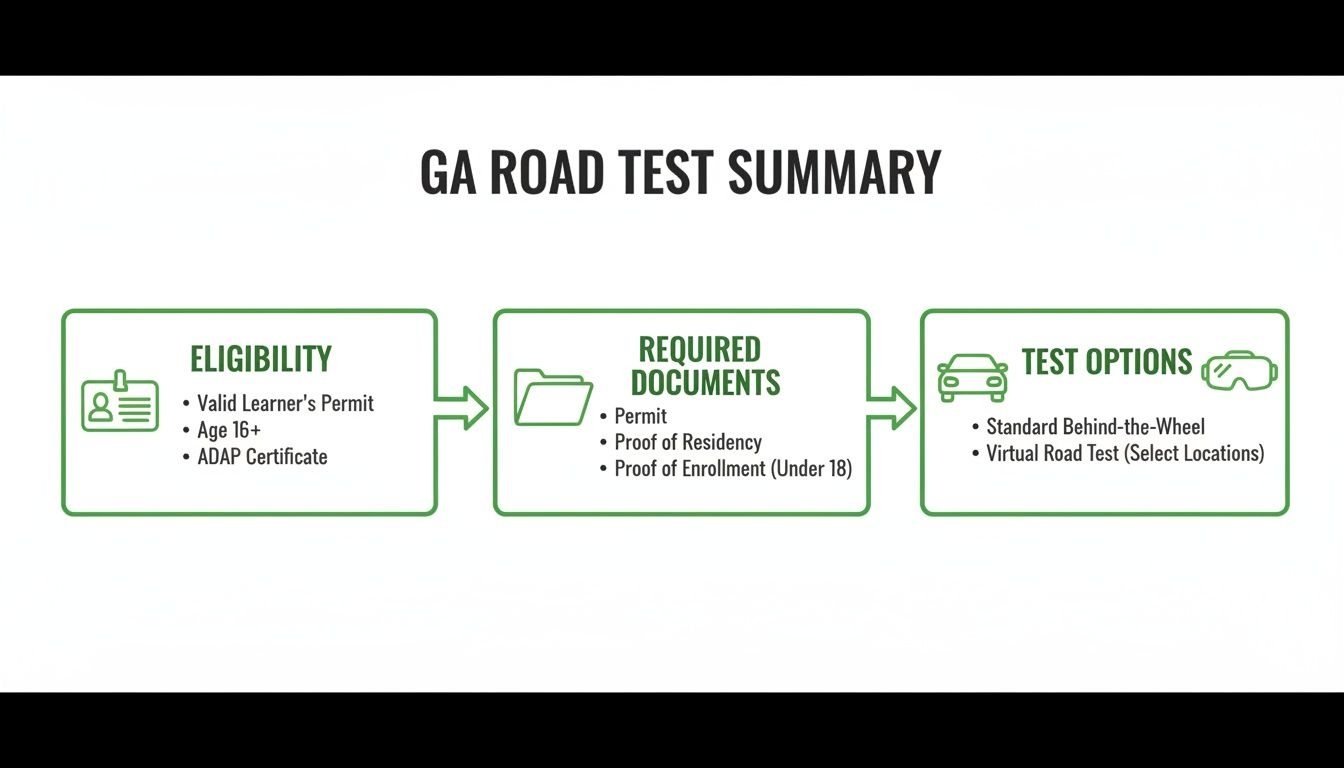
Think of it this way: nail down your eligibility, get your documents in a folder, and decide which test format you want to take. That's half the battle won right there.
Georgia Road Test At a Glance
This table breaks down the key things you need to know before scheduling your road test.
| Requirement | Key Details |
|---|---|
| Test Options | Traditional in-person test or the Virtual Road Test (VRT). |
| Age | At least 16 years old for a Class D license. |
| Learner's Permit | Must have held a valid learner's permit for one year and one day. |
| Driver's Ed | Required for 16 and 17-year-olds (Joshua's Law). |
| ADAP Certificate | Alcohol and Drug Awareness Program certificate required for teens under 18. |
| Accompanying Driver | A licensed driver 21 or older must be with you. |
| Vehicle | Must have valid registration and insurance for the test vehicle. |
These are the non-negotiables. Double-checking this list before you go will save you from getting turned away at the DDS.
Understanding Your Test Options
One of the biggest choices you'll make is between the traditional road test and Georgia's newer Virtual Road Test (VRT). With the traditional test, a DDS examiner sits in the passenger seat and gives you directions. It’s the classic setup most people picture.
The VRT, on the other hand, lets you use your own car with a licensed driver over 21 next to you. The examiner watches remotely through a camera and gives instructions on a hands-free device. This option has become incredibly popular, from the busy DDS centers in Macon to smaller towns across the state.
For many people, the Virtual Road Test (VRT) is a total game-changer. Testing in your own familiar car with someone you know beside you helps cut down on the anxiety that causes simple mistakes.
The numbers don't lie. Between January 1, 2022, and June 1, 2026, a whopping 166,658 drivers took the VRT, and they passed with an impressive 92% success rate. By 2023, the VRT already made up 75% of all road tests in Georgia.
Eligibility and Documentation: Don't Get Turned Away
No matter which test you pick, your paperwork has to be perfect. Forgetting even one document means you're not taking the test that day, plain and simple.
Here’s a quick checklist of the must-haves:
- Your ID: A current Georgia Learner's Permit.
- Car Paperwork: Valid vehicle registration and proof of insurance for the car you'll be using.
- A Licensed Driver: Someone 21 or older with a valid license has to come with you.
If you're under 18, you’ll also need your Alcohol and Drug Awareness Program (ADAP) certificate and proof that you completed a certified driver's ed course. Take a few minutes to check the official DDS website before your appointment to make sure you have everything. Getting it all together ahead of time lets you focus on what really matters—your driving.
Ensuring Your Vehicle Is Test-Ready
Showing up to your Georgia road test with a car that isn't up to snuff is probably the most frustrating way to get an automatic fail. If your vehicle doesn't meet basic state safety standards, the DDS examiner won't even let you turn the key.
This inspection happens first thing. An examiner in Atlanta, Savannah, or anywhere in between will walk around your car with a clipboard. If they spot a single problem, your test is over. It’s a simple pass/fail, so a thorough check beforehand is a must.
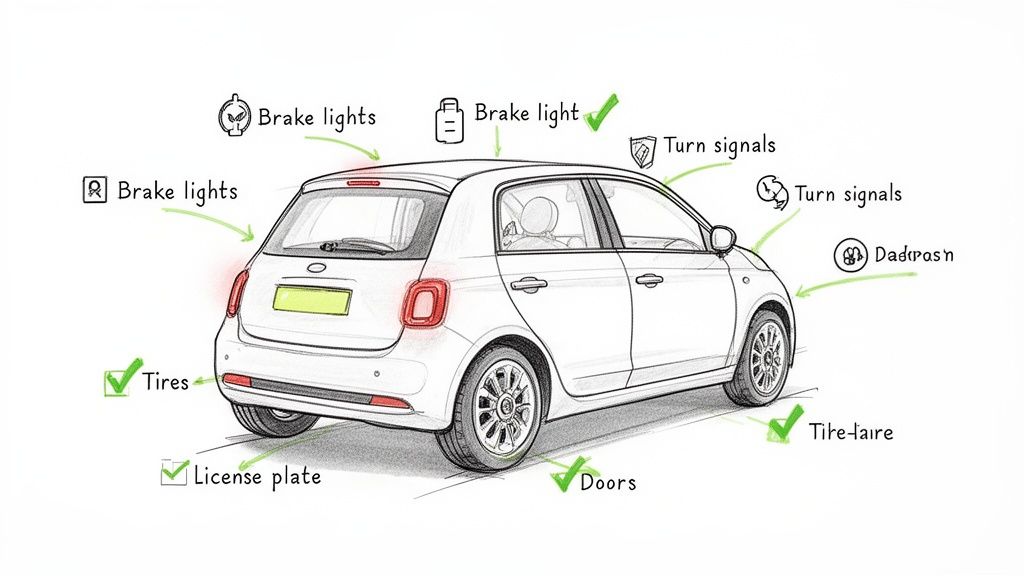
The Non-Negotiable Safety Inspection
Before you even worry about practicing your parallel parking, you need to do your own mini-inspection. Grab a friend or family member to help you check your lights while you sit inside the car. A quick five-minute check can save you another trip to the DDS.
Here's exactly what the examiner will look at:
- Brake Lights: Both main brake lights must work, and so does the third one that's usually in the rear window.
- Turn Signals: Check your front and rear signals on both the left and right sides. They have to blink correctly.
- Headlights and Taillights: Make sure they all turn on.
- Horn: Give it a quick honk to be sure.
- Tires: They need to have enough tread and be properly inflated. A bald tire is an instant fail.
- Windshield: The glass can't have any cracks that get in the driver's way of seeing the road.
These are the big ones, but the examiner is trained to spot other issues that could make the vehicle unsafe for a drivers road test in GA.
Beyond the Basics: What Else Examiners Look For
While lights and tires are pretty obvious, there are a few other things that can get you sent home. Examiners are meticulous because they're responsible for everyone's safety during the test, so they'll check things you might not think about.
For example, every door needs to open and close correctly from both the inside and the outside. The examiner must be able to get out fast in an emergency. The passenger-side seatbelt also has to be in perfect working order.
A clean, clutter-free car is more than just polite—it shows the examiner you take safety seriously. Anything blocking your view or loose items that could roll under the brake pedal are major red flags.
And look at your dashboard. Are any warning lights on? An illuminated "Check Engine" or "Airbag" light is a guaranteed fail. These lights point to problems that make the car ineligible for the test.
Final Vehicle Prep Checklist
Put yourself in the examiner's shoes and run through this list the day before your test.
Exterior Checks:
- License Plate: Is it clean, readable, and attached securely?
- Windows and Mirrors: Make sure all windows are clean and the side mirrors are intact and can be adjusted.
- Wipers: Your windshield wipers need to be in good shape.
Interior Checks:
- Cleanliness: The car should be reasonably clean and free of trash.
- Emergency Brake: Check that your parking brake engages and disengages properly.
- Registration and Insurance: Have your current, valid proof of registration and insurance out and ready. Don't make the examiner wait while you dig through your glove box.
Failing the vehicle inspection is a totally avoidable mistake. Taking 15 minutes to go through these checks ensures your car is ready, so you can focus on what really matters: showing off your safe driving skills.
If you find it's your skills that need some work, a defensive driving course is a great way to get ready for your next attempt. Our DDS-approved online and in-person defensive driving courses cover the exact maneuvers examiners look for, helping you build confidence behind the wheel.
Mastering the Core Driving Maneuvers
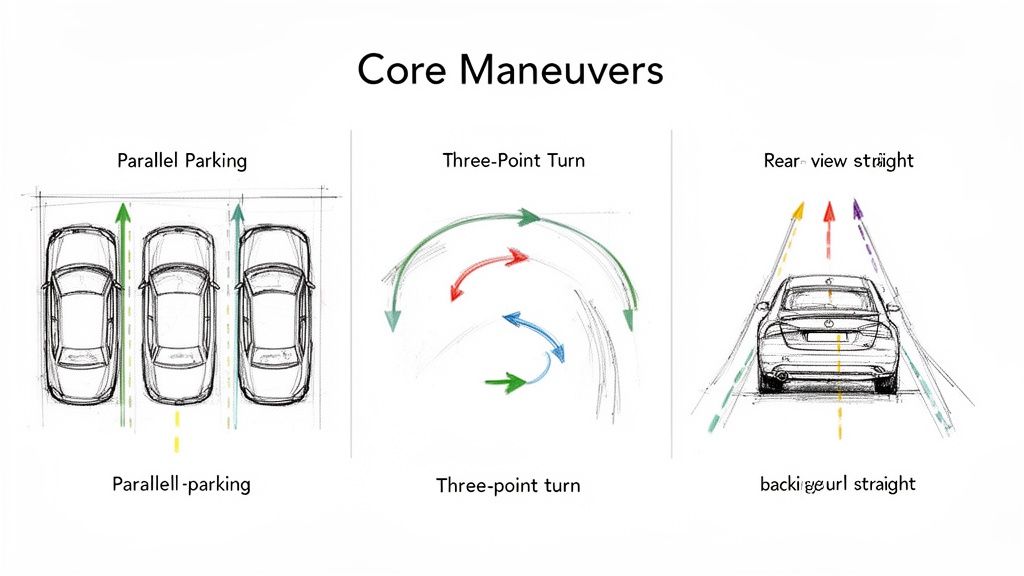
Passing the drivers road test in GA isn’t just about following traffic laws. It's about proving to the DDS examiner that you have total, confident control of your vehicle. They need to see you can handle a series of specific maneuvers safely and smoothly.
These aren't just random exercises; they test your spatial awareness and ability to follow directions under pressure. While they might feel a little intimidating at first, they become second nature with the right practice. Nailing these skills is your direct ticket to a passing score.
Straight Line Backing
One of the first things you'll probably do is back the car in a straight line for about 50 feet. Sounds easy, right? It’s a common spot for new drivers to slip up. The examiner wants to see you control the vehicle in reverse without weaving all over the place.
Here's how to do it right: place your right hand on the back of the passenger seat and turn your whole body to look directly out the rear window. Your left hand should stay at the 12 o'clock position on the wheel for small, gentle corrections. Don't rely on your mirrors—the examiner wants to see you are physically looking where you're going.
Think of it this way: you're in a packed parking garage in downtown Athens and have to back out without nicking the cars on either side. That’s the kind of steady control they’re looking for.
The Three-Point Turn (Turnabout)
Next up is often the three-point turn, also known as a turnabout. This move tests your ability to turn the car around completely in a narrow space. It's a vital skill for getting out of a dead-end street or fixing a wrong turn without causing a scene.
Executing it perfectly comes down to a clear sequence of actions:
- Pull Over: Signal right, pull over to the side of the road, and come to a complete stop.
- First Turn: Signal left, check for traffic, and turn the wheel hard to the left. Creep forward until you’re near the opposite curb.
- Reverse: Shift to reverse and crank the wheel all the way to the right. Check for traffic again, then back up just enough to give yourself room to pull forward.
- Finish: Shift into drive, straighten the wheel, and drive away.
Notice a pattern? Every step requires you to check your mirrors and blind spots. The examiner is watching for constant awareness.
Parallel Parking
Ah, the one everyone dreads. But parallel parking is just a simple, repeatable process. The secret is to identify your reference points on the car and practice until the motions feel automatic. It doesn't matter if you're squeezing into a tight spot in Macon or just parking on your street—the technique is identical.
First, signal your intent and pull up about two to three feet away from the car you're parking behind.
Pro Tip: When you're practicing, use cones or even a couple of big cardboard boxes to act as other cars. This lets you master the spacing and turning points without the stress of hitting someone's bumper. It’s the best way to build muscle memory.
After pulling alongside the front car, shift into reverse. Turn your wheel sharply to the right and back up until your car is at a 45-degree angle. From your driver's seat, you should be able to see the entire front of the car behind you.
Now, straighten the wheel and back up straight until your front bumper is clear of the car in front. Finally, turn your wheel all the way to the left and ease back into the space. A few small adjustments should get you centered, ideally 6-12 inches from the curb.
Navigating Intersections and Merging
Beyond these set maneuvers, a big chunk of your drivers road test in GA takes place on actual public roads. This is where the examiner evaluates your real-world driving.
- Intersections: You’ll be judged on how you handle intersections, both with and without stop signs or lights. This means stopping completely behind the line, looking left-right-left before moving, and yielding the right-of-way when you're supposed to.
- Merging: When you get on a busier road, you have to signal, check your mirrors and blind spot, then adjust your speed to match traffic. Hesitation is a huge red flag. You need to merge decisively but safely.
Your performance on the open road is just as critical as the specific maneuvers. Examiners also pay close attention to how well you read and react to road signs. If you're feeling rusty, check out our guide on the Georgia road sign test to make sure you're ready for anything.
Why the Georgia Road Test Isn't Just a Formality
Getting your driver's license is a huge milestone, but the road test is more than just a final hurdle. Think of it as a safety check. It’s how the state of Georgia makes sure every new driver has the essential skills to handle a car safely on roads packed with other people.
Passing means you’re not just ready for personal freedom—you’re ready to share the road responsibly. The test confirms you can react to sudden changes, obey traffic laws when you're nervous, and control your vehicle precisely. On a busy highway like Atlanta's I-285 or a winding country road, those skills are non-negotiable.
The Sobering Reality for Young Georgia Drivers
The importance of this test becomes crystal clear when you look at the stats for teen drivers. Inexperience is a tough teacher, and the numbers in Georgia show just how high the stakes are.
Here's a snapshot of the risks from 2022 alone:
- 192 drivers aged 15-20 were involved in fatal crashes on Georgia roads.
- Distracted driving was a factor in an alarming 36% of all crashes involving young drivers.
- The overall crash rate was 11,751 per 100,000 licensed young drivers.
You can dig deeper into these numbers in the Georgia Traffic Safety Facts report on young driver crash data.
With a minimum passing score of 75%, the road test is the baseline designed to prevent new drivers from becoming one of these statistics. It’s not about knowing the rules in a book; it’s about proving you can apply them in the real world before a bad habit leads to a tragedy.
It's a License to Keep Learning
Passing your road test is the beginning of your driving journey, not the finish line. The good habits you practice for the test—checking your mirrors constantly, braking smoothly, keeping a safe distance—are the building blocks for a lifetime of safe, defensive driving.
This is especially true for anyone trying to get their license back after a DUI. For them, it’s not just about passing a test. It’s about making a fundamental change in how they approach driving and responsibility.
The skills you learn in a DUI Risk Reduction program aren't just for the test; they are life-saving techniques. Understanding risk and making responsible choices are what prevent future incidents and keep everyone on the road safer.
How a Driving Course Can Help
This is where formal driver education makes a huge difference. A state-approved Risk Reduction course (often called DUI school) is required for license reinstatement after a DUI because it rebuilds a driver's understanding of risk from the ground up.
A defensive driving course is also a fantastic resource for anyone else.
- Teens preparing for their first test.
- Adults wanting to sharpen their skills.
- Anyone who failed the road test and needs to build back their confidence.
These courses give you structured training on how to spot hazards and avoid crashes—exactly what the DDS examiner is watching for. The goal isn't just to get you licensed, but to make you a qualified and committed safe driver.
If you’re getting ready for your test or need to meet state requirements, our Defensive Driving Courses are designed to give you the skills and confidence you need behind the wheel.
Navigating Test Day and Your Next Steps
The big day is here. After all that practice, your drivers road test in GA is the final step. The key right now isn't just about skill—it's about keeping a level head and handling the logistics so you can drive your best.
This professional evaluation is non-negotiable for a reason: it ensures everyone on the road meets a baseline for safety. This became a hot topic back in 2020 when the state temporarily waived the road test for nearly 20,000 new drivers during the pandemic.
Some driving instructors called the move 'irresponsible and dangerous,' arguing that a parent isn't always the best judge of a teen's real-world readiness. The controversy really underscored how vital a professional, unbiased assessment is. You can read about the temporary waiver on Fox News for more on that debate.
Your Pre-Test Game Plan
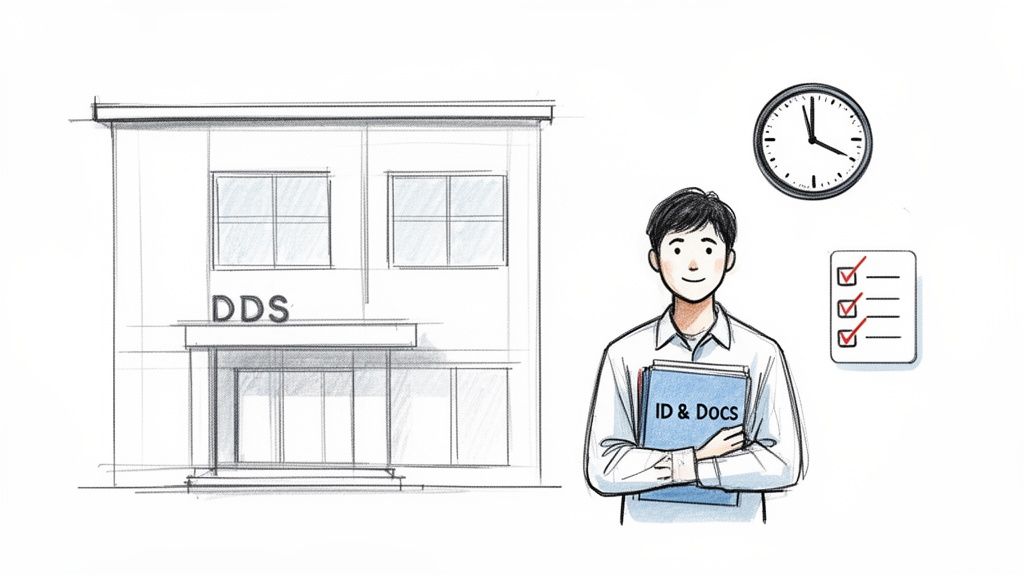
Give yourself a break on the morning of your test. Plan to show up at the DDS Customer Service Center at least 30 minutes early. That extra time is your cushion for surprise traffic or a long check-in line, especially at busy locations.
Keep all your paperwork in one folder, ready to go. The last thing you want is to be frantically digging through your glove box for your insurance card—that’s a guaranteed way to ramp up your stress before the test even begins. For a full rundown, you can check out our guide on the documents you need to legally drive.
Test day jitters are totally normal. While you wait, take a few slow, deep breaths. Remind yourself that you’ve done the work. The examiner isn't there to fail you; they just need to see that you can operate a vehicle safely and confidently.
After You Pass: Congratulations!
There's no better feeling than hearing the examiner tell you that you've passed. Once the driving portion is over, you'll go back inside the DDS office to make it official.
- You’ll get your picture taken for your brand-new license.
- Next, you'll pay the required licensing fee.
- You will walk out with a temporary paper license, which is valid immediately.
Your permanent plastic license will arrive in the mail within a few weeks. Enjoy the freedom, but always remember the responsibility that comes with it.
If You Don't Pass: What Happens Next
Failing your road test is a letdown, but it’s far from a dead end. Plenty of people need a second try, and the DDS has a clear process for what to do next. Think of it as a diagnostic report showing you exactly what to work on.
Here are the DDS rules for retesting:
- First Failure: You can try again after waiting at least one day.
- Subsequent Failures: You have to wait a minimum of seven days between any other attempts.
Don't waste that waiting period. The examiner gives you a scoresheet that pinpoints where you lost points. Was it a shaky parallel park? Forgetting a blind-spot check? That sheet is your new practice plan.
If you’re struggling with specific maneuvers or just can't seem to shake the nerves, a professional driving course is a smart investment. A DDS-approved defensive driving course teaches you to anticipate hazards and react smoothly—skills that examiners love to see. And for anyone needing to reinstate a license, a Risk Reduction course provides the critical foundation for safe driving. These programs are designed to turn your weaknesses into strengths so you can ace your next attempt.
To become a more confident and prepared driver, you can explore our online and in-person Defensive Driving courses.
Common Questions About the Georgia Road Test
It's completely normal to have a few questions before your test. Getting them answered ahead of time is the best way to walk into the DDS feeling ready.
Can I Use a Rental Car for My Road Test in Georgia?
This is a common question, and the short answer is almost always no.
Most rental car agreements don't allow their vehicles to be used for driving tests. More importantly, you probably won't be listed correctly on the insurance paperwork to meet the DDS's requirements.
You must arrive in a car with valid Georgia registration and current liability insurance. The easiest way to handle this is to borrow a car from a family member or friend who can come with you. This avoids getting turned away before your test even begins.
What Are Automatic Fails on the GA Driver's Test?
An automatic fail is exactly what it sounds like—a critical mistake that ends your test immediately. The examiner's job is to ensure you're a safe driver, so any action that creates a dangerous situation will result in a fail.
Some common automatic fails include:
- Causing an accident, even a minor one.
- Breaking a traffic law, like running a stop sign, speeding, or making an illegal turn.
- Refusing to follow the examiner's instructions.
- Showing a dangerous lack of control over the vehicle.
The test is all about proving you can handle a car safely in the real world. A single major error tells the examiner you aren't ready for that responsibility, leading to an automatic fail.
How Does the Virtual Road Test Work?
Georgia's Virtual Road Test (VRT) is a great alternative to the traditional in-person test. It lets you test in your own car with a licensed driver who is 21 or older in the passenger seat.
A DDS examiner watches you through a camera and gives directions using a hands-free device. The maneuvers and scoring are the same as the regular test, but many drivers in places like Augusta and Columbus find it much less stressful without an examiner sitting next to them.
I Failed My Test. What Defensive Driving Course Should I Take?
Failing your road test is frustrating, but it's also a chance to get better. If your nerves got the best of you or you need to sharpen your skills, a state-approved defensive driving course is a smart move. A 6-hour program will refresh your knowledge of traffic laws and teach you how to spot and react to hazards on the road.
This kind of course directly targets the skills needed to pass the drivers road test in GA. It's designed to make you a more confident, aware driver—which is exactly what the DDS is looking for.
At Georgia DUI Schools, our DDS-approved online and in-person defensive driving courses are specifically designed to make you a more confident and prepared driver. If you're ready to master the skills you need for your next attempt, explore our Defensive Driving course options.