When you search for drivers education courses in Georgia, you’ll find two very different worlds: one for teens getting their first license, and another for adults dealing with court orders, DUI charges, or license issues.
For adults, these courses are rarely optional. They're specific, state-certified programs required to handle a DUI, clear up a ticket, or get your license back. This guide focuses on the courses adults need for legal and license reinstatement purposes, including DUI Risk Reduction, Defensive Driving, Clinical Evaluations, and Victim Impact Panels.
What Are Georgia's Required Driver Education Courses?
For thousands of adults across Georgia, "drivers education" means something much more serious than learning to parallel park. These aren't high school driving classes. They are specialized programs built to address specific legal situations, like a DUI charge in Gwinnett County or a speeding ticket from the Atlanta Police Department.
The two most common courses you’ll encounter are the DUI Risk Reduction Program and the Defensive Driving Course (DDC). These programs are essential for satisfying court orders and requirements from the Georgia Department of Driver Services (DDS).
Let's quickly break down the most common driver improvement courses you might be required to take.
Georgia Driver Improvement Courses: A Quick Guide
This table gives a simple overview of the main courses for adults, what they're for, and who typically needs to take them.
| Course Type | Primary Purpose | Who It's For |
|---|---|---|
| DUI Risk Reduction | Fulfill legal requirements after a DUI or drug-related charge. | Drivers with a DUI, drug possession, or other serious offenses. |
| Defensive Driving (DDC) | Reduce license points, dismiss a ticket, or lower insurance rates. | Drivers with traffic violations or those taking it voluntarily. |
| Clinical Evaluation | Assess for substance use disorders as required by court or DDS. | Often for repeat DUI offenders or as determined by a judge. |
| Victim Impact Panel | Provide emotional context on the consequences of impaired driving. | Mandated for many DUI offenders by courts across Georgia. |
Now, let's dig into the two main courses.
Navigating Your Course Requirements
Figuring out which class you need can feel overwhelming, but it boils down to your specific situation. A DUI arrest in Cobb County sends you down a different path than a speeding ticket on I-75.
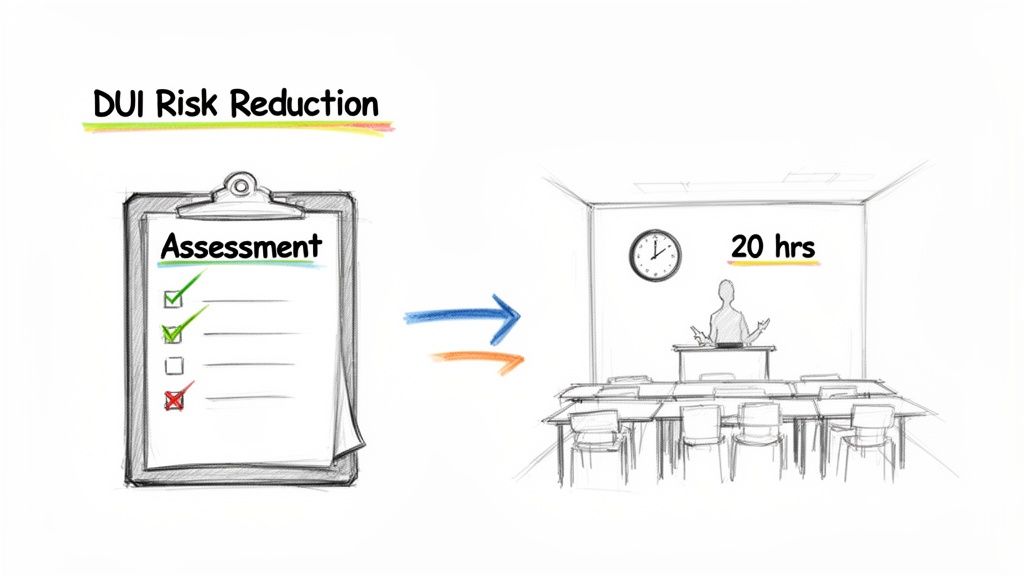
DUI Risk Reduction Course: This program is non-negotiable for anyone facing a DUI, drug possession charge, or other major violation. It's a two-step process: first an assessment, then a 20-hour course focused on understanding and changing high-risk behaviors.
Defensive Driving Course (DDC): This is a much shorter 6-hour course. A judge might order it for a minor traffic ticket, or you might choose to take it on your own to reduce points on your license or get an insurance discount.
This chart can help you see which path you'll likely need to take.
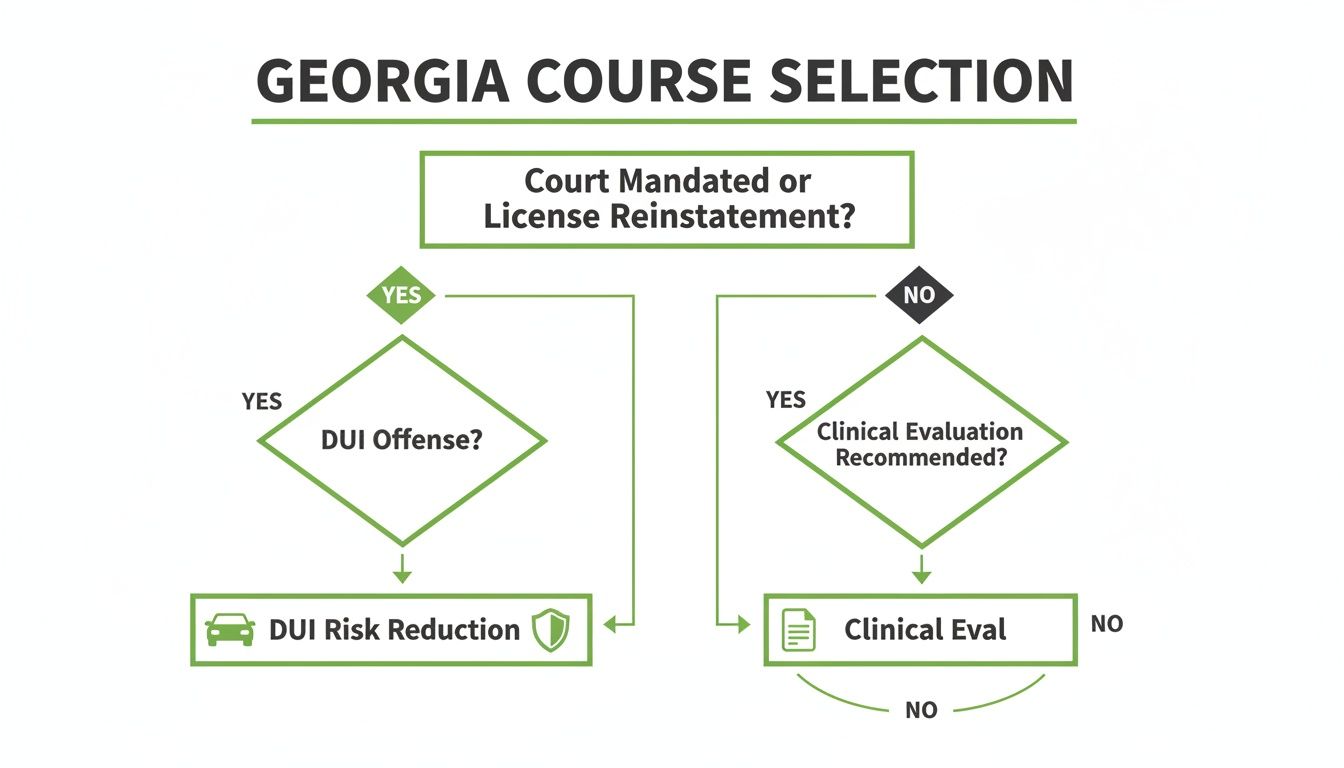
As you can see, your reason for being here—whether it’s a court order for a DUI from Dekalb County State Court or a personal goal to lower your insurance—points you to a specific solution.
More Than Just Checking a Box
While these courses are often mandatory, they’re not just about punishment. They're designed to give you real tools and knowledge about risk, responsibility, and the consequences of your choices on the road.
The DUI Risk Reduction program, for example, isn’t meant to make you feel bad. It’s about preventing another incident by helping you see the patterns that led to the first one.
Completing the right program is the key to moving past this. Whether you need to get your license back, clear points from your record, or just want to drive with more confidence, it all starts with enrolling in the correct class.
To see what's involved, you can learn more about how online drivers ed in Georgia works. Getting informed is the first step toward taking control, meeting your obligations, and getting back on the road safely.
Understanding the Georgia DUI Risk Reduction Program
If you're dealing with a DUI, drug possession charge, or another serious driving offense in Georgia, the DUI Risk Reduction Program is something you'll need to get familiar with. It's a mandatory part of the legal process, overseen by the Georgia Department of Driver Services (DDS), and it's your first step toward getting your license back.
Don't think of it as a punishment. It's really an educational program designed to help you understand the real risks of impaired driving and make better choices down the road.
The Two Core Components of the DUI Program
Every state-approved DUI program in Georgia follows the exact same structure, whether you're in Atlanta, Savannah, or Valdosta. It's broken down into two main parts that you have to complete in order.
The Assessment (NEEDS Survey): First, you'll take a 130-question survey called the NEEDS Assessment. This isn't a test you can pass or fail. It’s a confidential tool that helps create a profile of your personal attitudes and behaviors around driving and substance use.
The Intervention (20-Hour Course): After the assessment, you move on to the 20-hour classroom course. A certified instructor leads the class, using insights from the assessment to guide discussions and activities.
You have to finish both parts to get the official Certificate of Completion. That's the document you'll need to show the court or DDS that you’ve done what was required.
Key Takeaway: The Georgia DUI Risk Reduction Program is a required educational journey, not a penalty. Its goal is prevention, helping drivers understand and alter high-risk behaviors to avoid future incidents and regain their driving privileges safely.
What to Expect in the 20-Hour Intervention Course
The 20-hour course is where the real learning happens. It’s usually scheduled over a few days, like a weekend, to fit most schedules. The class is interactive and built to make you think.
You won't just be sitting there listening to a lecture. The classroom is all about group discussion and participation, focusing on the real-world impact of impaired driving. You’ll cover topics like:
- How alcohol and drugs actually affect your ability to drive.
- Georgia's specific DUI laws and the serious penalties involved.
- Figuring out your personal risk factors and triggers.
- Learning practical ways to avoid making the same mistake again.
With over 38 years in this field, we’ve guided more than 100,000 Georgians through this exact process. We know it works, and it gives you a clear, structured path to put a license suspension behind you.
Why This Program Is a Critical First Step
While everyone talks about teen driver's ed, the need for solid adult driving programs is just as real. For adults facing a license suspension for DUI or other serious offenses, a state-approved provider like Georgia DUI Schools offers the required drivers education courses in Georgia. It’s the essential pathway to getting your license back. You can read more about Georgia's driver education challenges and outcomes in the Georgia Driver's Education Commission's FY2023 report.
Bottom line: completing a DDS-approved DUI Risk Reduction course is the first and most important thing you need to do. It proves to the court and the state that you're taking this seriously. It’s the key that unlocks the door to reinstating your license and moving on.
Navigating Clinical Evaluations and Treatment Requirements
For some people, especially those with multiple DUIs or other serious offenses, the Risk Reduction course is just the beginning. The court or the Georgia Department of Driver Services (DDS) might also require something called a Clinical Evaluation.
Here’s a simple way to look at it: the DUI Risk Reduction course is like a general class that everyone in your situation has to take. A Clinical Evaluation, on the other hand, is like getting a personalized check-up from a specialist to determine if a substance use disorder is present.
What Is a Clinical Evaluation?
A Clinical Evaluation is a private, one-on-one meeting with a state-approved, licensed professional. Its goal is simple: to figure out if you might have a substance use issue that needs more attention.
This isn't about judgment or punishment. Think of it as a diagnostic tool to understand your specific situation.
The evaluator will ask you about your history with alcohol or drugs, your driving record, and what led to your offense. Being honest here is key. The entire point is to get an accurate picture so the right recommendations can be made for you. This assessment is often required for individuals declared Habitual Violators (HV).
The Role of ASAM Level 1 Treatment
If the evaluation shows that a substance use disorder is present, the clinician will likely recommend treatment. In Georgia, the most common requirement for DUI offenders is ASAM Level 1 Treatment.
This is a short-term outpatient program focused on education and counseling. It's designed for people who can get support while still managing their work and family lives—you won't be checking into a full-time facility.
The program usually includes:
- Group Counseling Sessions: You’ll meet with a small group and a counselor to talk through challenges and learn new coping skills.
- Individual Counseling: These one-on-one sessions give you personalized support and guidance.
- Educational Components: You will learn about addiction, how to prevent relapse, and ways to make healthier choices moving forward.
The goal here is therapeutic, not punitive. It’s about giving you the tools to address the underlying issues that may have played a part in your DUI.
A Clinical Evaluation is a confidential assessment to see if a substance use disorder exists. If one is identified, ASAM Level 1 treatment—a program of education and counseling—may be required to help you address the issue and satisfy court requirements.
How Evaluations Fit into the Legal Process
The order for a Clinical Evaluation can come from a couple of places. A judge in Fulton County, for example, might make it part of your sentence, or the DDS may require it to reinstate your license, especially if you have prior offenses or are a Habitual Violator.
It’s best to see this as a separate, parallel requirement to your DUI Risk Reduction course. If you’re ordered to do both, you must complete both.
The Certificate of Completion from your DUI course, along with the paperwork from your evaluation and any required treatment, are all necessary to finally close your case.
Finishing this multi-step process shows the state you’ve not only learned about the dangers of impaired driving but have also taken real steps to handle any personal substance use challenges. It's a critical part of showing responsibility and getting your full driving privileges back.
To understand more about this step, you can check out our guide on the drug and alcohol evaluation process and what it means for your case.
Using Defensive Driving Courses to Reduce Points and Insurance Costs
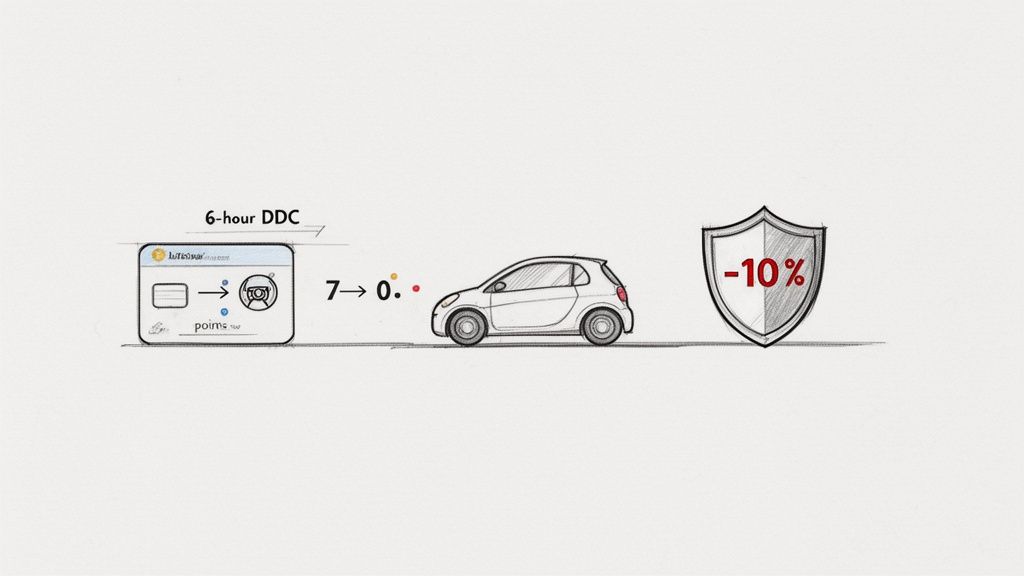
Here in Georgia, we have a few different driver education programs, and it's easy to get them confused. The DUI course is mandatory if you’re facing specific charges, but the 6-hour Defensive Driving Course (DDC) is a completely separate tool that's available to any driver. It's often a choice—and a very smart one at that.
Think of it as a strategic move for your driving record. Maybe you got a ticket and want to manage the fallout. Or maybe you're just tired of high insurance bills and want to knock them down a bit. This course is a clear, straightforward path to get you there.
The Tangible Benefits of Defensive Driving
Unlike courses that are purely for legal compliance, the DDC gives you a few different perks that can save you real money and protect your license. For most Georgia drivers, it’s a win-win.
Here are the top three reasons people sign up:
- Point Reduction: You can knock up to 7 points off your Georgia driver's license. This is a massive help for preventing a potential license suspension, and you can use this benefit once every five years.
- Court Requirements: Sometimes, a judge in a local court like the Athens-Clarke County Municipal Court will order you to take a DDC for a traffic ticket. Finishing the course is how you satisfy that order.
- Insurance Discounts: This is a big one. Most auto insurance companies in Georgia will give you a discount of 10% or more just for completing a state-approved DDC. That discount usually lasts for three years, which adds up to some serious savings.
For a professional who drives for work or a parent juggling a packed schedule, these benefits are more than just numbers. Getting a speeding ticket on I-285 doesn't have to turn into years of paying higher insurance premiums.
Choosing the Right Course Format for You
We all have different schedules and learn in different ways. That's why drivers education courses in Georgia come in a few different formats, so you can pick what works for you, whether you’re in Athens, Atlanta, or anywhere in between.
The 6-hour Defensive Driving Course typically comes in three flavors:
- Self-Paced Online: This is the most flexible route. You can log in and out whenever you want and work through the material completely on your own time.
- Live Virtual (Zoom): If you like having a live instructor but want to stay home, this is the perfect middle ground. It offers structure without the commute.
- Traditional Classroom: For those who learn best with face-to-face interaction, our classroom courses are held on weekends and weekdays at multiple locations across Georgia.
Key Insight: A Defensive Driving Course is a versatile tool. It can be used reactively to handle a ticket or proactively to secure an insurance discount, making it valuable for nearly every driver on the road.
The Broader Impact on Georgia Roads
Investing in driver education is a proven way to make our roads safer, but it's not always easy. Since 2005, Georgia has collected millions in fees meant for driver training, but state audits show that a lot of that money hasn't actually gone to the Georgia Driver's Education Commission (GDEC) to expand its programs.
That's where providers like Georgia DUI Schools come in. We fill the gap by offering DDS-approved courses that meet all state requirements and, more importantly, help create safer drivers. Whether you're trying to reduce points, lower your insurance bill, or just brush up on your skills, taking a DDC is a smart, effective step.
To learn more about how it could help you, check out the full benefits of taking a defensive driving course in Georgia.
Why Attending a Victim Impact Panel Is Required
In many Georgia DUI cases, a judge will order you to attend a Mothers Against Drunk Driving (MADD) Victim Impact Panel (VIP). It’s important to understand that this is a separate, 2-hour session that’s completely different from your Risk Reduction course.
This isn’t another class where you’ll be tested, and it’s not an extension of your DUI program. Think of it as a powerful, eye-opening experience designed to show the real human side of impaired driving—something statistics and legal definitions just can't capture.
What Happens During a Victim Impact Panel
During the panel, you'll hear directly from people whose lives were shattered by an impaired driver. The speakers are not actors; they are real victims of DUI crashes, family members mourning a loved one, or first responders who have been to these tragic scenes.
They share their stories in a raw, unfiltered way. You won’t just hear about an "accident"; you'll hear about the person who was lost—who they were, their dreams, and the void their death left behind. The point isn’t to shame you, but to put a real face and a real story to the consequences of driving under the influence.
A Victim Impact Panel isn't about laws or fines. It’s an experience built to create a deep, personal understanding of the human cost of impaired driving by hearing from those who have lived it.
The Purpose Behind the Requirement
Georgia courts, from Fulton County to the smallest local jurisdictions, see this experience as vital. Why? Because it addresses something a classroom lecture simply can't: the emotional motivation to change for good.
While a Risk Reduction course teaches you the laws and risks, the VIP forces a confrontation with the who—the real people hurt by these choices. The court’s goal is simple: to stop it from ever happening again.
By requiring you to listen to these deeply personal accounts, the justice system hopes to instill an understanding that goes far beyond just knowing the rules. It’s an appeal to your conscience, meant to create a lasting memory that comes to mind the next time you face a choice about driving after drinking.
This panel is often one of the final hurdles in resolving a DUI. It’s not just a box to check off a list. It's a moment to truly grasp the weight of your responsibility behind the wheel. Completing the VIP is a critical part of the drivers education courses in Georgia for DUI offenders and shows the court you've engaged with the full impact of your actions.
Your Top Questions About Georgia DUI & DDC Courses, Answered
When you're dealing with a court requirement or just trying to be a better driver, it's normal to have a lot of questions. We get it.
Here are straight-up answers to the questions we hear most often about driving courses in Georgia.
How Much Do These Courses Cost?
Good news—the state sets the prices for certified programs, so you won't see a lot of variation there.
- Defensive Driving Course (DDC): The 6-hour course has a statewide fee of $95. This applies whether you take it online or in a classroom.
- DUI Risk Reduction Program: The total cost for this program is $360. It's broken into two parts: $100 for the Assessment and $260 for the 20-hour Intervention course.
How Long Does the DUI Risk Reduction Process Take?
The basic program is pretty quick. The Assessment usually takes about 30-45 minutes. The 20-hour course is often scheduled over a weekend or a few days in a row to help you get it done fast.
However, your timeline can get longer if the court also orders a Clinical Evaluation and ASAM Level 1 Treatment. If that’s part of your requirement, the entire process could stretch over several weeks or even months. It’s always best to start right away to avoid any delays with your license.
One Key Thing to Remember: The DUI Risk Reduction program and the 6-hour Defensive Driving Course are completely different. They have different goals, timelines, and costs. Make sure you know exactly which one you need before you sign up.
How Do I Know if a Driving School Is Legit?
This is a huge deal. To satisfy any court order or license requirement, you must use a school that's been certified by the Georgia Department of Driver Services (DDS).
You can always check a school’s status on the official DDS website, which keeps a running list of all approved providers. Georgia DUI Schools is fully certified for all DUI, DDC, and Clinical Evaluation services, so you can be confident your Certificate of Completion will be accepted everywhere it needs to be.
Can I Take a Defensive Driving Course to Make a Ticket Go Away?
Maybe. In some parts of Georgia, a judge might let you complete the 6-hour Defensive Driving Course to get a minor ticket dismissed. But it’s not guaranteed—it’s entirely up to the specific court handling your case. Always check with the court clerk first before enrolling.
Even if ticket dismissal isn't on the table, the course is still a smart move. It can knock up to seven points off your license and usually qualifies you for an insurance discount.
The need for effective driver safety education remains critical. A state audit highlighted systemic issues within Georgia's approach, which you can explore further by reading the read the full findings on Georgia's driver education system to understand why modern training is so vital.
No matter which course you need, Georgia DUI Schools has you covered. We offer flexible schedules and different formats to make it simple to meet your requirements and get back on the road.
Ready to handle your court requirement? Find and enroll in a Defensive Driving Course today.