The bill shows up, you open it on your phone in a parking lot in Atlanta or at the kitchen table in Athens, and the first reaction is usually the same. Why did my premium go up again?
Most Georgia drivers I talk to are not looking for a gimmick. They want a practical way to lower costs without creating a new problem with the DDS, the court, or the insurance company. That is exactly where a defensive driving course to lower insurance can help, if you choose the right class and handle the paperwork the right way.
The confusion starts because Georgia drivers use the phrase “defensive driving” to mean several different things. Some people need a voluntary class to try to earn an insurance discount. Others need a class because of points. Others are dealing with a DUI, a license suspension, or a court order and assume the required class will also reduce their premium. Often, it does not.
After working with Georgia drivers for many years and serving numerous participants through Georgia DUI Schools’ programs described by the publisher, I can tell you the biggest mistake is signing up first and asking questions later. The smart move is to verify which course fits your situation, then take the one your insurer and the state will recognize.
If you want a plain-language overview of the practical upsides before you enroll, these defensive driving benefits in Georgia are a useful starting point.
Your Path to Lower Car Insurance Premiums Starts Here
A defensive driving class is not just for someone who got a ticket. In Georgia, plenty of drivers take one voluntarily because they want to control what they can control. Insurance costs are one of those things.
On busy roads around metro Atlanta, Gainesville, or Athens, people deal with heavy traffic, distracted drivers, quick lane changes, and the daily wear that comes with commuting. A good course helps in two ways. It can make you a more deliberate driver, and it can create a path to a premium discount if you meet the eligibility rules.
That second part matters. Across major U.S. insurers and markets, approved defensive driving courses can bring 5% to 20% off auto premiums, usually for up to three years, when the class is state-approved and accepted by the insurer, according to Policygenius on defensive driving course discounts. The exact amount depends on the state, the carrier, and your driving record.
The Georgia reality
Georgia drivers need to slow down and separate three goals that often get lumped together:
- Insurance savings
- Point reduction
- Court or DDS compliance after a violation
Those are related, but they are not identical.
A voluntary class taken to lower insurance works differently from a court-ordered class after a DUI or serious violation. If you mix those up, you can finish a course, spend the money, and still not get the discount you expected.
A defensive driving course works best when you treat it like a paperwork process, not just a class. The certificate only helps if the insurer accepts it for your policy.
Why this route still makes sense
Drivers with clean records often have the clearest path. Drivers with imperfect records may still benefit from the driving instruction, the point-reduction side, or preparing for better insurance options later. Either way, the class has value. You just need to be honest about which result is realistic for your situation.
Confirming Your Eligibility for an Insurance Discount in Georgia
The first phone call should go to your insurer, not the school.
Georgia has a state rule, but many drivers misunderstand how far that rule goes. The law creates a baseline. Your carrier still controls how it applies its own underwriting rules and which certificates it will accept.

What Georgia law says
Under O.C.G.A. 33-9-42, insurers must provide at least a 10% premium discount to drivers age 25 and older who complete a defensive driving course and have kept a clean driving record for the previous three years, as explained by Taggart’s summary of Georgia’s insurance discount rule.
That is the core rule Georgia drivers should know.
It also explains why many people are surprised when they do not qualify. If you are under the age threshold, or you have had tickets or chargeable accidents in that lookback period, the state-mandated discount may not be available to you.
Where drivers get tripped up
The law does not mean every person who finishes every class gets a discount. In practice, these are the common trouble spots:
Age issues
The Georgia statutory discount applies to drivers 25 and older.Record issues
A “clean” record for the required period matters. Tickets and chargeable accidents can affect eligibility.Course mismatch
A class accepted for court, probation, or point issues is not automatically accepted for insurance.Insurer approval
Your carrier may require a state-approved provider and may want confirmation before you enroll.
What to ask your insurance agent before you sign up
Call your insurer and keep the conversation simple. Ask direct questions.
- Do you offer a defensive driving discount in Georgia for my policy?
- Do I meet your eligibility requirements right now?
- Does my age or driving history affect whether I qualify?
- Do you require a Georgia DDS-approved provider?
- How do you want the certificate submitted?
- When would the discount show up on my policy?
- How long does the discount stay in effect before I need to retake the course?
If the agent sounds unsure, ask them to note your file or send the requirements in writing through the carrier portal or email.
That one step saves a lot of wasted effort.
Choosing the Right Georgia-Approved Course Format
A lot of Georgia drivers get stuck here. They ask whether they should take the online class, the Zoom class, or the classroom class, when the better question is whether the format matches the reason they are taking the course in the first place.
That matters because Georgia uses defensive driving courses for more than one purpose. One driver wants an insurance discount. Another needs a court-accepted class. Another is trying to reduce points. The course title can look similar across providers, but your insurer and the court are not always asking for the same thing. Pick the wrong format or the wrong version of the class, and you can spend six hours on a course that does not solve your problem.
Once you have confirmed what your insurer will accept, choose the format you can finish without attendance problems, tech issues, or constant interruptions. Providers like Georgia DUI Schools offer these options to Georgia drivers, including a Georgia online defensive driving course, but the same decision process applies with any DDS-approved school.
Defensive Driving Course Formats in Georgia
| Feature | Self-Paced Online | Live Virtual (Zoom) | In-Person Classroom |
|---|---|---|---|
| Schedule flexibility | Highest. Complete the material around your own schedule. | Moderate. You attend at set times from home. | Lowest. You attend at the school’s scheduled time. |
| Best for | Busy adults, shift workers, independent learners | Drivers who want structure without commuting | Drivers who focus better with an instructor in the room |
| Instructor interaction | Usually limited during the course | Real-time during class | Direct face-to-face interaction |
| Technology needs | Reliable internet and basic comfort with a computer, tablet, or phone | Reliable internet, camera, audio, and ability to follow virtual attendance rules | Minimal beyond registration |
| Home distractions | Can be a problem | Lower for drivers who do better with a fixed class time | Usually easier to control |
| Travel time | None | None | Required |
| Good fit for older drivers | Good if they are comfortable online | Good if they want live guidance | Good if they prefer a traditional classroom |
What each format does well, and where it can fail
Self-paced online works well for drivers with changing schedules, childcare duties, or long work hours. It gives you flexibility, but flexibility cuts both ways. I have seen plenty of drivers start strong, stop for dinner or a phone call, then lose momentum and drag the class out longer than they expected.
Live virtual classes help drivers who need a set appointment on the calendar. You still avoid the drive across town, but you have to be present, on time, and able to meet the provider’s participation rules. If your internet drops or you try to multitask through the session, that can create problems.
In-person classroom courses still have a place. Drivers who get frustrated with logins, webcams, and online timers often finish faster in a room with an instructor. After teaching Georgia drivers for decades, I can tell you this plainly. Some people learn better when they sit down, put the phone away, and handle it in one shot.
Match the format to your real situation
Choose self-paced online if your schedule changes week to week and you are comfortable working through material on your own.
Choose live virtual if you do better with a fixed class time and want the chance to ask questions as the course moves along.
Choose in-person if technology slows you down, home is too distracting, or you want direct instructor guidance from start to finish.
One more point matters here. If you have a less-than-clean record, do not assume the same class will satisfy every need tied to that record. Insurance discount courses, court-ordered courses, and point-reduction courses can overlap, but they are not automatically interchangeable. Before you enroll, make sure the provider’s course format and course approval line up with your exact purpose.
The right format is the one you will complete, with a valid certificate that fits your insurance or legal need the first time.
Enrolling and Completing Your Defensive Driving Program
Most problems happen before the class starts. The driver chooses a provider too quickly, assumes the certificate will work for insurance, and only checks the details after completion. Reverse that order.
Start with a Georgia DDS-approved provider. That is the baseline for a course that will hold up where it needs to hold up. Then confirm the insurer will accept that provider for the discount you are seeking.
The overall process is straightforward.
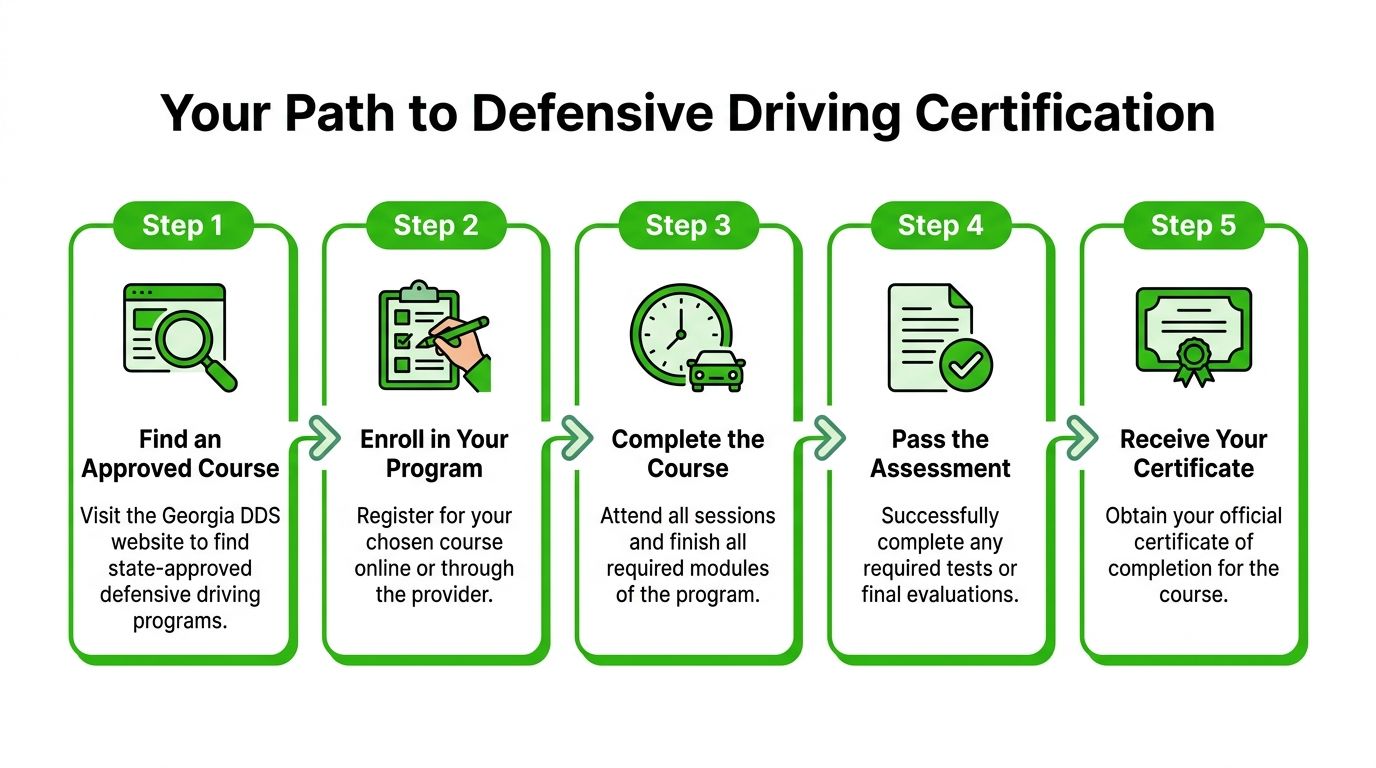
The enrollment path
Check the provider’s approval status
Look for a Georgia-approved school, not just a national website with broad claims.Match the format to your schedule
Pick online, live virtual, or classroom based on how you learn and how you live.Register with accurate information
Use the same legal name and identifying details you use with your insurer and DDS records.Show up and complete every required part
Attendance and completion rules matter. Partial completion does not get you a valid certificate.Review your completion documents
Make sure your name and course details are correct before you send anything to the insurer.
What the course usually covers
The typical course runs 6 hours and covers Georgia traffic laws, hazard perception, maintaining a 3-second following distance, distraction management, and related safe-driving techniques. Graduates report a 62% improvement in perceived safety, according to iDriveSafely’s discussion of defensive driving curriculum and outcomes.
That lines up with what experienced instructors see in class. Drivers often know the rules in a general sense, but they have not stopped to think about spacing, scanning, or distraction habits in a practical way for years.
What to expect during the class
The course is not advanced race-track driving. It is ordinary-road survival taught in a structured way.
You will typically work through topics such as:
Traffic law review
Georgia-specific rules that many drivers have forgotten or only half remember.Hazard recognition
Reading road conditions early instead of reacting late.Following distance
The 3-second rule gives drivers a simple, useful benchmark.Distraction control
Phones, passengers, and routine habits that increase risk.Decision-making
Passing, lane changes, and responding to other drivers who make bad choices.
A good student does not race through the material just to get the certificate. The point is to leave with habits that lower the chance of the next ticket or crash.
Before you leave the process
When you receive the certificate, check it carefully. Verify your name is correct and that the course is identified properly. If something is wrong, fix it before submission. Small errors create unnecessary delays with insurers.
Submitting Your Certificate and Securing Your Discount
Finishing the class is the halfway mark. The discount does not start because you completed the course. It starts when the insurer receives acceptable proof and applies it to your policy.
That means this step needs the same attention as the class itself.

How to submit it correctly
Insurers usually accept certificates through one of three paths: direct email to an agent or service team, upload through the policy portal, or mail if the company still processes documents that way. Use the method your carrier requests. Do not guess.
When you send the certificate, include enough information for them to match it to your policy:
- Your full name
- Policy number
- A short note saying you completed an approved defensive driving course
- The certificate itself
- A request for confirmation once the discount is reviewed
If you have an agent, send it through that agent and keep your own copy. If you deal directly with the carrier, save the upload receipt, email trail, or any portal confirmation.
What the discount can look like
Approved defensive driving courses can lead to an insurance discount of 5% to 20%, and the discount typically lasts for three years. One example listed by Policygenius is that GEICO offers up to 10% in some states for completing an approved online course, as noted in their guide to getting a defensive driving discount.
That range is why the pre-enrollment phone call matters. The class may be worth it financially, but you should know the likely return before you pay for it.
Timing matters
Do not expect every insurer to apply the change instantly. Some companies process it quickly. Others may reflect it at the next renewal or adjustment cycle.
Many drivers lose momentum at this stage. They submit the certificate, assume it is handled, and never check again.
Follow up after submission and ask one direct question: “Has the defensive driving discount been reviewed and applied to my policy?”
If the answer is no, ask what is missing. Sometimes the issue is not eligibility at all. It is just an incomplete upload, a certificate mismatch, or a file waiting in the wrong department.
Tips to Maximize Your Savings and Avoid Common Pitfalls
Drivers lose insurance discounts in ways that are completely preventable. In my experience, the biggest problems are not classroom problems. They are timing problems, paperwork problems, and assumption problems.

The mistakes that cost people money
A significant pitfall is denial based on recent at-fault accidents. Insurer rules can be strict, and 30% to 40% of denials are tied to recent claims or failure to renew the course after three years, according to DriveSafe Online’s discussion of insurance-premium impact and denials.
That should change how you approach the process.
If your record is not clean enough today, the class may still help you for other reasons, but you should not count on the insurance discount until your insurer confirms you are eligible.
What smart drivers do differently
Confirm approval first
Do not rely on a website headline. Ask your insurer whether your specific policy accepts the course.Use a Georgia-approved provider
A course that sounds legitimate is not enough. The approval has to line up with Georgia requirements and your carrier’s acceptance rules.Set a renewal reminder
If your discount period expires and you never retake the course, the savings can disappear.Ask about stacking discounts
Some carriers may let the defensive driving discount exist alongside other discounts. The only way to know is to ask.Keep copies of everything
Save the certificate, submission receipt, and confirmation that the discount was applied.
For additional practical ideas on the insurance side, this guide on how to lower car insurance rates in Georgia gives a broader view.
One trade-off to be honest about
A defensive driving class is not a magic reset button.
If a driver recently had a chargeable accident, a DUI issue, or another serious event on the record, the class may improve knowledge and help with other compliance goals, but it may not produce an immediate premium break. That does not make the course useless. It just means you should match the reason for taking it to your real situation.
The right mindset is simple. Take the class for the benefit you can receive now, not the one you hope will happen automatically.
Frequently Asked Questions for Georgia Drivers
Can I use a defensive driving course to reduce points on my Georgia license
In many situations, a defensive driving course may help with point-related issues, but point reduction and insurance discounts are not the same thing. A course taken for one purpose does not automatically accomplish the other. Always confirm what the class is being used for before you enroll.
Does a court-ordered DUI or Risk Reduction course qualify for an insurance discount
Usually, no. A common point of confusion is the overlap between DUI requirements and insurance savings. In general, a court-mandated DUI or Risk Reduction program does not qualify for a voluntary insurance discount, and a separate voluntary defensive driving course is typically required, as explained by SafeMotorist’s Georgia defensive driving discount discussion.
This is the point many Georgia drivers miss. If the court ordered one class, that does not mean your insurer will treat it as the class that lowers premiums.
How often can I take the course for an insurance discount in Georgia
The discount typically lasts for a set period with the insurer. Once that period ends, some drivers retake an approved course to seek renewal of the discount. The exact timing should come from your carrier, because the insurer decides how it applies the benefit to your policy.
If I have a less-than-perfect record, should I still take the class
Maybe, yes. It depends on your goal.
If you are looking strictly for an immediate insurance discount, verify eligibility first. If you need a course for points, safer habits, DDS-related reasons, or to put yourself in a better position later, the class can still be useful even if the discount is not available right now.
If you need a Georgia-approved option for insurance, point reduction, or sorting out the difference between a voluntary class and a court-required one, Georgia drivers can review course options and enroll through Georgia DUI Schools.