A lot of Georgia seniors aren’t looking for a lecture about driving. They’re looking for peace of mind.
You may want to keep driving to church on Sunday, head to a doctor’s appointment in Athens without asking for a ride, or make the trip to see family in Savannah on your own schedule. That freedom matters. So does feeling steady behind the wheel when traffic moves faster, intersections feel busier, and newer cars seem to have buttons for everything.
A defensive driving course for seniors can help with all of that. It isn’t about treating you like a new driver. It’s a practical refresher that helps experienced drivers stay safe, protect their license, and in many cases save money on insurance. In Georgia, it can also matter for a court requirement or point reduction, which is why many national articles stop being useful.
Staying Safe and Independent on Georgia Roads
A Georgia driver in their 60s or 70s isn’t worried about whether they remember how to steer, brake, or park. The bigger question is whether driving still feels as simple as it used to.
You might notice that night driving feels more tiring. A busy left turn in Decatur may take more concentration than it once did. A roundabout near a growing metro area can feel unfamiliar, even if you’ve driven safely for decades.
That doesn’t mean you’ve become a bad driver. It means roads, traffic patterns, and vehicles have changed. Bodies change too. A smart response is to adjust your habits before a small problem becomes a bigger one.
Why refresher training matters
Older adults make up a larger share of drivers than they did years ago. In 2021, drivers age 65 and older made up over 20% of all licensed drivers in the United States, up from 14% in 2001, according to NHTSA’s older driver safety information. The same source says drivers who complete formal training such as defensive driving courses have a 4.3% lower crash rate than drivers who don’t.
That’s why this kind of course matters. It gives you a chance to refresh your judgment, not just your memory of road signs.
Practical rule: Good driving isn’t only about reacting well. It’s about seeing trouble early enough that you don’t have to react suddenly.
Independence is part of safety
For many seniors, driving is tied to independence.
- Family life: Visiting children, grandchildren, and friends without depending on someone else’s schedule.
- Daily needs: Getting to the pharmacy, grocery store, bank, or a medical appointment.
- Confidence: Knowing you can handle Georgia roads without second-guessing every turn or lane change.
A solid course supports that independence in a realistic way. It helps you identify what’s changed, what still works, and where a few updated habits can make driving feel easier again.
What You Will Learn in a Senior Defensive Driving Course
A senior-focused class doesn’t start from zero. It assumes you already have years of road experience.
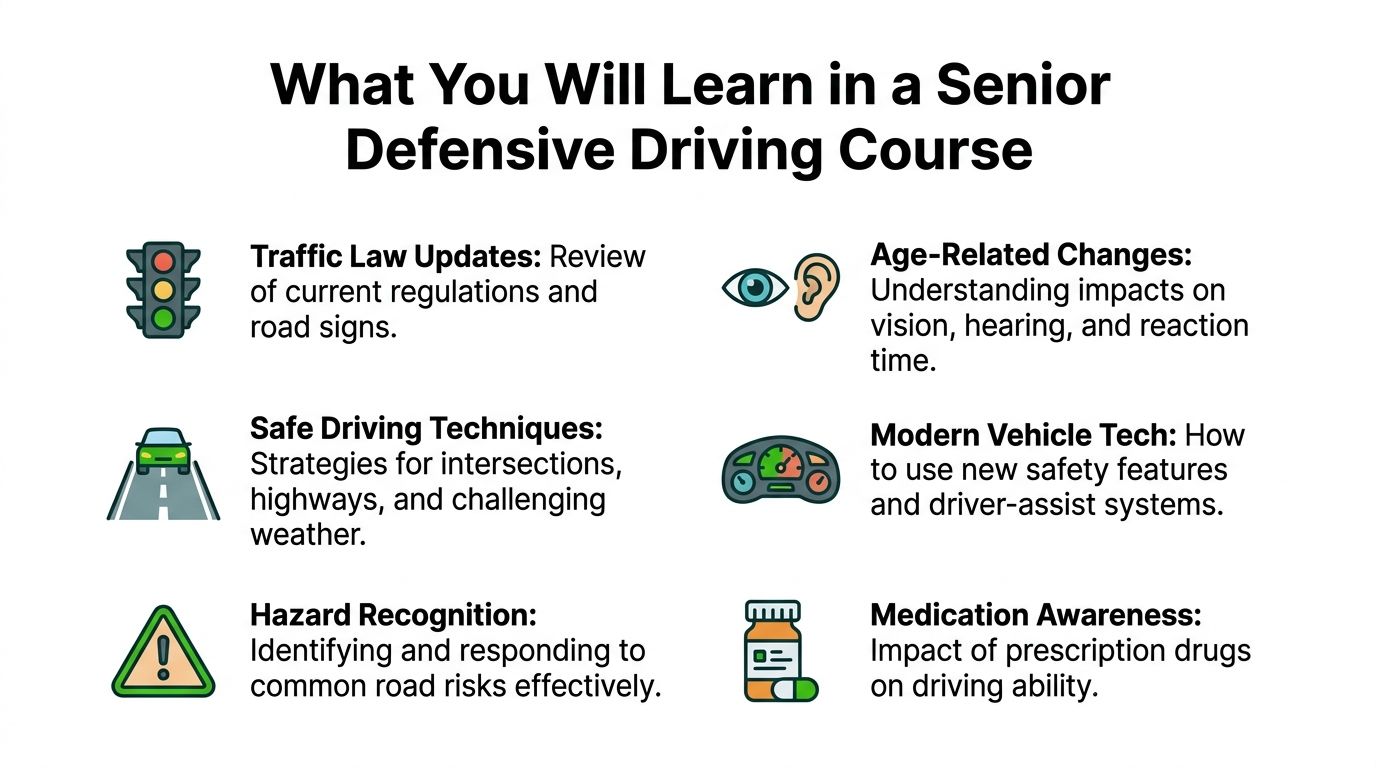
What it does is sharpen the parts of driving that matter most now. That includes hazard awareness, updated traffic rules, age-related changes, and the growing list of safety features in today’s vehicles.
The practical topics most seniors want help with
Here’s what shows up in a defensive driving course for seniors.
Traffic law updates: Rules change over time. Even if you’ve driven in Georgia for years, it helps to review current signs, right-of-way rules, and common traffic situations that lead to tickets or confusion.
Intersections and turning decisions: Many experienced drivers feel fine on a straight road but less comfortable with left turns across traffic, multi-lane intersections, merging, or roundabouts. A refresher course breaks those situations down into simple decision steps.
Following distance and scanning: Defensive driving teaches you to look farther ahead, notice problems sooner, and leave more room around your car. That gives you more time to make calm choices.
Distraction control: Phones get most of the attention, but distractions also include eating, adjusting navigation, or searching for glasses while moving. Seniors appreciate direct, practical advice on reducing overload inside the car.
Medication awareness: Some prescriptions, over-the-counter medicines, or combinations of medications can affect alertness, coordination, or judgment. Courses often address how to recognize that problem before you drive.
Vehicle safety features: Airbags, anti-lock brakes, backup cameras, blind spot warnings, and lane alerts can help, but only if you understand what they do and what they don’t do.
What makes these courses different from basic driver education
This isn’t about being scolded or tested like a teenager.
Senior programs focus on situations such as:
- Managing blind spots more deliberately
- Adjusting for slower reaction time with earlier planning
- Driving in rain, glare, or low-light conditions
- Recognizing when a route or time of day is no longer your best option
AARP’s evaluation of its Smart Driver program found that 97% of participants reported improving at least one driving behavior, and 9 out of 10 reported improving their driving confidence, according to AARP Driver Safety.
That result makes sense. Participants do not need a dramatic change. They need a handful of better habits they can use the next time they’re on I-285, driving through Marietta Square, or making a pharmacy run across town.
The best refreshers respect your experience. They help you drive with it, not in spite of it.
A simple example
Say you approach a busy Atlanta-area intersection and want to turn left. A senior defensive driving course may teach you to:
- Scan farther ahead before you enter the intersection.
- Judge whether oncoming traffic includes a fast-moving vehicle in the far lane.
- Delay the turn if visibility is limited.
- Avoid turning under pressure from cars behind you.
That sounds basic, but basic skills prevent a lot of trouble. Courses work because they turn those choices into repeatable habits.
Key Benefits Insurance Discounts and Point Reduction
For many seniors, the biggest surprise isn’t the safety piece. It’s that a course can also protect the household budget and the driving record.
That matters in Georgia, where one class may help with an insurance discount or with point reduction, depending on why you took it and whether the course meets state requirements.
Insurance savings can make the course pay off
Car insurance isn’t cheap, and many retirees watch recurring expenses closely.
The National Safety Council notes that completing a DDS-approved defensive driving course in states like Georgia can lead to insurance reductions of 5% to 15%, according to the NSC defensive driving program page. You need to send your completion certificate to your insurance company and ask how they apply the discount. Many people miss out by finishing the class, filing the certificate away, and never contacting the insurer.
A smarter approach is to treat the certificate like a coupon you’ve earned.
- Call your insurer directly: Ask whether they offer a mature driver or defensive driving discount.
- Confirm the paperwork: Some carriers want a copy by email, upload, or mail.
- Ask how long it lasts: Insurers often apply the discount for a set period, then you may need a new certificate later.
If you want more detail on practical ways to cut premium costs, this guide on how to lower car insurance rates is a helpful next step.
Point reduction can protect your record
The second benefit is less talked about, but for some Georgia seniors it’s more important.
A traffic ticket can do more than sting for a moment. It can affect your driving record, your insurance cost, and your peace of mind. If you’re carrying points, a new violation may feel stressful.
A defensive driving course may help reduce points when Georgia law allows it. In these situations, the class becomes more than a refresher. It becomes a practical tool for keeping your record in better shape.
Important reminder: Insurance savings and court or DDS credit aren’t automatically the same thing. The course has to meet Georgia’s rules for the purpose you need.
Why this matters more for seniors
Older drivers often want to avoid two things at once.
First, they want to avoid another ticket or collision. Second, they want to avoid anything that makes driving more expensive or complicated. A defensive course supports both.
Here’s the value in plain terms:
| Benefit | Why it matters to seniors |
|---|---|
| Insurance discount | Helps control a recurring expense |
| Point reduction | Can help protect your license record |
| Better habits | Reduces stressful driving situations |
| More confidence | Makes everyday trips feel manageable |
A good course doesn’t just help you “be safer.” It gives you a practical return. You may drive more calmly, save money, and avoid the kind of record problems that make independence harder to maintain.
Navigating Georgia's Rules for Defensive Driving
Many seniors find this aspect challenging.
A national article might tell you that a defensive driving course can help with insurance. That may be true. But in Georgia, if you need the course for point dismissal or a court-related requirement, the most important question is much more specific.
Is the course Georgia DDS-approved?
DDS approval is the first box to check
A critical gap in online information is that many national course pages don’t explain Georgia compliance clearly. For point dismissal in Georgia, the course must be state DDS-approved under OCGA §40-5-58, and there are many drivers age 65 and older in Georgia who may need clear guidance on using a course for both court orders and insurance discounts, as noted in this AARP-related mature driver context reference.
That’s the issue in plain language. A certificate from a provider that doesn’t meet Georgia’s rules may not help you with the problem you were trying to solve.
One course purpose, two very different situations
Many seniors take a defensive driving class voluntarily. They want a refresher and hope to reduce insurance costs.
Others take it because a judge, court clerk, attorney, or DDS-related situation made it necessary. The course may be part of what they need after a ticket or to deal with points on their record.
Those two situations overlap, but they aren’t identical.
| Situation | What you should verify |
|---|---|
| Taking the class for insurance | Ask whether your insurer accepts the certificate |
| Taking the class for court or points | Confirm the course is Georgia DDS-approved |
| Unsure which applies | Check both before enrolling |
Defensive driving is not the same as Risk Reduction
This is another common confusion point in Georgia.
A defensive driving course is different from the DUI Risk Reduction course. They serve different legal purposes. If your issue involves a DUI, license reinstatement after a DUI-related event, or a formal Risk Reduction requirement, don’t assume a defensive driving class will substitute for that requirement.
That mix-up happens often because both programs involve driving education, both may be discussed by courts or agencies, and both may be offered by the same type of provider. But the legal use is not interchangeable.
If a court paper, attorney, or DDS notice mentions DUI or Risk Reduction, stop and verify the exact course name before enrolling.
How to avoid choosing the wrong class
Before you register, ask three direct questions:
- Is this course Georgia DDS-approved?
- Will it satisfy the reason I’m taking it, such as insurance, court, or points?
- What do I need to do with the certificate after completion?
If you’re trying to protect your record, this page on how to remove points from your driving record can help you understand the process more clearly.
For seniors, the primary value isn’t just finding any course. It’s finding the right one the first time, so you don’t lose time, money, or credit.
Choosing Your Ideal Course Format
Once you know you need the right course, the next question is simpler. How do you want to take it?
Some seniors learn best in a classroom. Others would rather stay home and use a laptop. Neither choice is automatically better. The best format is the one you’ll complete comfortably.
A side by side comparison
Here’s a practical comparison of the main formats.
| Feature | In-Person Classroom | Live Virtual (Zoom) | Self-Paced Online |
|---|---|---|---|
| Best for | People who like face-to-face instruction | People who want live teaching from home | People who want maximum schedule flexibility |
| Interaction | Direct contact with instructor and classmates | Real-time questions with instructor | Less immediate interaction |
| Technology comfort needed | Low | Moderate | Moderate |
| Schedule style | Fixed time and place | Fixed time, but from home | Flexible log-in and log-out pacing |
| Learning pace | Group pace | Group pace | Your own pace |
| Good fit for seniors who | Prefer structure and routine | Like guidance but want to avoid travel | Want to work in shorter sessions |
In-person works well for drivers who want structure
A classroom can feel easier if you prefer a familiar setting and direct conversation.
You don’t need to troubleshoot Wi-Fi. You can ask a question right away. You may also find it easier to stay focused when you’ve set aside a specific time and place.
This format suits seniors who say, “I just want someone to explain it clearly.”
Live virtual gives you a middle ground
A live Zoom class gives you a real instructor without the drive across town.
That can be helpful if traffic, mobility, or distance makes classroom attendance less appealing. You still get real-time guidance, which many seniors prefer when they have questions about court paperwork, completion certificates, or course expectations.
Self-paced online offers the most flexibility
Some people do best when they can stop, take a break, and return later.
That’s the appeal of online self-paced learning. You can work from home and move through the material in shorter sessions. If mornings are your sharpest time, you can use mornings. If you’d rather spread the course across several sittings, that may be the easiest route.
If that format sounds right, you can review a Georgia option for a self-paced online defensive driving course.
Not every senior needs a simpler course. Many just need a format that matches how they already learn best.
What about newer vehicle technology
Modern cars create a new challenge. Helpful features can improve safety, but they can also create confusion.
One source discussing mature driver courses notes that seniors trained on advanced driver-assistance systems may receive insurance discounts up to 25%, while also warning that over-reliance on those systems can increase errors, according to this mature driver course discussion at Road Review.
The takeaway is straightforward. If your car has lane-keeping assist, adaptive cruise control, alerts, cameras, or similar tools, balanced instruction matters. You want to know how those systems support your driving, not replace your judgment.
How to Enroll and Get Your Certificate
Most seniors expect this part to be complicated. It isn’t.
Once you know the class needs to be Georgia-approved for your purpose, enrollment becomes a short checklist.
Step by step
Choose the correct course type
Make sure you’re signing up for a defensive driving course, not a DUI Risk Reduction class, unless your paperwork specifically requires the other program.Verify Georgia approval
If your goal is point reduction or court compliance, confirm the provider meets Georgia DDS requirements.Pick your format
Decide whether classroom, live virtual, or self-paced online fits your comfort level and schedule.Register
You’ll complete registration online or by phone. Have your contact information ready and keep any court paperwork nearby if your class is tied to a ticket or legal requirement.Complete the full course
Don’t leave early, skip required portions, or assume partial attendance counts. The certificate depends on proper completion.Receive your certificate
This is the document that proves you finished the course.
What to do with the certificate
The certificate only helps if it gets to the right place.
- For insurance: Send a copy to your insurance company and ask them to apply any available discount.
- For court or points: Follow the instructions given by the court or DDS process involved in your case.
- For your records: Keep a copy in a safe place. You may need it later.
A small detail that prevents big frustration
Match the name on your registration to your official documents. If your paperwork uses a full legal name, use that version consistently.
That may sound minor, but it can save time if you later need to present the certificate to an insurer, court, or state agency.
Common Questions from Georgia Seniors
Many seniors ask the same questions after they understand the basics. The answers are simple once the Georgia rules are clear.
How much does a defensive driving course cost in Georgia
The price depends on the type of course and why you’re taking it. If your class is tied to a court-related or point-reduction purpose, ask the provider what Georgia rules apply to that version of the course. If you’re taking it only for insurance savings, pricing may be handled differently.
The safest step is to ask for the exact total before you register and confirm whether the course is the correct one for your need.
How long is the course
A Georgia defensive driving course for court or point-related purposes is structured as a multi-hour course under the state framework discussed earlier. If you’re taking a class for a specific legal reason, verify the required length before you enroll.
If you see another program with a different title or time requirement, double-check that it isn’t a different course type.
Will this help me if I got a ticket
It may, but only if the course matches your situation.
Some seniors take the course after a citation because they want to address points or satisfy a court expectation. Others take it voluntarily after a close call because they want to improve their habits before another problem comes up.
The key is to confirm what the court, county, or DDS process requires in your case.
Is online learning too difficult if I’m not tech-savvy
No.
If you can open a website, read a screen, and click through pages, you can manage a self-paced course. If you’d rather have a live person guiding the process, a virtual class may feel easier because you can ask questions in real time.
A lot of seniors do better with online learning than they expect. The trick is choosing the format that matches your comfort level, not the one someone else prefers.
Will I still get value if I’ve been driving for decades
Yes, because the value isn’t in relearning the basics. It’s in updating judgment.
A driver with many years of experience gets the most from reviewing blind spots, night driving choices, medication effects, changing traffic patterns, and newer vehicle features. The course gives that experience a fresh tune-up.
Is this the same thing as a DUI course
No.
A defensive driving course is not the same as a DUI Risk Reduction course in Georgia. If your paperwork mentions DUI, license reinstatement, clinical evaluation, treatment, or Risk Reduction, verify the exact class name before you sign up.
What if my court issue is outside Georgia
Ask the court that issued the order.
A Georgia-approved defensive driving certificate may be useful, but you shouldn’t assume another state will accept it automatically. Always verify with the court, agency, or attorney involved before enrolling.
What should I look for before I register
Keep this short checklist handy:
- Correct course type: Defensive driving, not Risk Reduction, unless required
- Georgia approval: Important for court or point use
- Accepted format: Classroom, live virtual, or self-paced online
- Certificate process: Know where it needs to go after completion
- Support access: Choose a provider that can answer questions clearly
For many Georgia seniors, the best course is the one that keeps life simple. It should help you stay safer, stay independent, and handle state rules without confusion.
If you’re ready to take the next step, Georgia drivers can explore DDS-approved options through Georgia DUI Schools. They offer defensive driving courses in formats that fit different schedules and comfort levels, including online, virtual, and in-person choices.