A Cobb County DUI arrest usually starts the same way. Blue lights in the mirror on I-75, South Cobb Drive, or a quiet road near Marietta Square. You pull over, answer questions, and within a short time your night has turned into paperwork, towing, court dates, and fear about your license.
Many individuals in that moment think they have one problem. They do not. They have at least two. One is the criminal case. The other is the driver’s license problem with the state. Those two paths move at the same time, and that is where people get overwhelmed.
If you were just arrested, slow down and deal with this in order. Cobb County DUI laws are strict, but the process is easier to handle when you stop treating it like one giant disaster and start treating it like a checklist. You need to know what you are charged with, what happens in court, what can happen to your license, and what classes or evaluations may be required before you can move forward.
The Moment Your Life Changes A Cobb County DUI Stop
It is 11:40 p.m. You see blue lights behind you on Cobb Parkway or near Marietta Square. A routine drive turns into a stop, a few questions, roadside observations, and then handcuffs, a tow slip, and papers you do not fully process until the next morning.
That shock is normal.
What catches many drivers off guard is not only the arrest itself. It is how quickly one traffic stop splits into two separate problems that start running at the same time. One path goes to criminal court. The other goes to your driver’s license. They are connected, but they do not run on the same schedule, and missing one deadline can create trouble even while the other side of the case is still pending.
What the stop usually feels like
The first part often seems manageable. The officer asks where you were coming from, whether you had anything to drink, and whether you will step out of the car. Then the stop changes tone. The officer is no longer deciding whether to issue a warning. The officer is building a DUI investigation.
For first-time arrestees, that shift happens fast. One minute you are answering simple questions. The next, you are trying to remember what you said, what you agreed to, and why the paperwork mentions both court and your license.
That confusion makes sense. Georgia DUI cases already involve different legal theories, and many people arrested for the first time are still trying to sort out the basic difference between DUI and DWI in Georgia before they can even figure out what comes next.
Why the first 30 days matter so much
A Cobb County DUI arrest is not a single event. It works more like two clocks starting at once.
The court clock deals with the charge itself. The license clock deals with your privilege to drive. People often focus on the court date because it feels more dramatic, but the license side can move first and punish delay faster.
This is significant because people often assume a first arrest will be treated casually. In Cobb County, that assumption leads people to wait, and waiting is where avoidable mistakes happen.
What people usually need to understand right away
Three questions come up over and over after an arrest:
- What exactly am I charged with? A DUI case may be based on a test result, the officer’s observations, or both.
- Why is my license a separate problem? Because the state can act on your driving privilege on a different track from the criminal case.
- What should I do first? Get organized, read every paper you were given, and identify any deadline tied to your license before you focus only on court.
A good way to look at the stop is this. The arrest is the starting gun, not the finish line. From that point on, every document matters, every date matters, and the order you handle things in matters.
If you understand that early, the process becomes less mysterious. It is still serious, but it stops feeling like one giant blur.
Understanding Your DUI Charge in Georgia
The first papers after an arrest can make it sound like you were charged with one simple thing called “DUI.” In Georgia, that label can cover different theories, different types of proof, and different consequences. If you do not know which version appears on your paperwork, it is hard to tell what needs your attention first.
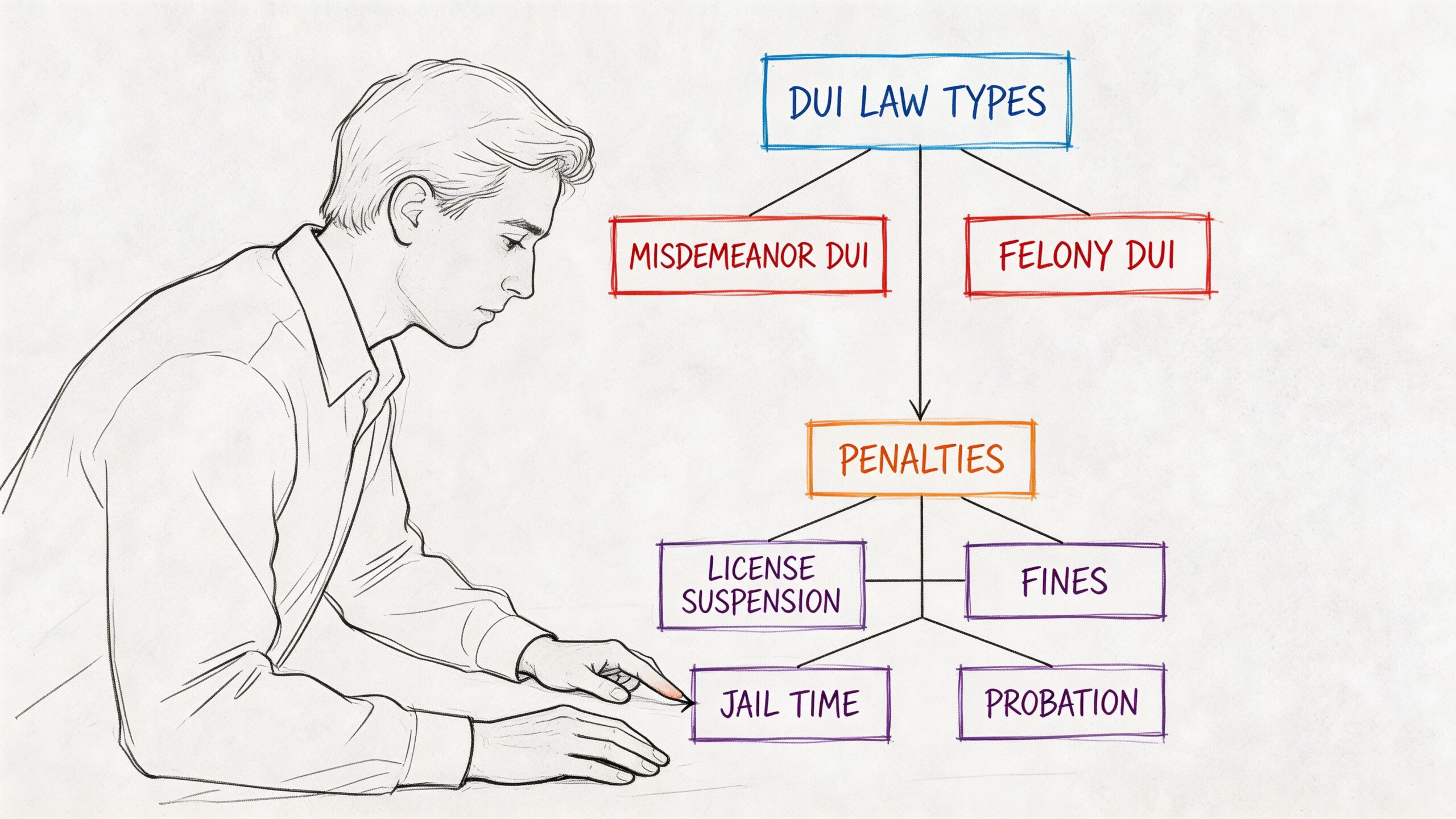
Under O.C.G.A. §40-6-391, Georgia recognizes DUI charges based on alcohol, drugs, or a combination of substances. The legal alcohol threshold also changes by driver category. For many drivers, the number people know is 0.08%. For commercial drivers, it is 0.04%. For drivers under 21, it is 0.02%.
DUI per se versus less safe
These two phrases trip people up because they describe two different ways the state may try to prove the same overall charge.
A DUI per se case is the number-based case. It works like a scale reading at the airport. If the bag is over the limit, the number itself becomes the problem. In a per se DUI, the state points to the chemical test result and argues that the reading crossed the legal line for your driver category.
A DUI less safe case is different. Here, the state argues that alcohol or drugs made you a less safe driver, even without a test result over the standard limit. That argument may rely on driving behavior, the officer’s observations, statements made during the stop, or roadside exercises.
That surprise is common. A driver may say, “My number was not that high,” and still face a charge because the state is not limited to one theory.
Why the exact charge matters right now
Your paperwork tells you more than what you are accused of. It hints at what evidence will matter on the court side and what may affect the license side.
If the allegation centers on a chemical test result, questions often focus on the test itself, when it was taken, and whether the state can support that result. If the allegation centers on impairment, attention often shifts to what the officer claims to have seen and whether those observations hold up.
This matters for a second reason. The same arrest can set two tracks in motion at once. The criminal court will deal with the charge. The driver’s license problem follows its own administrative path. Reading the citation, any chemical test notice, and every sheet handed to you after booking helps you see which facts may matter in both places.
The terms people mix up
Georgia law uses DUI, not DWI, as the charge name people usually see after an arrest. Everyday conversation blur the two. If you want a plain-English explanation, this guide on the difference between DUI and DWI in Georgia clears up the terminology.
Practical tip: Put your citation, bond papers, and any notice about chemical testing in one folder today. Then highlight the exact charge language. That single step makes the court track and the license track much easier to follow.
The Two-Front Battle Criminal Court and License Suspension
You get out of jail, look at the court date on your paperwork, and assume that is the main problem. In Cobb County, that assumption causes trouble fast. A DUI arrest usually starts two separate processes at the same time. One runs through criminal court. The other runs through the Georgia Department of Driver Services, or DDS.
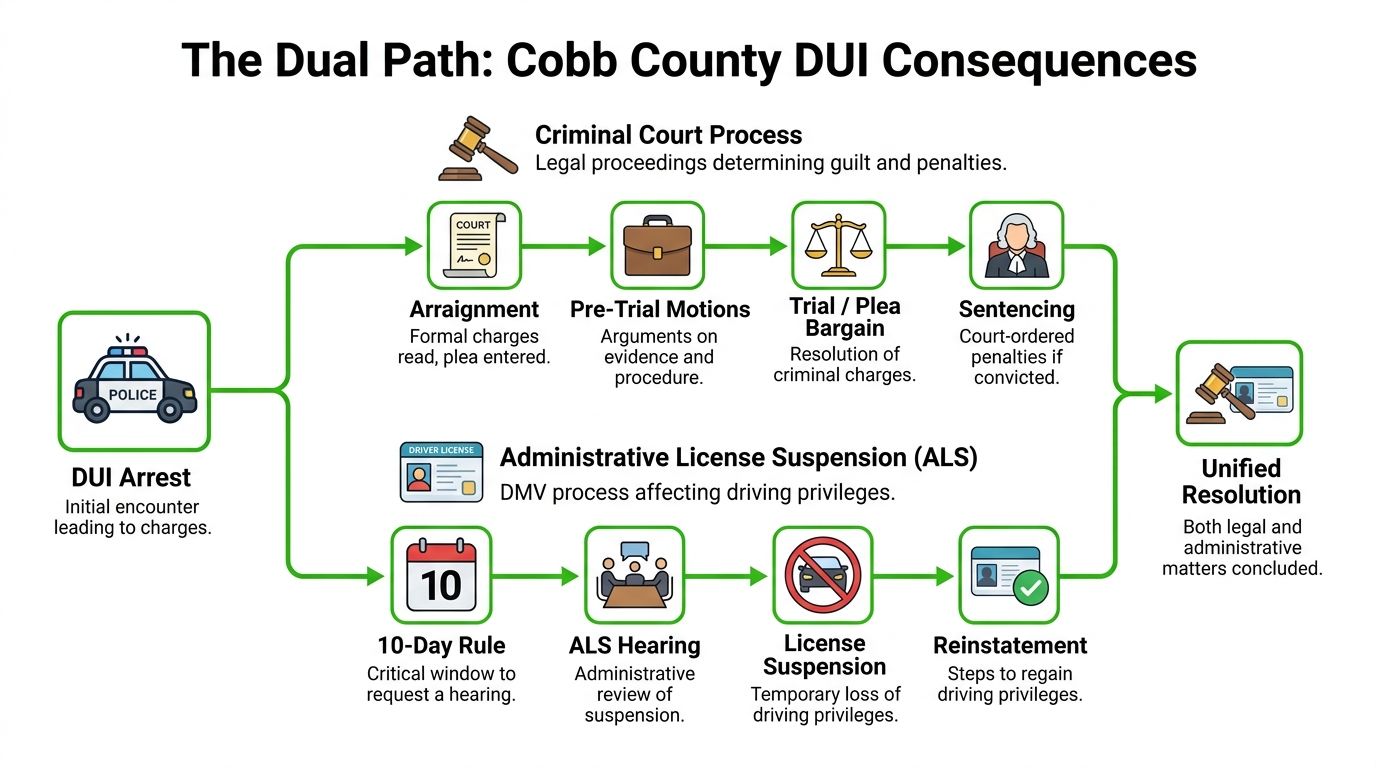
The easiest way to understand it is to picture two clocks starting on the same day.
The criminal court track decides the charge itself. That path deals with guilt or innocence, plea decisions, sentencing, fines, probation, jail exposure, and other court penalties.
The license track decides whether you can keep driving. That path is administrative. It has its own notices, deadlines, and consequences. It does not wait for the criminal case to finish before affecting your daily life.
Here is the side-by-side view:
| Track | Who handles it | What it decides |
|---|---|---|
| Criminal court | Cobb County court system | The DUI charge, plea, trial, and penalties if there is a conviction |
| DDS license action | Georgia Department of Driver Services | Whether your license is suspended, restricted, reinstated, or left in place |
That split confuses people because both tracks come from the same arrest, but they do not move in lockstep. A court date does not cancel a DDS deadline. A delay in court does not always protect your ability to drive. A good result in one track does not automatically fix the other.
For many drivers, the license side becomes the first real crisis. Getting to work, taking children to school, making probation appointments, and keeping medical visits all depend on transportation. Court feels bigger because it is formal and intimidating. Daily life usually feels the license hit first.
Why this catches people off guard
The paperwork often arrives in pieces. One sheet relates to the charge. Another may relate to testing or license consequences. If you do not sort those papers right away, it is easy to treat the whole case like one file with one deadline. It is not one file. It is two linked problems that need two sets of attention.
A good working habit helps here. Put every document in one folder, then make two stacks inside it. Label one Court and the other License. That simple step makes the process feel less chaotic because you can see which agency each paper belongs to.
The timeline that matters most
Use this basic sequence after an arrest:
Arrest and release
You receive paperwork tied to the charge and, in many cases, paperwork affecting your license.Early license decisions
DDS-related consequences can begin on a much faster timetable than the criminal case.First court appearances
The criminal case starts taking shape through hearings and formal court steps.Longer-term case resolution
The court track may continue for weeks or months while the license issue still needs separate attention.
That timing difference is the heart of the two-front battle. Court often feels slower. License trouble can feel immediate.
The lookback rule people mix up
Georgia also uses different lookback periods for different purposes. That is one reason people get conflicting answers when they ask friends what happened in another case.
For DDS suspension purposes, the state may look at a specific period. For criminal conviction escalation, the state may use a longer period, as noted earlier in this article. Those are not interchangeable rules. One affects the driving-privilege side. The other affects how prior convictions can change the court consequences.
If that sounds like two rulebooks, that is because it is.
Practical takeaway: After a Cobb County DUI arrest, track your case on two lines at once. One line is court. One line is your license. Write down every date, every notice, and every agency involved so one problem does not get worse while you are focused on the other.
Navigating the Cobb County DUI Court Process
A lot of people walk into the first court date expecting one big decision. Cobb County DUI cases usually do not work that way. Court works more like a series of checkpoints. Each one answers a different question, and each one gives you something specific to do.
That matters because your court case is only one track. Your license issue is the other. While the court side moves through hearings and paperwork, you need to keep your own file, calendar, and checklist so the two tracks do not get mixed together.
What the court process is doing
The court is trying to answer a few basic questions.
- What charge is being pursued
- What evidence exists
- Whether the case will resolve by plea or go to trial
- What conditions or penalties apply if there is a conviction
If you have never been through this before, it helps to picture the process like a ladder. You do not jump from arrest straight to final punishment. You move rung by rung, and missing one rung can throw off the whole climb.
The usual stages in a Cobb County DUI case
Arraignment
This is often the first formal courtroom step. You are told the charge, and a plea is entered. For many drivers, this is the moment the case stops feeling like paperwork and starts feeling real.
Pretrial review
This is the working stage of the case. The officer's report, test results, video, witness statements, and other evidence are reviewed. Legal issues may be raised here, and the court may set future deadlines or hearings.
Resolution talks or trial setting
Some cases are resolved through a negotiated plea. Others are prepared for trial. That decision usually turns on the evidence, the legal issues in the stop or arrest, and the person's prior history.
Sentencing or final court order
If there is a plea or conviction, the judge enters the sentence and lists what must be completed. That can include fines, jail time, probation terms, community service, classes, evaluations, treatment, and other conditions.
What people often misunderstand about the court side
The court date on your paperwork is not the date everything ends.
It is often the date the process begins in a more formal way. One hearing can lead to another. A reset may be granted. Records may need to be gathered. A class or evaluation may need to be completed before sentencing. That is why panic hurts people. So does passivity.
A better approach is steady compliance.
Penalties the court may discuss
Georgia DUI penalties depend on the facts of the case, your prior record, the test issue, and whether this is charged as a first or repeat offense. The court may discuss consequences such as:
| Penalty area | What it can involve |
|---|---|
| Fine | Court-ordered payment within the statutory range for the offense level |
| Jail | Minimum or extended custody time, depending on the charge and prior history |
| Probation | Supervision terms, reporting, and compliance conditions |
| Community service | Required service hours set by the court |
| Classes and programs | Risk Reduction, evaluation, or treatment requirements |
| Driving-related conditions | Orders tied to reinstatement steps or proof of completion |
The court may also require an alcohol and drug evaluation and follow-up care. If your paperwork mentions SAP or treatment planning, learn how the SAP Program works in Georgia DUI cases so the requirement does not catch you off guard later.
What to do while the case is pending
Treat your case like a two-folder project. One folder is for court. One is for your license.
For the court folder, keep these items together:
- Citation and bond papers
- Court dates and courtroom location
- Proof of any classes, evaluations, or treatment
- Receipts for fines, fees, towing, and related costs
- Notes from calls with the clerk, your lawyer, or program providers
- Any documents or records tied to the stop, arrest, or testing
A simple mistake causes a lot of trouble here. People complete something the court asked for, then show up without proof. Keep every certificate and receipt.
A practical timeline mindset
Court often feels slow, then suddenly urgent.
You may have weeks between hearings, but that does not mean nothing is happening. Deadlines can still be running in the background. Paperwork may still need to be filed. Program slots may fill up. If your case later requires DUI School, evaluation, or treatment, waiting until the last minute can create delays that affect sentencing, probation compliance, or reinstatement steps.
Questions to ask early
Ask direct questions and write down the answers.
- What court is handling my case
- What is my exact charge
- When is my next appearance
- Do I need to complete anything before that date
- If I finish a class or evaluation, where do I file proof
- Who should I contact if my address changes
Clear questions save time. Vague questions usually create more stress.
The safest way to handle this stage
Show up. Stay organized. Confirm every date. Keep proof of every step you complete.
People who do best in Cobb County DUI cases are usually the ones who stop guessing early. They treat the court process and the license process as two separate timelines, and they manage both on purpose.
Protecting Your Driving Privileges from the DDS
For many drivers, the license side is the part that wrecks normal life fastest.
Court may feel like the main event, but the DDS issue is what determines whether you can legally drive to work, take a child to school, or keep routine appointments. That is why you need to treat the administrative process as its own project.
The first thing to understand
The DDS process is not just a side note to the criminal case. It has its own deadlines, paperwork, and consequences. If you ignore it, you can create a much longer interruption in your ability to drive.
The exact timing of what you can request and when depends on the type of arrest, the testing issue, and the notice you received. Read your documents carefully and confirm the deadline tied to your case.
What this part of the process focuses on
The administrative side usually centers on questions like these:
- Was there a chemical test issue
- Was there a notice of suspension
- Do you need to request a hearing or pursue another eligibility path
- What steps does DDS require before reinstatement
These are practical questions, not philosophical ones. They affect transportation, employment, and compliance.
Why the DDS process feels unfair
Many drivers say the same thing, “How can my license be at risk before my court case is finished?”
That frustration is common because the systems are separate. The state treats the privilege to drive as an administrative matter that can move on its own timeline.
Tip: If you rely on driving for work, do not assume your employer will understand a sudden interruption. Get clear on your status early so you can make a plan before a missed shift turns into a job problem.
Reinstatement is often where delays grow
Drivers tend to focus on suspension and forget about reinstatement. But reinstatement can require proof of completion, documentation, and sometimes additional steps tied to assessment or treatment.
That is where people run into terms they have never dealt with before. For example, some drivers confuse DUI education with workplace substance programs. If you are trying to understand that broader category, this explanation of what the SAP program is helps distinguish different compliance systems.
Keep your attention on paperwork
On the DDS side, small paperwork errors create large delays. That includes:
- Old addresses: Notices go to the wrong place.
- Missing completion records: You finish a requirement but fail to document it properly.
- Wrong assumptions: You think court completion automatically updates your driving status.
The safest approach is simple. Read every notice. Keep copies. Confirm what DDS still needs. Do not drive on assumption.
Meeting Your DUI School and Treatment Requirements
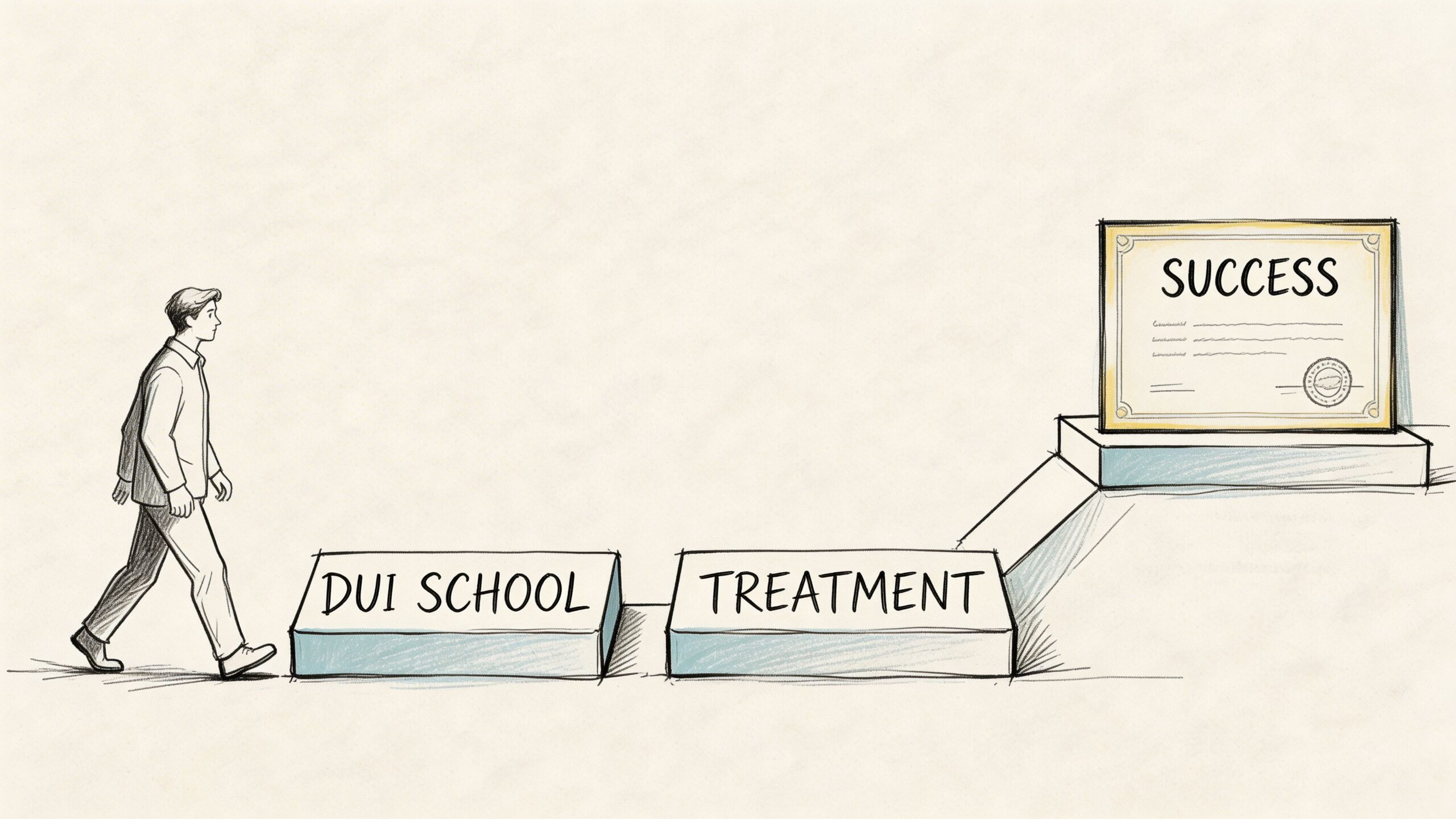
You leave court thinking, “I took care of the case, so I should be done.” Then someone mentions DUI School, an evaluation, and maybe treatment. That is the point where many Cobb County drivers feel lost, because these steps can affect both your court case and your ability to get fully back on the road.
A good way to understand this section is to separate the jobs each requirement does. The court wants proof that you completed what the judge ordered. DDS looks for what is needed to clear your driving status. An evaluator looks at whether education alone is enough or whether more care is recommended.
What Risk Reduction means
In Georgia, Risk Reduction is the state-approved DUI School program. It is not just any alcohol awareness class, and it is not a substitute for counseling if counseling is later required.
For many people, this is the first box to check. But it is only one box.
The part that causes confusion
Drivers often hear “DUI School” and assume the whole requirement starts and ends there. In some cases, it does not. Your case may also involve a clinical evaluation, and that evaluation can lead to a treatment recommendation.
That creates two tracks to watch at the same time:
- Court compliance: What your sentence or probation requires
- License compliance: What DDS will want before your driving status is fully cleared
- Clinical compliance: What the evaluator recommends after the assessment
- Case-specific extras: Items such as a Victim Impact Panel if ordered
Those tracks can overlap, but they do not always move in a straight line.
Why the evaluation matters
The evaluation works like a checkpoint after the class. It answers a practical question, is education enough, or does this case call for added treatment?
That is why some people get surprised late in the process. They finish the class, then learn another appointment is still missing. If you want a plain-English explanation of that step, this overview of online drug and alcohol evaluations explains what the appointment covers and why it matters in DUI cases.
How to keep the two-track process straight
Use a simple checklist and treat each item like a separate receipt you must collect.
First, confirm whether the court order specifically names Risk Reduction, an evaluation, treatment, or any panel requirement. Second, ask what completion document each provider gives you. Third, keep copies for yourself before you assume the next office received them. A class certificate does not automatically prove you finished an evaluation, and an evaluation does not automatically prove you completed recommended treatment.
One missed handoff can slow everything down.
The safest approach
Schedule the class and any required evaluation early, not at the last minute. Providers may have limited openings, and treatment, if recommended, takes longer than a one-day class.
If you were just arrested, focus on sequence. Finish what can be finished now. Verify what still must be reported to the court, what must be shown to DDS, and what has to be completed before you can say the case is behind you.
Is the Cobb County DUI Court an Option for You?
A second or repeat DUI often changes the conversation in a big way. Instead of asking only, "How do I finish probation and get this over with," you may also be asking whether the court will push for a more structured program built around treatment, supervision, and close follow-up.
In Cobb County, that program may be DUI Court.
DUI Court is generally aimed at people with repeat DUI history, not someone facing a first arrest. It is a specialty court program that focuses on long-term behavior change. That usually means frequent check-ins, treatment requirements, testing, and stricter supervision than a standard case. The goal is not to close the file. The goal is to reduce the chance that the person ends up back in court again.
Who should ask about it
If your case involves a prior DUI, ask your lawyer whether DUI Court could become part of the discussion. Ask early. Do not assume you will be offered a place, and do not assume you can request it late and still keep all your options open.
Eligibility and admission are controlled by the court. Your record, the facts of the case, and the program's screening process all matter.
What the commitment usually looks like
The Cobb County DUI Court program is described by the county as a long-term, treatment-based court option. According to Cobb County DUI Court program information, participation commonly lasts 12 to 24 months.
That timeline matters because it helps you plan realistically.
A one-day class fits on a calendar. A year or more of treatment, reporting, testing, and court supervision affects work schedules, transportation, family routines, and money. If you are weighing this option, treat it like a second job with rules attached.
How it fits into the two-track DUI process
Here is where people get confused. DUI Court may help shape the criminal court side of your case, but it does not erase the separate license side.
Those are two different tracks.
One track is the court case in Cobb County. The other is your ability to keep, restore, or reinstate your license through DDS. DUI Court participation can overlap with what the court expects from you, but it does not automatically handle every DDS requirement for you. A good way to picture it is two checklists on the same kitchen counter. Completing one does not mean the other is finished.
So if DUI Court is being discussed, ask four direct questions:
- Does this program change my criminal sentence, and how
- What separate steps still apply to my driver's license
- Which completion records do I need to keep for court
- Which records, if any, must also be shown to DDS
Why some people choose it
For the right person, DUI Court offers structure that ordinary probation may not provide. Some drivers do better with close supervision, regular accountability, and a treatment plan that is checked instead of merely assigned.
That does not make it an easy option.
It makes it a serious option.
The practical test
Before you agree to pursue DUI Court, be honest with yourself about daily life, not just legal strategy.
- Can you show up consistently for a long program
- Can you follow treatment rules even when work and family get messy
- Can you handle testing, reporting, and monitoring without falling behind
- Can you stay organized enough to track both court duties and license duties at the same time
A repeat DUI case often turns into a paperwork and compliance problem as much as a court problem. People get into trouble when they assume one office told the other office, or one program completion covers every requirement. If DUI Court is on the table, treat it as a structured commitment with benefits, pressure, and a long timeline, not as a shortcut.
Your Immediate Checklist After a Cobb County DUI Arrest
When people freeze after an arrest, they usually do so because they do not know what to do first. Start here.
- Read every paper you were given: Your citation, bond paperwork, and any notice affecting your license matter.
- Calendar every deadline immediately: Court dates and DDS-related deadlines should go into your phone and onto paper.
- Confirm your exact charge: Do not rely on memory from the roadside.
- Preserve evidence: Save receipts, location history, towing records, and anything else tied to the stop and arrest.
- Get legal advice quickly: Cobb County DUI cases move fast, and early advice is more useful than late cleanup.
- Do not miss court: Missing a court date creates a second crisis.
- Check your driving status before you drive again: Do not guess.
- Ask what completion items may be required: Risk Reduction, evaluation, treatment, and related compliance steps often take planning.
- Keep a case folder: One place for notices, class records, payment receipts, and court documents prevents costly confusion.
For local help, many drivers start by identifying the court named on their paperwork, then contacting the appropriate clerk’s office or defense counsel to confirm the next date and the exact status of the case.
Final reminder: The person who handles a DUI case best is usually not the person who panics least. It is the person who responds early, keeps records, and completes each required step in order.
If you need to complete a state-approved requirement after an arrest, Georgia DUI Schools offers DUI/Risk Reduction courses, clinical evaluations, ASAM Level 1 treatment, Victim Impact Panels, and flexible online or in-person options across Georgia.