Getting your Georgia learner's permit is a huge step, and the path to getting one is pretty clear once you know what to do. The whole process is designed to make sure you're ready for the responsibility of driving.
It all starts at a Georgia Department of Driver Services (DDS) center. Before you head to a local office in places like Athens or Alpharetta, you need to be at least 15 years old, have the right documents handy, and be prepared to pass a two-part knowledge exam.
This permit, officially called a Class CP Instructional Permit, is your first ticket into Georgia's Graduated Driver Licensing (GDL) program. It’s all about helping new drivers like you get crucial experience with a licensed adult in the car.
The Path to Your Permit
Think of getting your permit as a series of small, manageable steps. First, you hit the age requirement. Next, you'll need to round up a specific set of documents that prove who you are and where you live. After that, it’s time to head to the DDS to take your vision and knowledge tests.
This chart breaks down the basic flow for you.
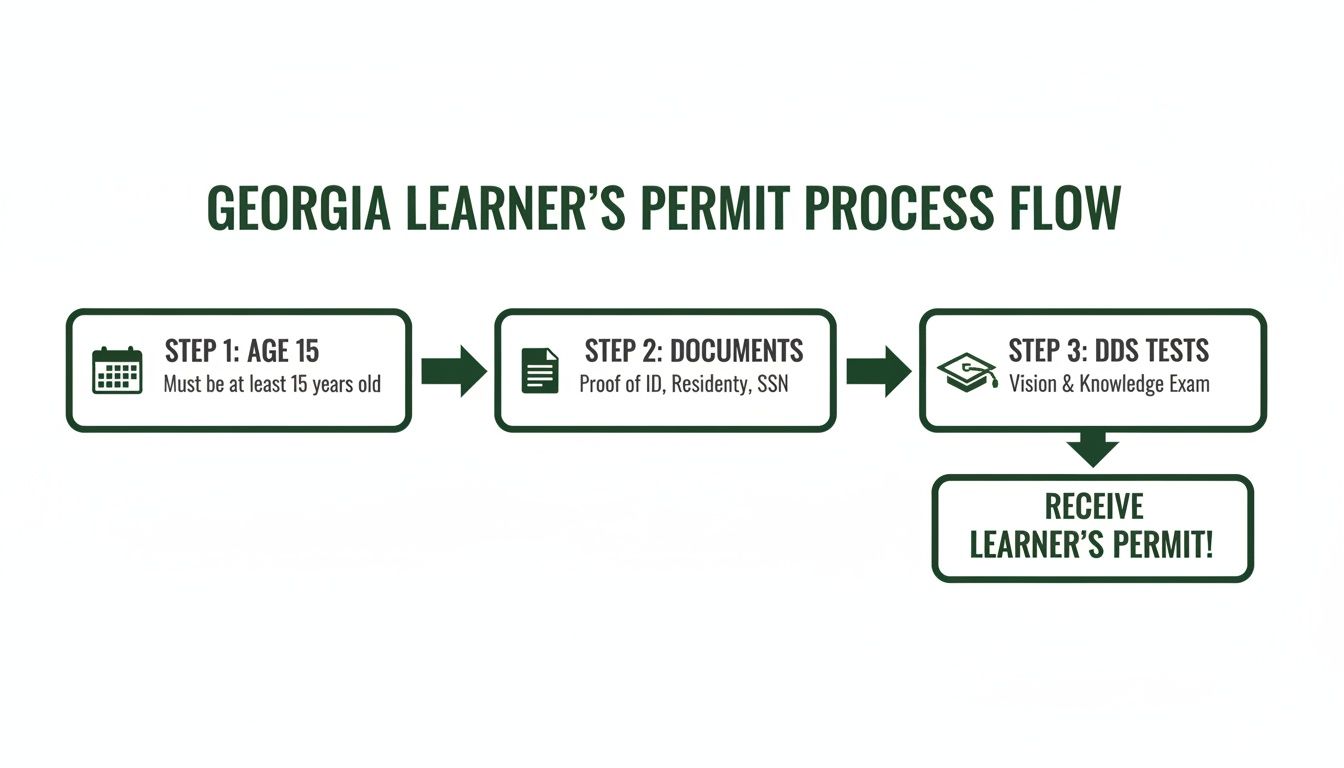
As you can see, it really boils down to three things: being old enough, having your paperwork in order, and passing the tests.
To make sure you have everything ready for your appointment, use this quick checklist.
Georgia Learner's Permit Quick Checklist
| Requirement | Details |
|---|---|
| Minimum Age | You must be at least 15 years old. |
| Identity Proof | Original or certified copy of your Birth Certificate or a valid U.S. Passport. |
| Social Security Proof | Your original Social Security card or a W-2 showing your full SSN. |
| Residency Proof | Two documents proving Georgia residency, like utility bills or bank statements. For minors, a parent/guardian's documents are used. |
| School Enrollment | A Certificate of School Attendance (DS-1) dated within the last 30 days. |
| Parent/Guardian | A parent or legal guardian must be present to sign your application. |
| ADAP/eADAP | Proof of completion of the Alcohol and Drug Awareness Program. |
Having these items organized and ready to go will make your trip to the DDS go much smoother.
Why This Process Matters
In Georgia, you can get your learner's permit at age 15, which is an exciting first step toward independence. In 2022, a whopping 71% of Georgia’s 15-20 year-olds had a permit or license.
But that freedom comes with a serious reality check. Young drivers in that same age group accounted for 8% of all licensed drivers but were involved in 10% of vehicle crashes. You can dig into more of these teen driving stats on the DDS website.
This is exactly why Georgia’s Graduated Driver Licensing (GDL) program exists. It’s not about holding you back—it's about easing you into the driver's seat safely, one step at a time, to reduce those risks.
Going through this process ensures you're not just getting a piece of plastic but are truly preparing for the road ahead. Once you have your permit, a state-approved education program is a smart next move.
Our comprehensive defensive driving course is a great way to build the skills and confidence every new driver needs.
Gathering Your Essential Documents for the DDS

Let's be honest—the biggest roadblock for most people getting their Georgia learner's permit isn't the test. It's the paperwork. I've seen countless people get turned away from the Department of Driver Services (DDS) for one missing document, and it's a frustrating waste of time.
To make sure your trip to the DDS is a successful one, you need to get all your ducks in a row before you go. The DDS has very strict rules to verify who you are and where you live, so there’s no room for error.
Proof of Identity and Citizenship
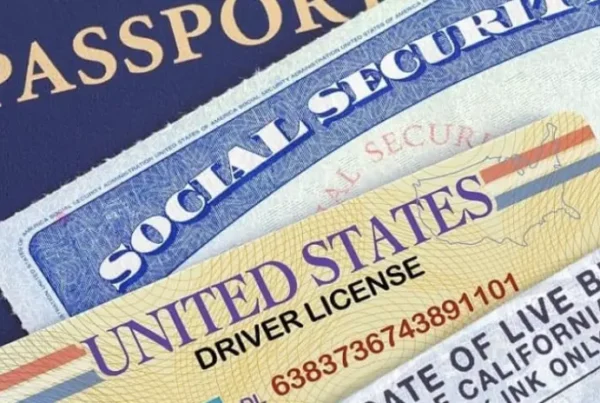
First up, you need to provide solid proof of your identity and U.S. citizenship. Don't even think about bringing photocopies or expired documents; they will be rejected on the spot.
You must bring one of these original or certified documents:
- Original or Certified U.S. Birth Certificate: This has to be the official copy from a government agency, not the cute one from the hospital. If you were born in Georgia and need a fresh copy, you can order one from the Georgia Department of Public Health's Vital Records office.
- Valid, unexpired U.S. Passport.
- Consular Report of Birth Abroad (FS-240).
You also need to prove your Social Security Number. The easiest way is to bring your original Social Security card. If you’ve misplaced it, a recent W-2 form from an employer that shows your full SSN will also work.
Proving You Live in Georgia
Next, the DDS needs to see proof that you're a Georgia resident. You'll need two different documents that show your current address. For most teens, this will mean using documents belonging to a parent or legal guardian.
The name and address on your residency documents have to perfectly match the info of the parent or guardian signing your application. This is a common trip-up, so double-check it.
Acceptable documents include:
- A recent utility bill (e.g., Georgia Power, Atlanta Gas Light) from the last 2 years.
- A bank statement from a local branch like Truist or Synovus.
- Your most recent school report card or official transcript.
- Any mail from a federal, state, or local government agency.
A parent can also sign a DDS form to certify your residency, but they'll still be required to show their own two proofs of residency. For a full rundown, check out our guide on the documents needed to legally drive in Georgia.
The School Enrollment Form (DS-1)
Finally, if you're under 18, you absolutely must bring a Georgia Certificate of Attendance (Form DS-1). You can get this form from your high school's main office, whether you go to a big public school like North Gwinnett High or a small private one.
Here's the catch: this form is only valid for 30 days. Don't get it too early! Plan on picking it up right before your scheduled DDS appointment to make sure it doesn't expire. This document proves you're enrolled in school, which is a non-negotiable requirement for a learner's permit in Georgia.
Passing The Knowledge And Vision Tests With Confidence
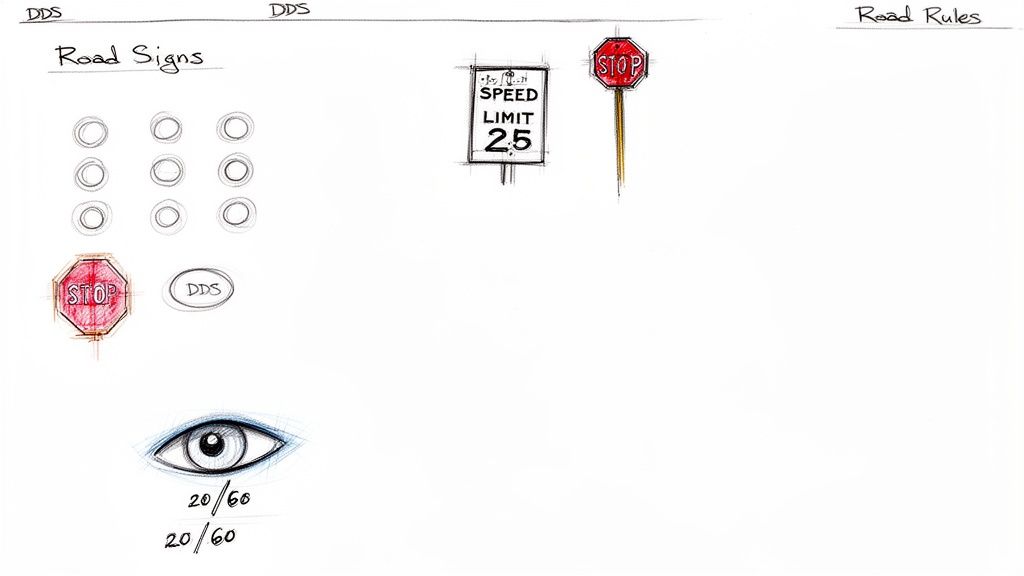
It's completely normal to feel some butterflies about the Georgia DDS tests. But don't worry—with a little smart preparation, you can walk in feeling confident and walk out with your new permit.
The whole thing boils down to a vision screening and a two-part knowledge exam. Both are designed to make sure you’ve got the basics down before you get behind the wheel.
The knowledge exam is split into two sections: Road Signs and Road Rules. You have to score at least 15 out of 20 on each section to pass. This isn’t trivia; it’s about proving you understand the core principles that keep everyone safe on the road.
Mastering The Georgia Driver's Manual
Your absolute best friend in this process is the official 2026 Georgia Driver's Manual. Every single question on the permit test comes directly from this book. Don’t just skim it—read it like it's a textbook for a final exam, because it is.
Make sure you really understand these key chapters:
- Traffic Laws: This covers your fundamentals, from speed limits to the rules for passing other cars.
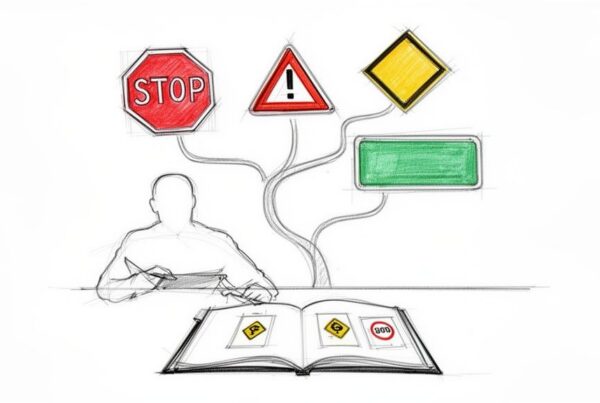
- Signs, Signals, and Markings: You need to know what a sign means instantly just by its shape and color.
- Right-of-Way: Knowing who goes first at an intersection isn't just a test question; it’s a critical real-world skill.
Knowing this material inside and out is non-negotiable. In 2022, 71% of Georgia’s 15-20-year-olds had a permit or license. While that’s a lot of young drivers, they also made up 8% of the total licensed population but were involved in 10% of all crashes. This is exactly why passing these tests is so important for building safe driving habits from day one. You can read more about it in the 2022 Georgia Traffic Safety Facts on young drivers.
Smart Study Strategies And Practice Tests
Just reading the manual is a good start, but you have to actually test your knowledge to see what sticks. Find some DDS-approved practice test apps or websites and start quizzing yourself. This is the best way to find your weak spots before you're sitting at the DDS.
One of the most common mistakes people make is getting confused by four-way stops. The rule is simple: the first vehicle to get there has the right-of-way. If two cars show up at the same time, the driver on the left has to yield to the driver on the right.
Speed limits can also be tricky. Remember the general rules, but also pay attention to specifics, like how speeds on major highways like I-285 around Atlanta can change depending on traffic or construction. For a deeper dive into this part of the exam, check out our guide on how to ace the GA road sign test.
Passing The Vision Test
Before you even get to the knowledge exam, you’ll have to pass a quick vision screening. To pass, you need to have at least 20/60 vision in one eye, either with or without corrective lenses.
If you wear glasses or contacts for driving, make sure you have them with you. The test is easy—you'll look into a machine and read a few letters or identify symbols.
If you fail the vision test, you won’t be allowed to move on to the knowledge exam that day. If you have any doubts about your eyesight, it’s a good idea to visit an optometrist for a check-up before your DDS appointment.
Your Day at the DDS From Appointment to Permit

Alright, you’ve gathered your documents and studied the driver's manual. Now it’s time for the main event: your trip to a Georgia Department of Driver Services (DDS) Customer Service Center.
Here's my first and most important piece of advice: schedule an appointment online. This one move can be the difference between a quick in-and-out visit and spending hours in those notoriously long lines, especially at busy spots like the centers in Atlanta, Macon, or Savannah.
You can try walking in, but it's always a gamble. Scheduling ahead secures your spot and lets you plan your day with confidence.
Navigating the DDS Process
Try to get there about 15 minutes early. This gives you a little breathing room to find parking, get through any initial check-ins, and organize your papers one last time before they call your number. Trust me, you don't want to be frantically digging through your bag when it's your turn.
Once inside, the process is pretty straightforward. A DDS agent will start by checking every single one of your documents. Once they confirm everything is in order, you’ll take the vision test and then the two-part knowledge exam.
Pass those, and it’s time for your photo!
Make sure you're camera-ready, because this picture is sticking with you until you get your next license. After the photo, the last step is just paying the fee.
The learner's permit fee is $10, so be ready to pay on-site.
What to Bring and How to Pay
Besides your required documents, all you need is yourself and your parent or guardian. The DDS makes paying easy with several options.
- Cash: Always works.
- Credit/Debit Cards: They take Visa, Mastercard, Discover, and American Express.
- Mobile Pay: Most locations now accept Apple Pay and Google Pay, too.
To avoid any last-minute panic, keep everything in a single folder. Do one final check before you leave the house: birth certificate, Social Security proof, two residency documents, and your 30-day valid Certificate of Attendance (Form DS-1).
As soon as you pay, you’ll get a temporary paper permit right on the spot. This is your official green light to start driving with a supervisor. Congratulations, you now know how to get your learner’s permit in Georgia! The real fun—and learning—starts now, behind the wheel.
A great way to build on your on-the-road practice is with structured lessons that boost both your skills and your confidence. Check out our DDS-approved driver's ed course to start your driving journey the right way.
Got Your Permit? Here’s What Happens Now
Holding that new Class CP Instructional Permit is a great feeling—it’s your official start to a life of driving. But getting the permit is just the first step. The real work starts now, and it comes with some serious rules you need to follow to the letter.
The biggest rule is the supervision requirement. Any time you’re behind the wheel, a licensed driver who is at least 21 years old must be in the front passenger seat with you. No exceptions. This isn't just about having an adult in the car; it’s about having an experienced guide who can coach you through tough spots, like merging onto a packed Atlanta freeway or handling a sudden thunderstorm.
Understanding Georgia's Graduated Licensing Rules
Your learner's permit is the first stage in Georgia’s Graduated Driver Licensing (GDL) program. The whole system is set up to ease you into driving in low-risk, controlled situations before you gain more freedom. Think of it as your driving apprenticeship.
To move up to the next level—a Class D Provisional License at age 16—you have to hit a few key milestones.
- Hold Your Permit: You must have your learner's permit for at least one year and one day.
- Supervised Driving Hours: You have to log a total of 40 hours of supervised driving practice. Your parent or guardian will need to sign off on these hours, so it's not just a suggestion.
- Night Driving: At least six of those 40 hours must be done at night. Driving after dark brings its own unique set of challenges, and this is where you learn to handle them.
This structured approach really works. Georgia's GDL system and its requirements have helped the state earn strong national rankings for teen driver safety. In fact, Georgia placed 10th overall for teen drivers, largely because the state requires those 40 supervised hours before a teen can get their Class D license. You can read more about how these rules contribute to safer roads in this analysis on teen driving in Georgia.
Building Good Habits from Day One
These initial 40 hours are where you build the foundation for a lifetime of safe driving. This is your time to practice everything, from parallel parking in a tight spot in downtown Decatur to correctly navigating a confusing multi-lane roundabout.
This period is about more than just logging hours. It's about developing situational awareness, learning to anticipate what other drivers might do, and building the muscle memory to react calmly and correctly when things get stressful.
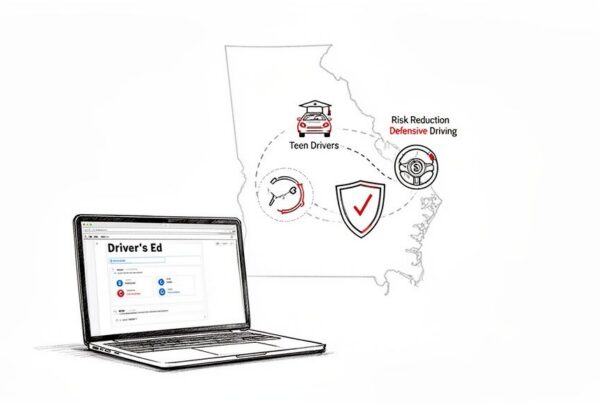
Enrolling in a good driver's education course is one of the smartest things you can do to supplement your practice. A formal program goes beyond what a parent can teach, offering structured lessons on hazard perception, defensive driving, and navigating the specific challenges of Georgia's roads.
For those who want a flexible option, a DDS-approved online driver's education course is an effective way to master these critical skills on your own schedule. Plus, completing a course often leads to significant insurance discounts, which is a great bonus for your parents.
Got Questions About the Georgia Learner's Permit? We've Got Answers.
Getting a learner's permit is a big step, and it's normal to have a few questions pop up along the way. We get calls and emails about this all the time, so we've put together answers to some of the most common things people ask.
What Happens If I Fail the Permit Test?
First off, don't panic. It happens more often than you might think. If you don't pass either the Road Signs or Road Rules section of the knowledge exam, you can't retake it on the same day.
You have to wait at least one full day before trying again. If you fail a second time (or more), that waiting period extends to seven days. Take that time as a good excuse to really dig back into the Georgia Driver's Manual and focus on the topics that tripped you up.
Can I Use Driving Experience from Another State?
Yes, you can! This is a big question for families who've recently moved to Georgia. If a teen has already logged some supervised driving hours in another state, they can absolutely count toward the Georgia requirement.
The key is that the experience must have been supervised by someone who was at least 21 years old and held a valid driver's license in that state. Your parent or legal guardian will still need to sign an affidavit at the DDS, certifying that all 40 hours (including six at night) were completed.
Keep a detailed log of your driving hours, no matter which state you're in. Note the date, how long you drove, and whether it was day or night. That log is exactly what your parent or guardian will need to confidently sign the DDS form.
How Do I Replace a Lost or Stolen Permit?
Losing your permit is a pain, but thankfully, getting a replacement is pretty simple. You'll just need to head back to a DDS Customer Service Center and apply for a new one.
Be sure to bring the same documents you used to get your permit the first time. The DDS needs to re-verify everything. This includes:
- Proof of your identity (like a certified birth certificate)
- Proof of your Social Security Number
- Two documents proving Georgia residency
The replacement fee is $5. While snapping a picture of your permit on your phone is a smart backup, remember that only the physical card is considered valid when you're behind the wheel.
Do I Still Need a Permit If I'm 18 or Older?
If you're 18 years or older and have never had a license, you are not required to hold a learner's permit for a specific amount of time. You can go straight for a full Class C driver's license if you feel ready.
Just remember, you'll still have to pass the same vision test, knowledge exam, and the on-the-road driving test. Many adults with little driving experience find it incredibly helpful to get a learner's permit first anyway. It gives them a legal way to practice on the road before facing the pressure of the road test.
No matter where you are in your driving journey, building a strong foundation of safety is the most important thing you can do. The instructors at Georgia DUI Schools are experts in the defensive driving skills that prepare you for the real-world challenges on Georgia's roads.
Ready to become a safer, more confident driver and fulfill your Joshua's Law requirement? Check out our state-approved DDS-approved online driver's education course.