Before you can get your Georgia learner’s permit, you have to pass the road sign test. This isn’t just about memorizing shapes and colors; it’s about understanding the basic language of the road. It’s a skill that keeps everyone safer every single time you drive, whether you’re navigating the Downtown Connector in Atlanta or a rural road in Valdosta.
Why the Road Sign Test Is Your First Step to Safer Driving
Think of the road sign test as the first real step in your driving journey. Before you can handle the busy I-285 Perimeter in Atlanta or a quiet country road, you need to prove you understand the signs that direct traffic. This is non-negotiable, whether you’re a teen eager to drive or an adult trying to get your license back after a DUI.
To get your learner’s permit, you must pass the two-part DDS knowledge exam. It includes the Road Signs Test and the Road Rules Test. Many new drivers find the sign test surprisingly tricky.
Here’s a quick look at what the Georgia Road Sign Test involves.
Georgia Road Sign Test At a Glance
| Test Component | Number of Questions | Passing Score | Who Needs to Take It |
|---|---|---|---|
| Road Signs | 20 | 15 correct (75%) | New drivers seeking a learner’s permit |
| Road Rules | 20 | 15 correct (75%) | New drivers seeking a learner’s permit |
You’ll take both tests together, for a total of 40 questions. You need to get at least 30 right overall to move on.
More Than Just a Test
Knowing your road signs is about more than just passing a test—it’s the foundation of defensive driving. Recognizing a “Slippery When Wet” sign just before a classic Georgia downpour or seeing a “No Passing Zone” sign on a two-lane road like Highway 129 are the kinds of things that prevent accidents.
Being able to instantly recognize and react to road signs is a core part of defensive driving. It’s what helps you avoid a hazard instead of becoming one.
For anyone working to get their license reinstated, proving you know your signs is a big deal. It shows you’re committed to being a safe, responsible driver again. A solid grasp of road signs builds the confidence you need for any situation on the road. As you’ll see in our guide on the benefits of defensive driving, this basic knowledge is your best defense against accidents.
This guide will walk you through everything. We’ll cover all the sign categories, point out the ones that trip people up, give you practice questions, and lay out a study plan so you can walk into the DDS and pass.
Cracking the Code: A Guide to Georgia’s Road Sign Categories
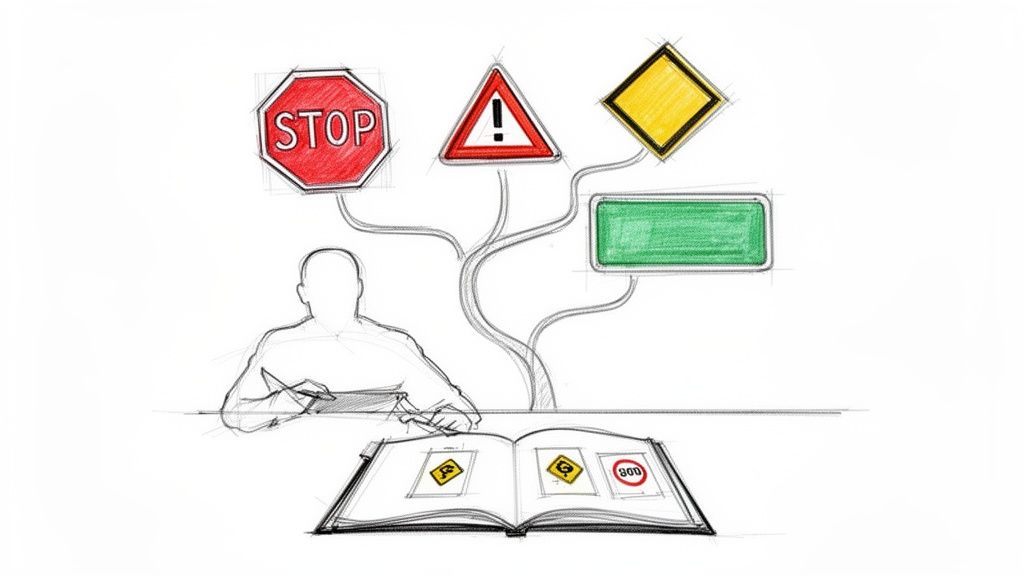
Passing the GA road sign test isn’t about memorizing hundreds of signs one by one. It’s about learning to speak a new language—the visual language of the road. Every sign uses a specific shape, color, and symbol to get its message across. Once you get the hang of these basic rules, you can usually figure out what a sign means even if it’s your first time seeing it.
Think of it like learning the alphabet before you learn to read. Master these core sign categories, and you’ll be well on your way to becoming a more confident and safer driver.
This chart shows how knowing your road signs and rules is your direct path to earning that Georgia learner’s permit.
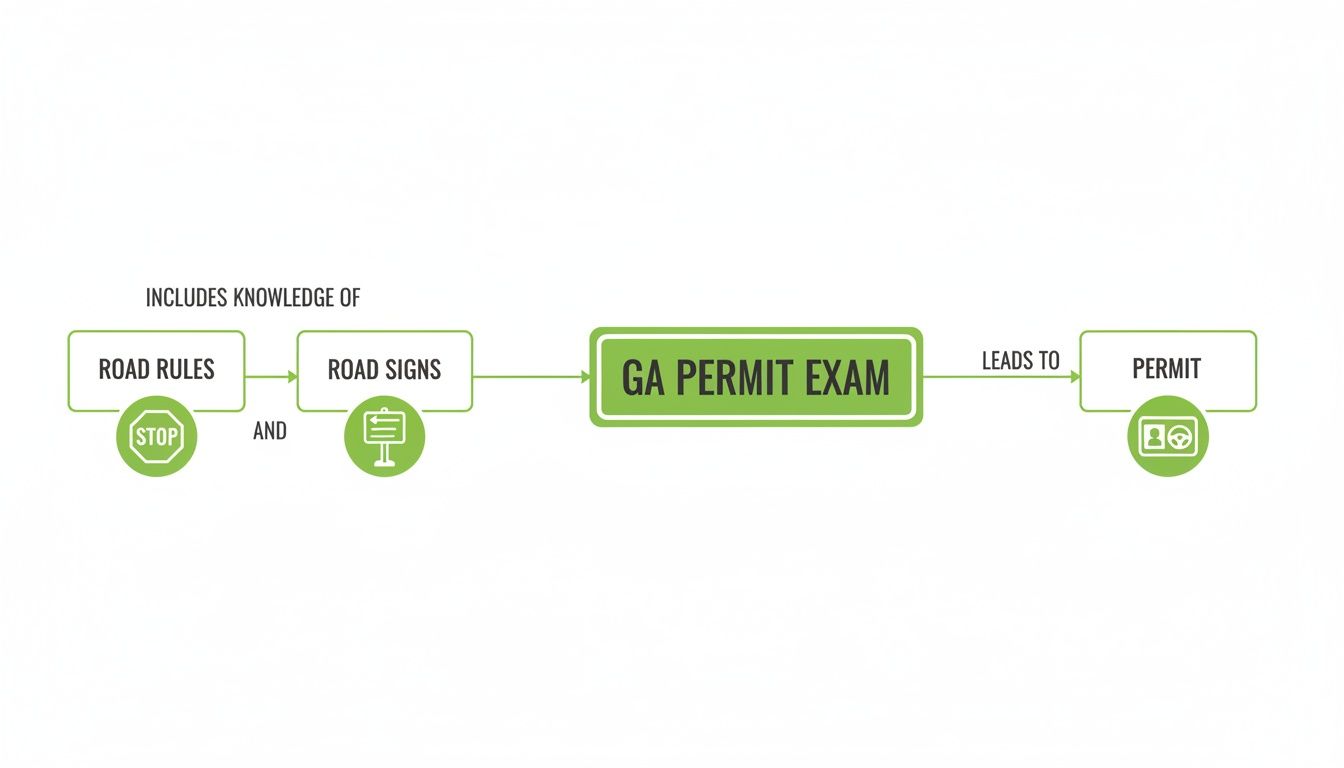
As you can see, both sides—the rules of the road and the signs—are equally important for passing your exam and getting behind the wheel.
Regulatory Signs: These Are the Law
Regulatory signs aren’t suggestions; they’re the law, printed on a sign. They tell you exactly what you must do or, more often, what you must not do. Most are rectangular with black or red letters on a white background.
Of course, the two most famous exceptions are the STOP sign (an octagon) and the YIELD sign (an inverted triangle). Their unique shapes make them impossible to miss, even from far away or in bad weather.
Ignoring these signs isn’t just a bad idea on your test. It’s a traffic violation that comes with fines and points. For example, rolling through a stop sign in a Savannah historic square can tack three points onto your driving record.
You’ll see these all over the state:
- Speed Limit Signs: These set the legal top speed, whether it’s 25 MPH in an Athens neighborhood or 70 MPH on I-75 heading toward Macon.
- Do Not Enter: A critical sign for preventing head-on collisions, especially on one-way streets in downtown Atlanta.
- Peach Pass Only: This is a Georgia-specific sign you’ll find on the I-85 and I-75 express lanes. It means the lane is only for drivers with a Peach Pass.
Warning Signs: A Heads-Up for What’s Ahead
If regulatory signs are orders, warning signs are helpful alerts. They give you a heads-up about potential dangers or changes in the road so you have plenty of time to react. You’ll know them instantly: almost all are diamond-shaped with black symbols on a yellow background.
That consistent look is designed to trigger a quick response. The second you see that yellow diamond, your brain should think, “Okay, slow down and pay attention.”
The moment you spot a diamond-shaped sign, ease off the gas and scan the road. It’s a simple habit that defines defensive driving and gives you those crucial extra seconds to avoid an accident.
Whether you’re on a curvy road in the North Georgia mountains or navigating a construction zone on the I-16/I-95 interchange near Savannah, these signs are your best friend for knowing what’s coming.
Common examples include:
- Curve Ahead: Tells you the road is about to bend. A sharp arrow means a tight turn, while a gentler arrow indicates a wider curve.
- Slippery When Wet: Absolutely essential for Georgia’s pop-up thunderstorms, this sign warns that the road surface loses traction in the rain.
- Railroad Crossing Ahead: This one has its own unique pre-warning sign: a yellow circle with a black “X” and “RR.” It’s your first clue that you’re approaching tracks.
Guide Signs: Your GPS in Sign Form
Guide signs are all about helping you get where you’re going. They give you directions, tell you how far you have to go, and point out services or attractions. Unlike the other types, guide signs use different colors to give you different kinds of information.
- Green Signs: These are for navigation. They show exit numbers, street names, and distances to cities. Think of the big green signs on GA-400 telling you where to get off for Roswell or Sandy Springs.
- Blue Signs: These point to driver services. If your tank is getting low on I-20 headed to Augusta, a blue sign will let you know which exit has gas, food, or a place to stay.
- Brown Signs: These are for recreation and culture. You’ll see brown signs pointing you toward places like the Chattahoochee National Forest or along Georgia’s Historic High Country Trail.
By getting a feel for these categories, you’re not just memorizing. You’re building a mental framework that makes studying for the GA road sign test much easier and more effective, preparing you for both the exam and a lifetime of safe driving. Our Online Drivers Ed course dives deep into these concepts to make sure you’re fully prepared.
The Signs That Trip Everyone Up: Common and Tricky Georgia Road Signs
So, you know your basic Stop and Yield signs. That’s a great start, but the GA road sign test is designed to go deeper. It wants to know if you can handle the specific, sometimes confusing signs you’ll face in the real world.
These are the signs that often cause drivers to lose points on the exam. More importantly, they’re the ones that require split-second decisions on Georgia’s busy roads. Let’s get these mastered now.
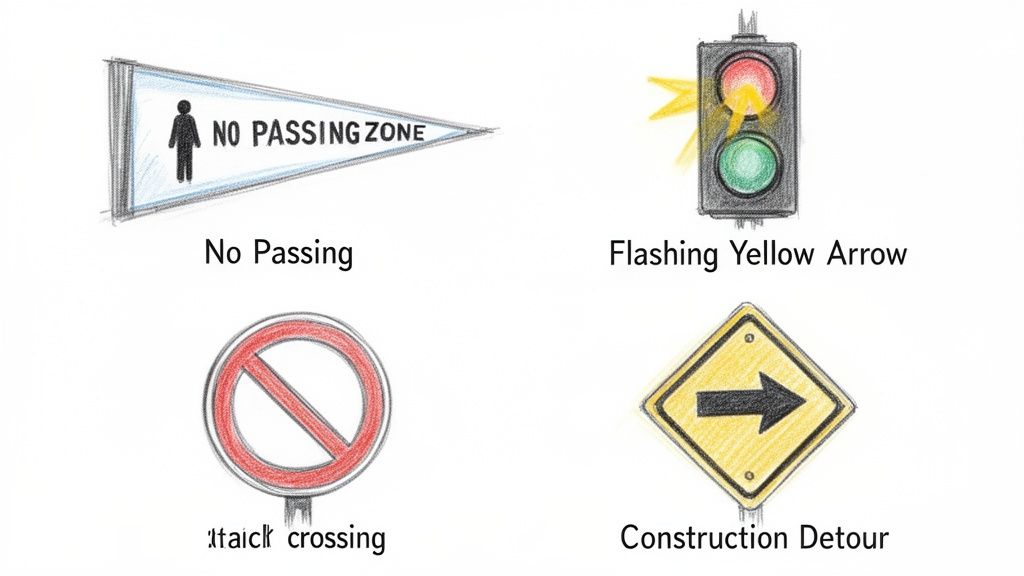
Tricky Regulatory Signs
Some regulatory signs are more than just a speed limit. Their specific shapes or instructions can be confusing, and missing their meaning can lead to a failed test or a dangerous situation on the road.
A classic point of confusion is the difference between two key passing signs.
- No Passing Zone Sign: This is the yellow, pennant-shaped sign on the left side of the road. Think of it as a “heads-up” that you’re about to enter a no-passing zone. Its unique shape helps you recognize it even if it’s covered in mud or snow.
- Do Not Pass Sign: This is the vertical, rectangular white sign. It appears right at the start of the no-passing zone. When you see this, you absolutely cannot legally pass another vehicle.
Think of it this way: the pennant is the “get ready” signal, and the rectangle is the “do it now” command. You’ll see this combo all the time on two-lane highways like US-441 heading towards the mountains.
That Confusing Flashing Yellow Arrow
Traffic signals are also fair game on the road sign test, and one of the most misunderstood is the flashing yellow arrow. You’ll find them everywhere from busy Atlanta intersections to suburban crossings in Cumming.
A Flashing Yellow Arrow means you can turn left, but only after yielding to oncoming traffic and pedestrians. Oncoming traffic has a green light, so it’s your job to wait for a safe gap. It does not mean “hurry up and turn.”
Mistaking this for a solid green arrow (which gives you the right-of-way) is a major mistake on the test and on the street. You must be able to identify its meaning as “turn with caution after yielding.”
Decoding Construction Zone Signs
With major projects like the ongoing I-285/GA-400 interchange improvements, Georgia’s roads are always under construction. You can bet the GA road sign test will ask about these orange-and-black diamond-shaped signs.
“Road Work Ahead” is easy enough, but what about the others?
- Lane Ends, Merge Left/Right: This sign is a direct order, not a suggestion. It means your lane is disappearing, and you need to signal and merge safely. It’s not an invitation to speed up and cut someone off.
- Detour: This sign, often with an arrow, tells you to leave your current route for a temporary one. You might see a “Detour 1000 FT” sign first, giving you advance warning.
Understanding these signs is critical. In fact, state data shows that 20-30% of first-time test-takers under 21 fail, with confusion over these exact signs being a major reason. This isn’t just about passing a test; misinterpreting these signs is a leading cause of accidents for new drivers. You can read more on the state’s official findings in Georgia’s detailed impaired driving report.
By focusing on these tricky signs, you’re building the confidence to handle whatever the road throws at you. For those who want to truly master these rules and become a safer driver, our Defensive Driving course provides in-depth training on sign recognition and real-world driving skills.
Practice Questions for the GA Road Sign Test (With Answers)
Knowing the signs is one thing, but actually passing the test is another. The best way to get ready for the real GA road sign test is to practice with questions that look and feel just like the ones you’ll see at the DDS.
We’ve put together some sample questions that cover the common signs you’ll definitely see, plus a few of the trickier ones that tend to trip people up.
The official test hasn’t changed much over the years. You’ll get 20 questions and need to answer 15 correctly to pass (a 75% score). Even so, DDS data shows that about 22% of people fail the road signs section on their first try. That number jumps to 35% for drivers trying to get their license back after a DUI.
Let’s run through some examples so you’re not one of them. You can find more details on the history of Georgia’s road sign standards and testing on Wikipedia.
Sample Question 1
Question: You see a yellow, pennant-shaped sign on the left side of the road. What does it mean?
A) Yield Ahead
B) No Passing Zone
C) School Zone
D) Road Narrows
Answer: B) No Passing Zone.
Explanation: This is a giveaway. The pennant is the only sign with this unique shape. It’s always on the left-hand side of the road to warn you that you’re entering a no-passing zone. Think of it as the heads-up before you see the rectangular “Do Not Pass” sign.
Sample Question 2
Question: What does this circular, yellow sign with a black “X” and “RR” indicate?
A) Crossroads Ahead
B) Stop Sign Ahead
C) Railroad Crossing Ahead
D) Road Closed Ahead
Answer: C) Railroad Crossing Ahead.
Explanation: The circular shape is reserved for one thing and one thing only: an advance warning of a railroad crossing. As soon as you spot this sign, you need to slow down and start looking and listening for a train.
Sample Question 3
Question: This sign is an octagon. What must you do?
A) Slow down and proceed with caution.
B) Come to a complete stop and yield to traffic and pedestrians before proceeding.
C) Stop only if other cars are approaching.
D) Merge into the adjacent lane.
Answer: B) Come to a complete stop and yield to traffic and pedestrians before proceeding.
Explanation: An octagon always means stop. No exceptions. This means a full, complete stop—not a rolling “California stop.” You must stop behind the white line, before the crosswalk, or before entering the intersection.
Sample Question 4
Question: You are approaching an intersection and see a flashing yellow arrow traffic signal. What should you do?
A) Stop completely and wait for a green arrow.
B) Proceed quickly before oncoming traffic arrives.
C) Yield to oncoming traffic and pedestrians, then turn left when it’s safe.
D) The light is broken; treat it as a four-way stop.
Answer: C) Yield to oncoming traffic and pedestrians, then turn left when it’s safe.
Explanation: A flashing yellow arrow means you can turn left, but it’s not a protected turn. Oncoming traffic still has the right-of-way. You have to wait for a safe gap in traffic before you go.
Use Practice to Master the Signs
Running through practice questions like these helps lock the information in your brain. It trains you to see a sign’s shape and color and know what to do instantly, which is a core skill for any defensive driver.
To get the basics down, it’s all about memorizing the shapes and colors. They give you a ton of information before you can even read the words.
Understanding Sign Shapes and Colors
| Shape/Color | Meaning | Common Example (Sign Type) |
|---|---|---|
| Octagon (Red) | Stop | Stop Sign (Regulatory) |
| Triangle (Red/White) | Yield | Yield Sign (Regulatory) |
| Diamond (Yellow) | General Warning | Curve Ahead (Warning) |
| Diamond (Orange) | Construction Warning | Lane Ends (Warning) |
| Pennant (Yellow) | No Passing Zone | No Passing Zone (Warning) |
| Circle (Yellow) | Railroad Advance Warning | Railroad Crossing (Warning) |
| Rectangle (White/Black) | Law or Regulation | Speed Limit (Regulatory) |
| Rectangle (Green) | Direction or Guidance | Exit Sign (Guide) |
Memorizing this table is a huge first step.
The more you practice, the more confident you’ll feel walking into the DDS. If you want a full review of every road sign and the rules of the road, our Defensive Driving program is a great way to prepare. It’s a state-approved course that can get you ready for the test and help you learn skills to reduce points on your license.
Your Roadmap to Passing: A 7-Day Study Plan and Essential Resources
Staring at the massive list of Georgia road signs can feel overwhelming. It’s one thing to know you have to study, but it’s another thing entirely to know how.
The best way to pass without the last-minute panic is to follow a simple, organized plan. We’ve put together this 7-day study schedule to break the material down into small, daily chunks. It’s designed for busy people, so you can build your knowledge step-by-step instead of cramming everything in the night before.
Your Week-Long Study Blueprint
This plan groups the signs by category, which makes them much easier to learn and remember. Each day builds on the last, so you’ll feel confident and prepared by the end of the week.
-
Day 1: Regulatory Signs. Start with the signs that are the law—the ones that tell you what you must or must not do. Focus on the big ones: Stop, Yield, Speed Limit, and “Do Not Enter” signs. Grab the Georgia Driver’s Manual and get familiar with those rectangular white signs that set the rules of the road.
-
Day 2: Warning Signs. Today is all about the yellow, diamond-shaped signs. Your job is to learn the visual language that warns you of what’s ahead. This includes curve signs, intersection warnings, and signs like “Slippery When Wet.” Make sure you know the unique, pennant-shaped “No Passing Zone” sign—it’s a common test question.
-
Day 3: Guide and Info Signs. This is where you learn the color-coded system that helps you navigate. Green signs give directions, blue signs point to services (like gas stations or hospitals off I-75), and brown signs guide you to recreational spots like state parks.
-
Day 4: Tricky and Specific Signs. Set this day aside for the signs that tend to trip people up. Go back over the flashing yellow arrow, confusing construction zone signs, and Georgia-specific ones like the “Peach Pass Only” signs you see on the I-85 express lanes in Atlanta.
A fantastic way to make this stick is to be a “sign spotter” when you’re a passenger in a car. Actively identifying signs in the real world connects what’s in the manual to what you’ll actually see on your test and every day after.
From Study to Practice
Now it’s time to shift gears from learning to doing. The second half of the week is all about putting your knowledge to the test and getting comfortable with the exam format.
-
Day 5: Take a Full Practice Test. Find a good online practice test and take a full 20-question mock road sign exam. Time yourself, be honest with your answers, and see how you score. This will instantly show you where you’re strong and where you still need work.
-
Day 6: Review and Reinforce. Go through every question you missed on your practice test. Don’t just memorize the right answer; dig into the Georgia DDS Driver’s Manual and understand why you got it wrong. This is the most important step to lock in the information.
-
Day 7: Final Review and Relax. Today is not for cramming. Do a quick, light review of all the sign categories to boost your confidence. Your main goal is to get a good night’s sleep so you walk into the DDS alert, calm, and ready to go.
While the DDS manual is your go-to guide, other resources can give you a serious edge. For teens and new drivers looking for a complete program, our online Driver’s Ed course offers a comprehensive dive into every aspect of road safety, including a detailed review of all road signs. It’s a powerful tool for anyone serious about not just passing the GA road sign test, but becoming a genuinely safe and defensive driver for life.
Beyond the Test: How Sign Knowledge Impacts Insurance and Driving Records
Passing your GA road sign test is a huge first step, but what happens next is what really counts. Knowing your road signs isn’t just about getting a passing grade at the DDS—it’s the foundation of safe, defensive driving. This knowledge directly affects your driving record and how much you end up paying for car insurance.
Think about it this way: every traffic ticket is basically a failing grade on a real-world driving test. When you run a stop sign in Sandy Springs or miss a “No Turn on Red” sign in downtown Atlanta, it’s not just a small slip-up. You’ve failed to obey a critical regulatory sign, and that comes with real penalties.
The High Cost of Ignoring Signs
In Georgia, many of the most common traffic tickets are handed out for ignoring road signs. These violations add points to your license, which can lead to a suspension. They will also almost certainly make your insurance premiums spike.
- Failure to Obey a Traffic Control Device: This is a broad violation that covers ignoring signs like Yield, Do Not Enter, or turn restrictions. It adds 3 points to your license.
- Running a Stop Sign: Getting convicted for failing to come to a complete stop will also add 3 points.
- Speeding: Going over the posted speed limit can add anywhere from 2 to 6 points, depending on just how fast you were going.
Those points add up fast. If you get 15 points in a 24-month period, your license will be suspended. That’s a serious consequence that takes a lot of effort to fix.
For drivers who have already gone through a license reinstatement after a DUI, keeping a clean record isn’t just important—it’s everything. Proving you’re a responsible driver, starting with perfect attention to road signs, is the best way to protect your driving privileges.
The Smart Solution for a Clean Record
The good news is that you are in control. Knowing road signs inside and out is the best way to avoid tickets in the first place. But if you’ve already got some points on your record, completing a state-approved defensive driving course is the most direct way to manage them.
Taking this proactive step can remove up to 7 points from your license once every five years. Insurance companies love to see this, and they often reward drivers with lower premiums because it shows you’re committed to being a lower-risk driver. For more on this, check out our guide on how to lower car insurance rates.
Common Questions About the GA Road Sign Test
Got a few last-minute questions before you head to the DDS? Let’s clear them up. Here are the answers to what most new drivers are asking.
What Happens If I Fail the Road Sign Test in Georgia?
If you don’t pass the road sign test, you can’t get your permit that day. It’s a hard stop.
You have to wait at least one full day before you can try again. If you fail a second time, that waiting period jumps to seven days for every attempt after that.
This is exactly why preparing ahead of time is so important. It saves you from the frustration of multiple trips to the DDS.
Are the GA Road Sign Test Questions All Multiple Choice?
Yes. The test is made up of 20 multiple-choice questions.
On the computer, you’ll see a picture of a sign and have to pick the correct meaning from a list of choices. You need to get at least 15 out of 20 right to pass this part of the exam.
Keep in mind: You have to pass both the road signs and road rules sections. If you pass one but fail the other, the score doesn’t carry over. You’ll have to retake the entire knowledge test.
Can I Take the Georgia Road Sign Test Online?
No. The official DDS knowledge exam has to be taken in person at a DDS Customer Service Center.
Online practice tests are great for studying, but the real test for your learner’s permit or license reinstatement must be done at a DDS office. They do this to make sure the test is secure.
For a comprehensive review that covers every sign and rule you need to know, Georgia DUI Schools offers state-approved courses designed to make you a safer, more confident driver. Enroll today in our Defensive Driving and Driver Improvement course to prepare for your test and learn skills for a lifetime of safe driving.