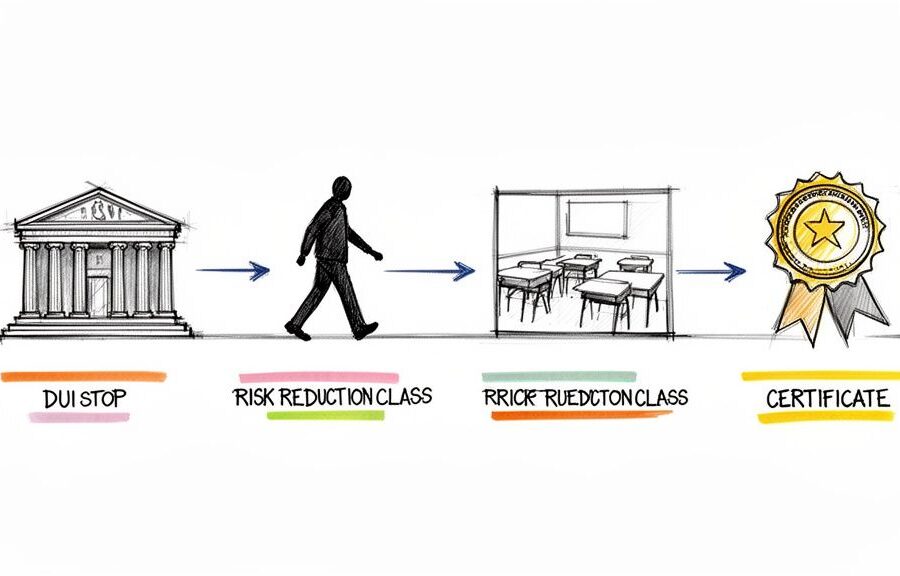

You’ll hear people use DUI and DWI like they mean the same thing, and a lot of the time, they do. But the real difference comes down to the laws in a specific state. Some states have separate charges, but here in Georgia, we keep it simple: the only official charge for impaired driving is DUI, or Driving Under the Influence.
Unpacking DUI vs DWI Terminology in Georgia
If you get pulled over and arrested for impaired driving in Georgia, don't expect to see "DWI" anywhere on your ticket or paperwork. Our state’s legal system puts all impaired driving offenses under one name: DUI.
It doesn’t matter if the impairment comes from alcohol, illegal drugs, prescription pills, or some combination of them. The charge is always DUI.
The Real 'Difference' Is in the Details
So, if Georgia only uses the term DUI, why does one person’s case seem so different from another’s? It’s not about the name of the charge. It’s all about the specific details of your arrest.
These details are what determine how serious the penalties will be from both the Georgia courts and the Department of Driver Services (DDS). While the state laws are the same everywhere, the specifics of your case matter. The factors that really shape the consequences include:
- Your Blood Alcohol Concentration (BAC) when you were arrested.
- What substance was causing the impairment (alcohol, drugs, or both).
- Whether this is your first, second, or subsequent offense.
- Your age—drivers under 21 have to deal with much stricter "zero tolerance" rules.
In Georgia, an officer in any jurisdiction, from Atlanta to Savannah, can charge you with DUI even if your BAC is below the 0.08% legal limit. If they can show evidence that you were driving unsafely because of any level of impairment, it's called a "DUI-Less Safe" charge.
Comparing DUI and DWI in Practice
Even though the law is straightforward in Georgia, it helps to see how other states handle these terms. It clears up why there’s so much confusion in the first place. This table breaks down how different states use the acronyms.
| State Example | DUI Usage (Driving Under the Influence) | DWI Usage (Driving While Intoxicated/Impaired) |
|---|---|---|
| Georgia | The sole charge for all impaired driving. | Not used as a legal charge. |
| Texas | A charge typically for minors with any detectable alcohol. | The standard charge for adults impaired by alcohol or drugs. |
| New York | A lesser charge (Driving While Ability Impaired). | The primary, more serious charge for a BAC of 0.08% or higher. |
| Idaho | The sole charge for all impaired driving, similar to Georgia. | Not used as a legal charge. |
At the end of the day, if you’re dealing with an impaired driving charge here in Georgia, you need to focus on the facts of your DUI case. The first step is to understand that you're facing two kinds of penalties—criminal and administrative—and figure out what you need to do to get your license back.
A huge part of that process is completing a state-approved course. To get on the right track with both the court and DDS requirements, you’ll need to complete a mandatory DUI/Risk Reduction Program, which is a critical piece of getting back on the road.
How Georgia Defines and Prosecutes DUI Offenses
We've established that Georgia uses "DUI" as the official, catch-all term for impaired driving. But the law goes much deeper than a simple three-letter acronym.
Understanding the specifics of your DUI charge is absolutely critical. The details of your arrest will directly shape the consequences you face, both in court and with the Georgia Department of Driver Services (DDS).
Georgia law is clear: you can't drive or be in "actual physical control" of a moving vehicle if you're under the influence of alcohol or drugs to the point that it makes you a less safe driver. This opens the door to several different types of DUI charges.
The Different Faces of a Georgia DUI
When you're facing a prosecutor in a Georgia courtroom—whether it’s in Fulton, Gwinnett, or Clarke County—they can pursue a conviction based on a few different categories of impairment. The evidence they have determines the exact charge.
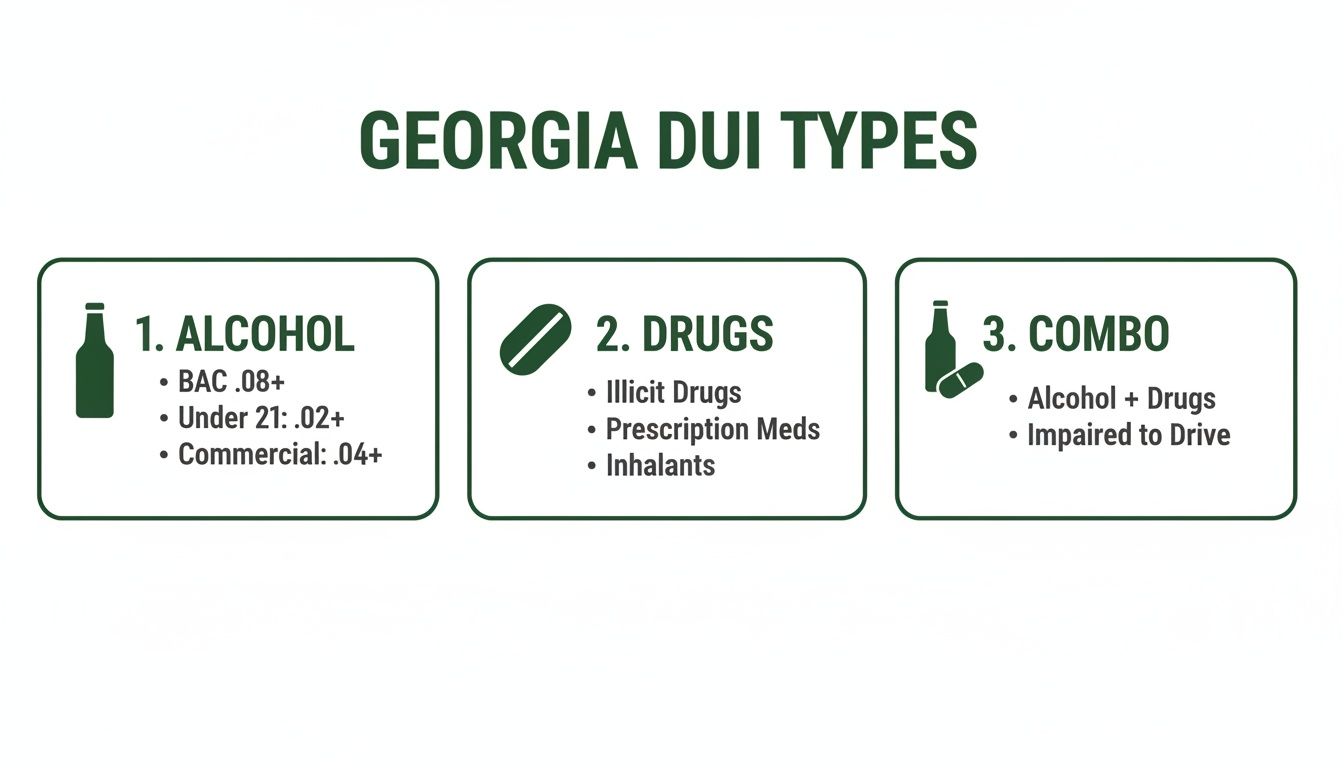
Most charges fall into one of these three buckets:
- DUI-Alcohol: This is the one everyone knows. It's typically proven with a Blood Alcohol Concentration (BAC) test showing 0.08% or higher for drivers over 21.
- DUI-Drugs: This applies if you’re impaired by any drug. That includes marijuana, cocaine, or even legally prescribed medications like anxiety pills or painkillers if they make it unsafe for you to drive.
- DUI-Combination: If you're impaired by a mix of alcohol and one or more drugs, you can be hit with a combination charge.
Many people think you can only be charged if a chemical test—like a breathalyzer or blood test—proves you're impaired. That's a huge misconception and a very dangerous one in Georgia.
An officer's testimony alone can be enough for a conviction. If a police officer sees you driving erratically, you fail field sobriety tests, or you show other clear signs of impairment, they can arrest you for a “DUI-Less Safe” offense, even without a BAC reading.
How Arrest Details Impact Your Case
The specific circumstances of your arrest change everything.
For example, a driver in Alpharetta arrested for a first-offense DUI-Alcohol with a 0.09% BAC faces a very different road ahead than a driver in Athens charged with a second-offense DUI-Drugs based only on the officer's observations.
These details determine court penalties like fines and jail time. They also dictate the administrative penalties from the DDS, like how long your license is suspended and which educational programs you must complete. Knowing the exact nature of your charge is the first step toward getting your life and license back.
To satisfy the state's requirements and get back on the road, you'll need to complete a state-certified course. You can learn more about the required DUI/Risk Reduction Program to get started on the right path.
Comparing Administrative vs. Criminal DUI Penalties
After a DUI arrest in Georgia, you’re not just facing one problem—you’re fighting on two separate fronts. There’s the criminal case that goes through the court system, and at the same time, an administrative case with the Department of Driver Services (DDS).
It’s a two-track process, and you have to deal with both. The court decides on criminal penalties like jail time or fines, while the DDS deals exclusively with your driver's license and your privilege to drive.
The administrative penalties can hit almost immediately. The DDS can issue an Administrative License Suspension (ALS) long before your court date ever arrives. This is a civil action, not a criminal one, designed to quickly get potentially impaired drivers off the road.
These dual penalties apply no matter what type of DUI charge you're facing.
Forgetting about the DDS side of things is a common mistake. If you don't appeal your ALS within 30 days, your license will be suspended, even if your criminal case is eventually dismissed.
The Two Paths of a Georgia DUI
First, there’s the criminal path. This is where you’ll go to court and a prosecutor will try to prove you are guilty of DUI. If you’re convicted, a judge will sentence you with criminal penalties.
For a first-time DUI conviction in Georgia, that can mean:
- Jail Time: Up to 12 months
- Fines: Between $300 and $1,000, plus court surcharges
- Community Service: A minimum of 40 hours
- Probation: Usually 12 months
At the very same time, you have the administrative path with the DDS. These penalties are completely separate from what the court orders and are mandatory if you want to get your license back.
Georgia DUI Penalties: Criminal vs. Administrative Consequences
This table shows how the two sets of penalties work. You have to satisfy the requirements from both columns to fully resolve your DUI.
| Consequence Type | Criminal Penalties (Court-Ordered) | Administrative Penalties (DDS-Mandated) |
|---|---|---|
| Primary Action | Jail time, fines, probation, community service. | Administrative License Suspension (ALS). |
| Key Requirement | Completing the judge's full sentence. | Finishing a state-approved DUI/Risk Reduction Program. |
| Financial Impact | Fines starting at $300 to $1,000 for a first offense. | License reinstatement fees, typically $210. |
| Evaluation | A judge might order a clinical substance abuse evaluation. | The DDS requires the Needs Assessment from your DUI course. |
Keep in mind that successfully navigating one path doesn’t clear the other. Paying your court fines won't get your license back, and completing your DUI school for the DDS won't make your criminal charges go away.
The costs go well beyond fines and fees, too. After a DUI, car insurance rates can jump by an average of 71%, creating a huge financial strain for years. You can learn more about all the consequences of a DUI in Georgia and what it takes to move forward.
You have to complete both processes successfully. To get started on the administrative side, you can enroll in a DDS-Certified DUI/Risk Reduction Program and begin meeting the state's requirements.
Understanding Georgia’s BAC Thresholds

While people often get caught up in the DUI vs. DWI debate, what really matters in Georgia is your Blood Alcohol Concentration (BAC). This number is the cornerstone of any impaired driving charge.
Georgia law doesn’t leave room for interpretation—it sets firm BAC limits that determine if you’re legally impaired. These numbers are non-negotiable, and they can change based on your age and the kind of vehicle you’re driving.
Georgia's Three Key BAC Limits
The state uses a tiered system for BAC, and if you're over the limit for your specific situation, you can be charged with a DUI. Here are the three main thresholds you need to know:
- 0.08% BAC: This is the standard legal limit for most drivers who are 21 and over and driving a regular passenger car.
- 0.04% BAC: A much stricter limit applies if you’re operating a commercial vehicle like a semi-truck or a bus. This lower number reflects how much more damage a large vehicle can cause in a crash.
- 0.02% BAC: This is Georgia's "zero tolerance" limit for drivers under the age of 21. It basically means any measurable amount of alcohol can lead to a DUI.
These aren't just guidelines; they are hard legal lines. For example, a commercial truck driver in Macon with a 0.05% BAC is over their legal limit, but a 30-year-old driving a sedan would not be. The context is everything.
How Georgia's Limits Compare to the Rest of the World
It's helpful to see how seriously Georgia takes these laws by looking at global standards. Drunk driving is a massive issue worldwide—a staggering 16.6% of injured drivers are found to have been driving drunk.
Many countries follow the World Health Organization (WHO) recommendation of a 0.05% BAC limit for most drivers and 0.02% for young or commercial drivers. You can see how these standards impact road safety by reviewing the full research on these global findings.
While many nations have adopted the WHO’s advice, the U.S. standard of 0.08% is actually more lenient than in places like Sweden, which holds all drivers to a tight 0.02% limit. This really puts into perspective why even a first-offense DUI in Georgia is a serious matter.
The state’s strict BAC limits are directly tied to why its educational programs are mandatory. The goal isn’t just to punish—it’s to educate drivers on the real-world risks to prevent it from happening again.
Getting through these requirements starts with knowing what you have to do. A state-certified DUI/Risk Reduction Program is a mandatory step toward getting your license back, giving you the education you need to move forward.
Your Step-By-Step Guide to Georgia License Reinstatement
After a DUI arrest, figuring out how to get your license back can feel like a maze. The good news is that the Georgia Department of Driver Services (DDS) has a very specific process to follow. If you complete each step correctly, you can get your driving privileges back and get on with your life.
First things first: you have to serve the mandatory license suspension. The length of time depends on your specific situation, like whether this is your first offense or if you’ve had a DUI before.
First-Time DUI Reinstatement Steps
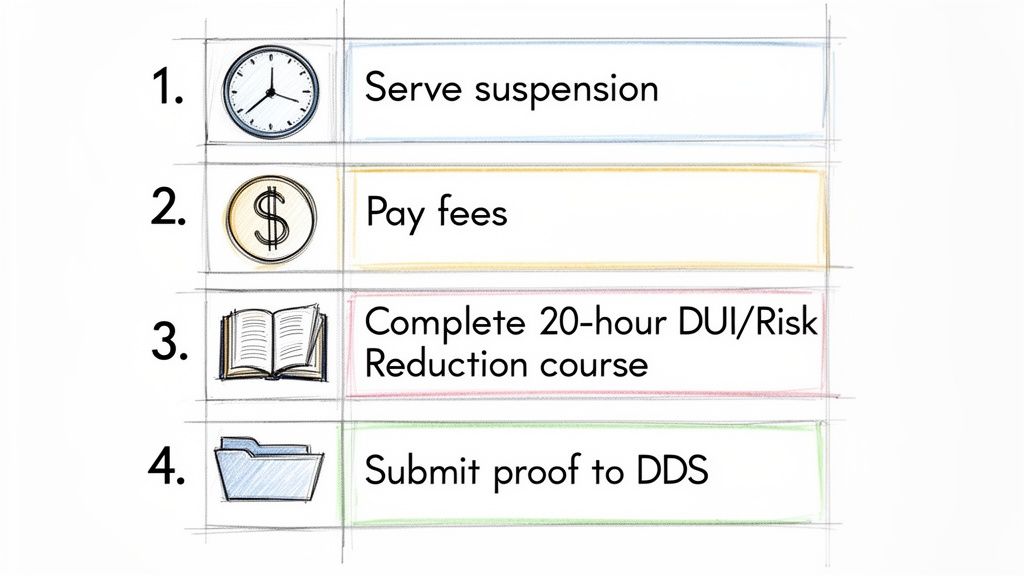
For most people facing their first DUI in Georgia, getting your license back comes down to three main actions. You have to check every box before the DDS will reissue your license.
- Serve the Suspension Period: For a first offense, this is typically a 120-day suspension.
- Pay Reinstatement Fees: You’ll need to pay all the required fees to the DDS. The standard fee is $200 if you pay by mail or $210 if you handle it in person.
- Complete the DUI/Risk Reduction Program: You must finish a state-approved 20-hour course and make sure the Certificate of Completion is submitted to the DDS.
These rules are the same whether you're in Atlanta or a smaller town like Milledgeville. The requirements are set by the state, so they apply everywhere in Georgia.
Keep in mind that just waiting for the suspension period to end isn't enough. The DDS won't automatically send you a new license. You have to be proactive, complete the course, pay your fees, and submit the proof.
Requirements for Multiple Offenses
If you have more than one DUI conviction, the process gets more involved. The basic steps are still there, but the state adds extra requirements because repeat offenses are seen as a higher risk.
For drivers with two or more DUIs within a five-year window, getting your license back will also require:
- Installing an Ignition Interlock Device (IID): This is a device that makes you provide a clean breath sample before your car will start. You’ll be required to have it for a specific amount of time.
- Undergoing a Clinical Evaluation: You will have to complete a substance abuse evaluation with a qualified professional. Depending on what the evaluation finds, you might be required to complete more treatment. For example, some drivers might need to learn more about the specifics of the SAP program if they are a DOT-regulated employee.
Taking these steps shows the state you're taking this seriously and are committed to driving safely again. The single best action you can take to get started is to enroll in a certified Risk Reduction course.
Fulfilling Your Court and DDS Requirements
After a DUI charge, you’ll get a list of requirements from the court and the Georgia DDS. Choosing the right school to help you check off those boxes is a huge decision.
An approved, experienced provider makes this whole process simpler by putting everything you need under one roof.
Look for a school with locations that are easy to get to, like those across metro Atlanta and Athens, plus flexible class times. The best programs offer online, weekend, and evening classes because, let's be real, you still have a life to live. This helps you meet your obligations without turning your schedule upside down.
Look for a School That Handles Everything
You'll find that the best option is a provider that does more than just the mandatory DUI/Risk Reduction course. A full-service school will also handle all the other related services the court might throw at you.
This creates a clear, straightforward path from start to finish. A single provider should offer:
- The state-required 20-hour DUI/Risk Reduction course
- Court-ordered clinical evaluations and any follow-up treatment
- ASAM Level 1 treatment programs
- Victim Impact Panels (like the MADD VIP)
- Defensive driving courses for points reduction
When you're sorting through the consequences of a DUI vs. DWI, the common denominator in Georgia is that you must complete state-certified programs. Sticking with one provider that handles it all ensures every step you take is recognized by the DDS and the court, which is the simplest way to get your license back. You can get more information by learning what a court-ordered clinical evaluation actually entails.
The reality for drivers in Georgia after a DUI arrest is that a Risk Reduction course isn't optional—it's mandatory. Since 1988, state-approved schools have helped over 100,000 drivers get back on track through their many locations and online classes, proving just how vital they are in the license reinstatement process. You can learn more about the risks of impaired driving by checking out national statistics on the topic.
By picking a DDS-approved provider with a long, proven history, you get the peace of mind that your time and money are going toward fulfilling your requirements correctly the first time. It's the best way to move forward.
Ready to get this handled? Enroll in a DUI/Risk Reduction Course today and take the next step with confidence.
Frequently Asked Questions About Georgia DUI Law
Getting charged with a DUI can feel overwhelming, and it's normal to have a lot of questions. We've put together some straightforward answers to the questions we hear most often about Georgia's laws.
Can I Get a DUI in Georgia if My BAC Is Below 0.08%?
Absolutely. You don’t have to blow a 0.08% to be convicted. Georgia has what’s known as a “DUI-Less Safe” law.
This means if a police officer can show that alcohol or drugs—even prescription medication—impaired your ability to drive safely, you can still be charged. They'll use things like your driving pattern, your performance on field sobriety tests, and other observations as evidence.
What Is the Difference Between a DUI Course and Defensive Driving?
People often mix these two up, but they serve very different purposes.
- A DUI/Risk Reduction course is a specific 20-hour program. It's mandated by the Georgia DDS to get your license back after a DUI conviction.
- A defensive driving course is much shorter, usually a 6-hour class. People often take it voluntarily to get a discount on their insurance or to reduce points on their license. A judge might also order it in some traffic cases, but it's not the same as the state-required DUI program.
How Long Does a DUI Stay On My Driving Record in Georgia?
A DUI conviction in Georgia is permanent. It will stay on your official driving record forever and cannot be expunged or cleared.
Do I Have to Complete the DUI Course in the County Where I Was Arrested?
No, you don’t. You are free to complete your mandatory DUI/Risk Reduction Program at any DDS-certified school anywhere in Georgia. The location of your arrest doesn't matter, as long as the school is state-approved.
At Georgia DUI Schools, all of our programs are DDS-approved and designed to meet every state and court requirement. When you're ready to take the first step toward getting your license back, you can enroll in our DUI/Risk Reduction Program to get started.